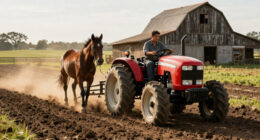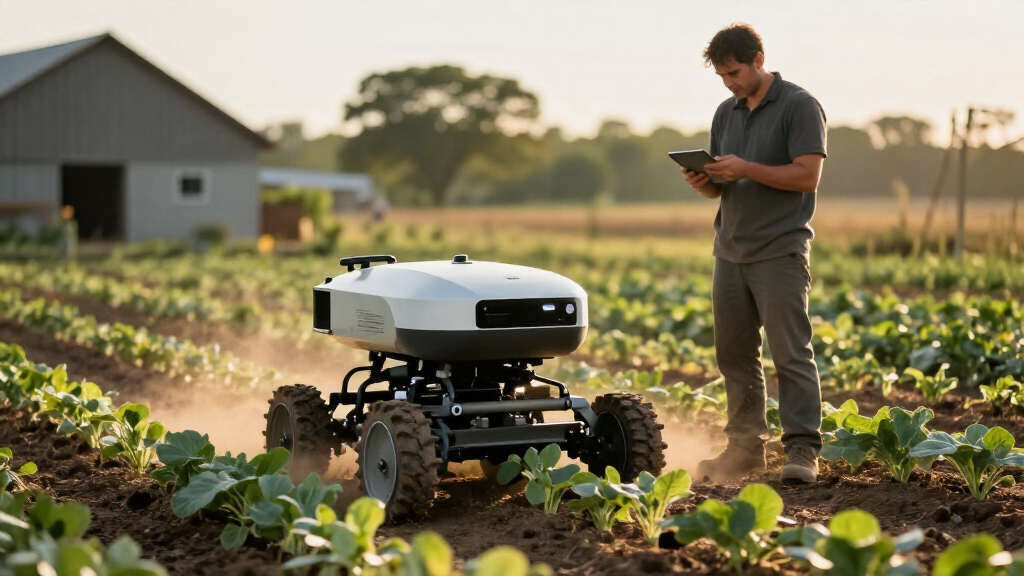

🔍 Read the full analysis: What The Farming Era Can Teach Us About Automation on ThorstenMeyerAI.com
TL;DR
A November 3, 2026, article from ThorstenMeyerAI.com uses agriculture’s long decline in employment share to examine what automation can mean for work. It reports that about 928 million people still work in agriculture worldwide, while arguing that farming’s transformation took generations and does not establish how quickly other sectors may change.
ThorstenMeyerAI.com published an analysis on November 3 examining how farming became a much smaller source of employment as tools, crop science and fertilizer increased food production. The article uses agriculture as a historical case study for automation, while acknowledging that its proposal that other sectors could become highly automated within a decade or several decades is the author’s thesis, not an established forecast.
The article estimates that 73.7% of the U.S. labor force worked in agriculture around 1800, citing economic historian Stanley Lebergott’s figures, later published by the U.S. Census Bureau. The underlying labor-force total includes enslaved people, and the pre-1840 figures are estimates rather than census counts. The account says the agricultural share later fell to about 1.5% of U.S. workers.
The shift took place through a sequence of changes, not a single machine. The article points to John Deere’s steel plough, developed in 1837, later mechanical equipment, synthetic ammonia production and crop breeding. It says dwarf wheat varieties introduced in India and Pakistan in the 1960s produced sturdier plants that could support more grain when combined with fertilizer and irrigation.
As a measure of output, the article cites Indian official figures showing wheat production rising from 12.3 million tonnes in 1964–65 to 26.4 million tonnes in 1971–72. It also reports an International Labour Organization estimate that 928 million people worked in agriculture worldwide in 2025, around one in four workers. The article argues that fewer agricultural workers have not meant less food, citing global cereal production growth since 1961; those output figures do not, by themselves, describe how food is distributed or who can afford it.
Farm Productivity and the Jobs Shift
The history matters because it separates employment share from total output. A sector can produce more while employing a smaller portion of the workforce, as agricultural mechanization and new farming methods did in the countries discussed. That distinction is relevant to current debates about whether automation will reduce the amount of work available or change where workers are needed.
The article’s evidence also cautions against treating automation as an instant event. In the U.S. example, farming’s employment share declined over a long period, while the number of farm workers continued rising until about 1910, reaching a reported 11.8 million. Germany’s agricultural share fell from 43% to 25% between 1882 and 1939 while its farm workforce remained between eight and 10 million. These figures suggest that workforce shares and headcounts can move differently during structural change.
For workers and employers, the case raises questions about where people move as productivity rises and whether new jobs appear in other sectors. The source describes a broad economic shift but does not establish that every displaced worker found comparable work, or that future automation will follow the same path. Farming is a historical example, not a timetable for office, factory or service-sector change.
Popular right now

Bose QuietComfort True Wireless Earbuds with Active Noise Cancellation, Black

Philips Café Aromis Automatic Espresso Machine with LatteGo Pro Milk System

KitchenAid Classic Series 4.5-Quart Tilt-Head Stand Mixer, Onyx Black
As an affiliate, we earn on qualifying purchases.
From Hand Labor to Higher Yields
The article situates early agriculture within an economy where food production depended heavily on human and animal muscle. Hand tools, draft animals and weather constrained how much a household could grow, leaving large shares of the population working on farms. It gives figures from several countries: estimates put agriculture or the broader primary sector at about 85% of Japan’s workforce in 1872; China’s 1952 series recorded 83.5% in the primary sector; and India’s 1951 census counted cultivators and agricultural laborers as 69.7% of workers.
Those figures are not all measured in the same way. Some refer to agriculture, while others include forestry and fishing, and several are historical reconstructions rather than direct census counts. The article notes that Germany’s first official occupational count, in 1882, put agriculture and forestry at 43.4% of workers, but may have undercounted women working on family farms.
Its account follows three broad developments: improved tools, chemical fertilizer and higher-yield crops. Fritz Haber filed a patent for ammonia synthesis in 1908, and industrial production followed. In the 1960s, dwarf wheat varieties developed through plant-breeding work associated with Norman Borlaug spread to India and Pakistan. The article treats these developments as parts of a long transformation, alongside machinery and changes in farming practice.
„The share fell long before the headcount.“
— Thorsten Meyer, author of the ThorstenMeyerAI.com article
Limits of the Automation Comparison
The article does not establish that the pace or effects of agricultural change will repeat in other sectors. Its suggestion that automation could reach a very high level within a decade or a few decades is an interpretation, not a measured prediction; the source does not define precisely what counts as a sector becoming automated or provide a forecasting method.
Several historical numbers also have limits. The U.S. estimate for 1800 predates reliable census labor data and includes enslaved workers; international figures vary in date, definition and coverage. The source reports global agricultural employment for 2025, but the material provided does not specify how the ILO estimate was calculated. More broadly, production totals do not show how gains were distributed among farm owners, workers and consumers, or what happened to particular people who left farming.
The Series Turns to Industry
The article is Episode 2 of Thorsten Meyer’s “Work After Work” series, which compares the economy’s field, factory and office sectors. It says Episode 3 will examine mechanical reapers, threshers and tractors, extending the farming account from tools and crop science to farm machinery.
No new data release, policy decision or research milestone is announced in the source. The next development identified is the series’ planned discussion of machinery. Whether its historical comparison can help forecast automation in other sectors remains an open question, not a conclusion established by this installment.
Key Questions
What is the article’s main argument?
It argues that farming shows how a sector can produce more food while employing a smaller share of workers, after a long sequence of technological and scientific changes. The author uses that history to frame questions about automation elsewhere, rather than proving that other sectors will follow the same path.
How many people still work in agriculture worldwide?
The article cites an ILO estimate of 928 million people in 2025, or about one in four workers worldwide. The source material does not provide further detail on the estimate’s methodology.
Not at first. The article says the U.S. farm-worker count continued to rise until about 1910, when it reached 11.8 million, even as agriculture’s share of the workforce was falling. A workforce share and a headcount measure different things.
Does the article predict that automation will reach 90%?
No. The author presents the possibility that automation could reach a sector of up to 90% within a decade or a few decades as his thesis, not a fact. The article does not provide a formal forecast or define the measure.
What comes next in the series?
The source says the next installment, Episode 3, will cover mechanical reapers, threshers and tractors. It does not give a publication date for that episode.
Source: ThorstenMeyerAI.com