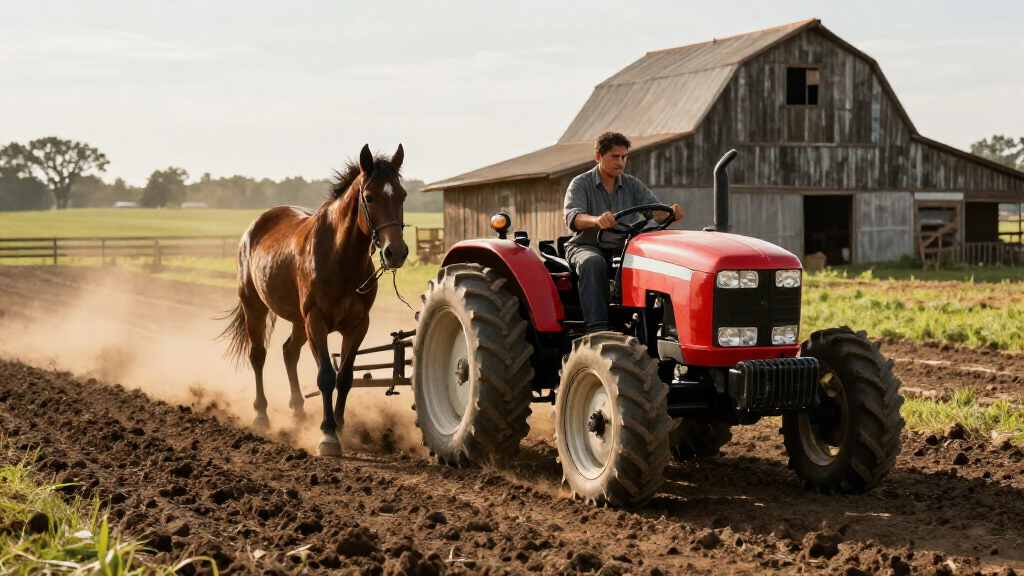
🔍 Read the full analysis: Horse Or Tractor? The Changing Face Of Farm Labor on ThorstenMeyerAI.com
TL;DR
U.S. farm horses and mules peaked at 26.7 million in 1918, then fell to 3.1 million by 1960 as tractors and other machinery spread. Farm employment also declined while output per worker rose, but the horse-to-tractor story is an analogy—not proof that automation will affect human workers in the same way.
A November 4, 2026, report from ThorstenMeyerAI.com traces how tractors and other machinery displaced working horses and mules on U.S. farms, offering a historical case study in automation as driverless farm equipment advances today. The U.S. farm animal population peaked at 26.7 million in 1918 and had fallen to 3.1 million by 1960, while farm employment also contracted over the period.
Figures reprinted by the U.S. Census Bureau from Department of Agriculture estimates put the combined number of farm horses and mules at 26.7 million on January 1, 1918. Horses alone peaked earlier, at 21.4 million in 1915. By 1960, the combined count was 3.1 million, a decline of almost 90% from the 1918 peak. The source says farmers generally stopped breeding replacements; it does not describe a single event that removed the animals from farm work.
Tractors spread over the same decades. The report lists about 1,000 tractors on U.S. farms in 1910, 246,000 in 1920, 920,000 in 1930 and 4.69 million in 1960. Around 1955, its figures show tractors outnumbering horses and mules: 4.35 million to 4.31 million. The counts come from historical series with differing census dates, and the report notes that the USDA counted horses and mules together from 1951.
The shift was not limited to tractors. Combine harvesters rose from about 4,000 on U.S. farms in 1920 to more than one million in 1960, according to the report. It also cites an Agriculture Department estimate that one farm worker supplied 7.1 people in 1910 and 47.1 in 1970. That measure includes people abroad supplied through exports, and it reflects broader changes in farming, including machinery, fertilizer and improved seed.
What the Farm Shift Changed
The machinery shift changed both the use of land and the scale of farm production. In 1915, the source says, about 93 million acres of harvested U.S. cropland—more than a quarter of the total—grew feed for horses and mules. By 1960, that area was about five million acres. The freed land could be used for other crops, while tractors required fuel mainly when operating rather than feed every day.
Farm employment fell as productivity rose. The report gives a peak of 13.6 million U.S. farm workers in 1916 and 4.5 million in 1970, even as the wider U.S. labor force doubled. It says new jobs were concentrated in cities, requiring many people to move. These figures show a major employment change, but do not by themselves establish how much machinery alone caused it or describe the experience of every worker.
The history matters to current debates because it shows that a technology can eliminate a large category of work while the wider economy and other kinds of employment change. But the report cautions against treating the horse as a prediction of what will happen to people: workers have political rights and can retrain or move, while horses could not make those choices.
Popular right now

Dyson W1 PencilWash Wet and Dry Cleaner with Dok Cordless Wet Floor Cleaner

Bose QuietComfort Headphones (2nd Gen), Wireless Over-Ear Noise-Cancelling Headphones, Hazelnut Taupe

Dyson Car+Boat Cordless Handheld Vacuum
As an affiliate, we earn on qualifying purchases.
From Fordson to Farm Robots
Gasoline tractors existed before World War I, but the report describes early models as heavy and expensive, better suited to large farms. Ford introduced the Fordson in 1917. The Henry Ford museum calls it “the first mass-produced and inexpensive lightweight tractor” and says it was designed for small farmers. The report notes that the 100,000th Fordson left the assembly line on February 21, 1920.
The report also connects that history to present-day automation, while describing current farm robots as limited in scope. It says John Deere’s 16-camera autonomy kit, introduced in February 2025, handles tillage on select large tractors. It also reports that China said about 74% of ploughing, sowing and harvesting was mechanized in 2023. That figure is attributed to China and covers those three activities; it is not a measure of all farm work or a direct comparison with U.S. mechanization.
Economist Wassily Leontief compared workers with horses replaced by tractors in 1983, according to the report. His analogy highlights the possibility that technology can make some forms of labor less necessary. The same source stresses a key limit: unlike horses, people can vote and have agency in how societies respond to economic change.
„“Nobody retrained them, and there was no mass event.”“
— ThorstenMeyerAI.com report
Limits of the Horse Comparison
The historical figures document changes in farm animals, machinery and employment, but they do not isolate the effect of tractors from other changes in agriculture and the wider economy. The report gives no detailed account of how former farm workers fared individually or how many moved into particular occupations.
It also does not establish how quickly modern autonomous machinery will spread, how many jobs it may affect, or whether current systems can perform tasks beyond the specific uses described. The China mechanization figure is attributed to the country and is not directly comparable to the U.S. tractor counts. The horse analogy is a framework for discussion, not a forecast with a quantified outcome.
Tracking Automation on Farms
The next developments to watch are the expansion of autonomous equipment beyond limited tasks, the farms and crops where it can operate, and whether machinery changes the number or type of workers farms need. The source report gives no announced timetable for broader deployment or new labor projections.
For historical comparison, the report’s central measures remain the fall from 26.7 million farm horses and mules in 1918 to 3.1 million in 1960, alongside declining farm employment and rising output per worker. New claims about modern automation should be assessed against their stated time periods, tasks and comparison baselines rather than assumed to repeat that history.
Key Questions
When did tractors outnumber horses and mules on U.S. farms?
The historical figures in the report show the crossover around 1955: 4.35 million tractors compared with 4.31 million horses and mules. The source notes that the underlying counts use census dates that vary slightly.
How many horses and mules worked on U.S. farms at the peak?
The combined farm population peaked at 26.7 million on January 1, 1918, according to Department of Agriculture estimates reprinted in the U.S. Census Bureau’s historical statistics.
Did the change reduce the number of farm workers?
U.S. farm employment fell from a reported peak of 13.6 million in 1916 to 4.5 million in 1970, while the number of people supplied by each farm worker rose. Those figures cover a period of broad economic and agricultural change and do not show that machinery alone caused the employment decline.
Are today’s autonomous tractors replacing farm workers in the same way?
The source describes current agricultural automation as limited in scope. It cites a John Deere autonomy kit for tillage on select large tractors, but provides no estimate of jobs affected or evidence that the historical horse-to-tractor pattern will be repeated.
Source: ThorstenMeyerAI.com