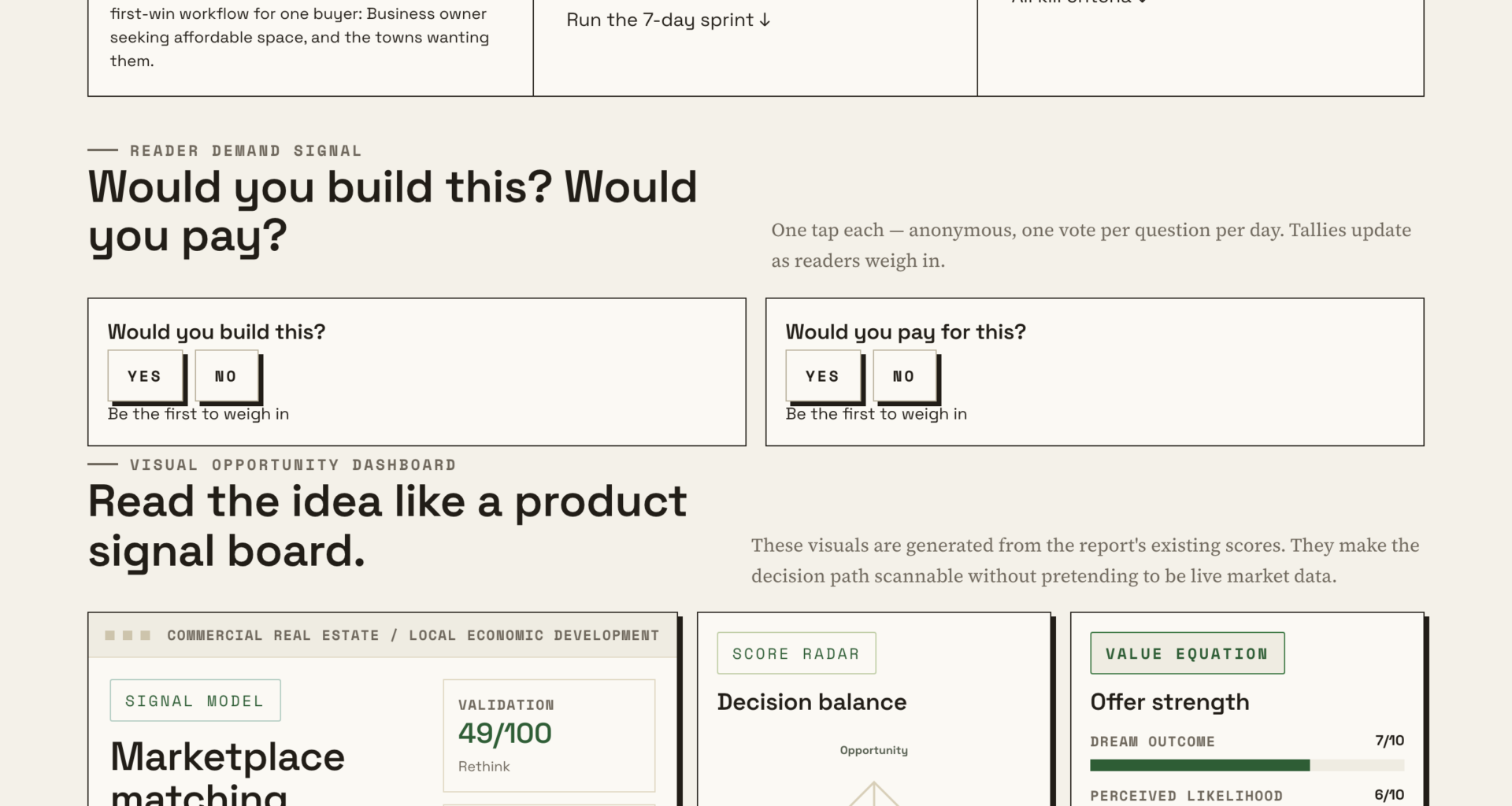

📊 Full opportunity report: From Empty Storefront To Business Opportunity: Making The Match on IdeaNavigator AI — validation score, market gap, and execution plan.
TL;DR
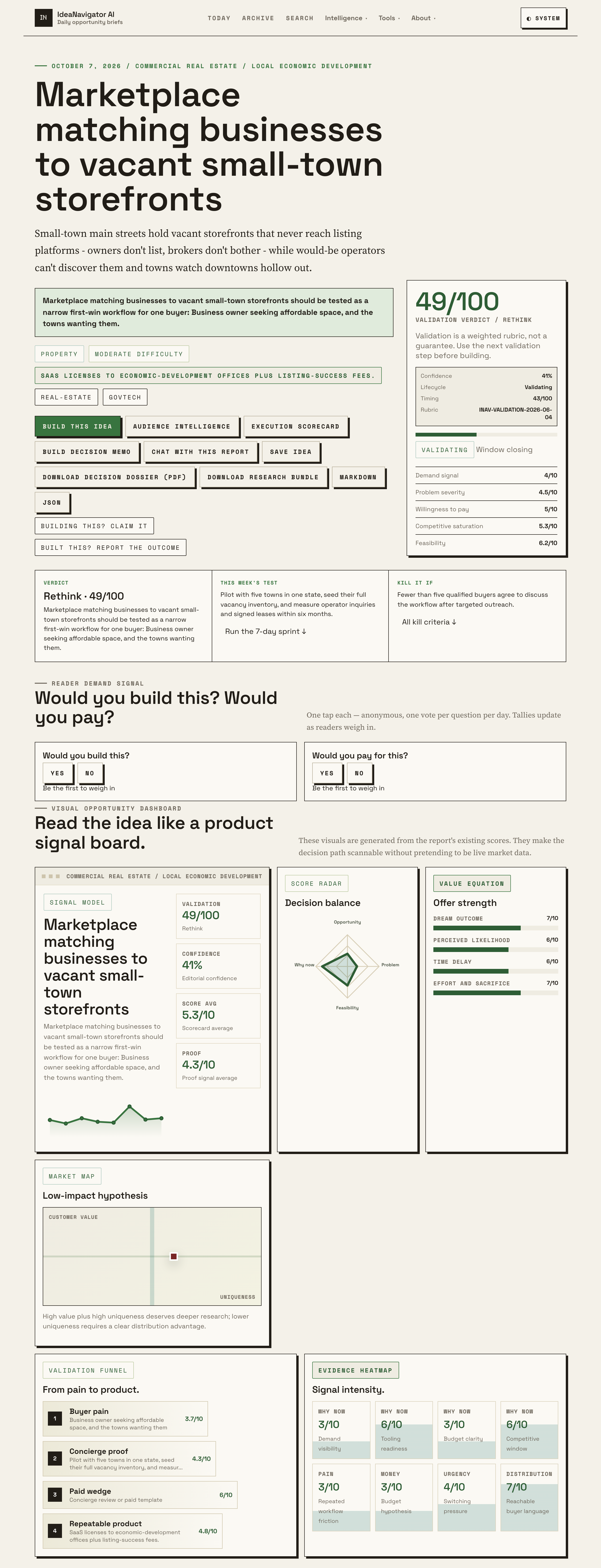
IdeaNavigator AI has proposed testing a marketplace that connects business operators with vacant storefronts in small towns and routes potential matches to local economic-development offices. The suggested pilot would cover five towns in one state and track inquiries and signed leases over six months; no pilot launch or results are confirmed.
IdeaNavigator AI has proposed a pilot marketplace to connect business operators seeking affordable space with owners of vacant small-town storefronts, with local economic-development offices helping route inquiries and identify available grants. The proposal calls for testing the service in five towns in one state and measuring operator inquiries and signed leases over six months; it does not report that a pilot has begun.
The proposed marketplace would let towns and property owners post storefront information, including photos, size and rent. Listings would also identify incentive programs, while operators could browse by town profile and foot-traffic data. The plan says potential matches would be sent to the relevant local development office, with available grants attached.
The concept is aimed at a gap described in the proposal: some storefront owners do not list their spaces on commercial property platforms, while brokers may not take on those properties. That can leave prospective operators unable to find spaces and towns with limited ways to connect vacancies to incoming businesses. These are the proposal’s framing of the problem, not findings from a reported survey.
For an initial test, IdeaNavigator AI recommends collecting a full vacancy inventory for five towns in one state, then tracking operator inquiries and signed leases during a six-month period. The suggested revenue model combines software licenses sold to economic-development offices with fees tied to successful listings. No pricing, participating towns, platform launch, or lease outcomes are specified.
A Direct Link From Vacancies to Operators
If tested, the marketplace could give operators a single place to find storefronts that are otherwise difficult to discover, while giving towns a structured way to connect property owners with prospective businesses. Adding local incentives and grant information to listings could help development offices identify support relevant to a particular inquiry rather than treating property search and business assistance as separate tasks.
The proposal also sets a measurable test for whether the approach is useful: whether a complete inventory produces inquiries and, ultimately, signed leases within six months. Those measures could help towns distinguish browsing activity from actual occupancy outcomes. But the plan itself provides no evidence yet that a marketplace would increase leasing, improve downtown conditions, or make grants more effective.
For property owners, the proposed service could offer another channel to reach potential tenants without relying solely on established listing platforms or brokers. For economic-development offices, a software licensing model would make the offices both service partners and prospective customers. Whether towns would pay for the platform, and whether listing-success fees could support its operation, remains untested.
business storefront listing software
As an affiliate, we earn on qualifying purchases.
As an affiliate, we earn on qualifying purchases.
How the Proposed Pilot Would Work
The idea is positioned within commercial real estate and local economic development. Its intended users are business owners seeking affordable space and towns trying to attract operators to empty storefronts. The proposal says remote-work migration has renewed interest in small towns and that economic-development offices have grant money available for this kind of matching effort. It offers no specific migration figures, grant programs, or examples of towns already pursuing the approach.
The proposed workflow brings property details, town information and local assistance together. Owners or towns would supply listings; operators would search by community profile and foot traffic; and inquiries could reach the local development office alongside details of relevant incentives. That structure is intended to address both the discovery problem and the handoff from a property search to local business support.
The recommendation is to begin narrowly rather than build for a broad market immediately: choose five towns in one state, enter their full vacancy inventory and evaluate activity over six months. That would allow a test of whether listing coverage and referrals translate into leases before the idea is expanded. The proposal does not name a state, identify participating offices, or provide an implementation schedule.
small town commercial property scanner
As an affiliate, we earn on qualifying purchases.
As an affiliate, we earn on qualifying purchases.
Pilot Funding and Participation Are Unknown
The proposal does not confirm that any town, property owner, economic-development office, or business operator has agreed to participate. It also gives no launch date, budget, platform specification, grant names, or criteria for deciding whether a listing has succeeded. The proposed six-month measurement period is a recommendation, not a stated schedule for an active trial.
Several practical questions remain open: how vacancy information would be verified and kept current; who would maintain listings; how foot-traffic data would be collected; and how inquiries would be matched to grants. The proposal also does not define the baseline against which the pilot’s results would be compared, or what number of inquiries or leases would count as success.
There is no reported evidence yet that the business model would be financially sustainable or that the service would fill storefronts that otherwise would remain empty. The claims about renewed small-town commercial interest and available grant funding are part of the proposal’s rationale, but no supporting data or named programs are supplied.
As an affiliate, we earn on qualifying purchases.
A Five-Town Test Is Proposed
The next step described in the plan is to recruit five towns in one state and compile a complete inventory of their vacant storefronts. To turn that recommendation into a test, organizers would need to establish which offices are responsible for referrals, confirm listing permissions with owners, and determine how rent, space details, incentives and foot-traffic information will be maintained.
If the pilot proceeds, the proposed evaluation would track operator inquiries and signed leases for six months. Publishing the number of participating properties, inquiry-to-lease results, and any comparison baseline would help towns and potential customers judge whether the marketplace is producing outcomes beyond online interest. No pilot launch, recruitment announcement or results are provided at this stage.
local economic development grants guide
As an affiliate, we earn on qualifying purchases.
As an affiliate, we earn on qualifying purchases.
Key Questions
Has the storefront marketplace launched?
No launch is confirmed. The material describes a proposed marketplace and recommends a pilot, but does not identify a live service or launch date.
What would the proposed marketplace include?
Listings would include photos, size, rent and incentive programs. Operators would browse by town profile and foot-traffic data, and inquiries would be routed to local development offices.
How would the idea be tested?
The proposed test is to seed the full vacancy inventory in five towns in one state and measure operator inquiries and signed leases over six months. No results or comparison baseline have been reported.
How is the service supposed to make money?
The suggested model combines software licenses for economic-development offices with fees tied to successful listings. The proposal gives no prices or evidence of customer commitments.
Which towns or grants are involved?
None are named. The proposal does not identify participating towns, development offices, grant programs, or property owners.
Source: IdeaNavigator AI