
📊 Full opportunity report: Social Media Management Software Built For Team Workflows on IdeaNavigator AI — validation score, market gap, and execution plan.
TL;DR
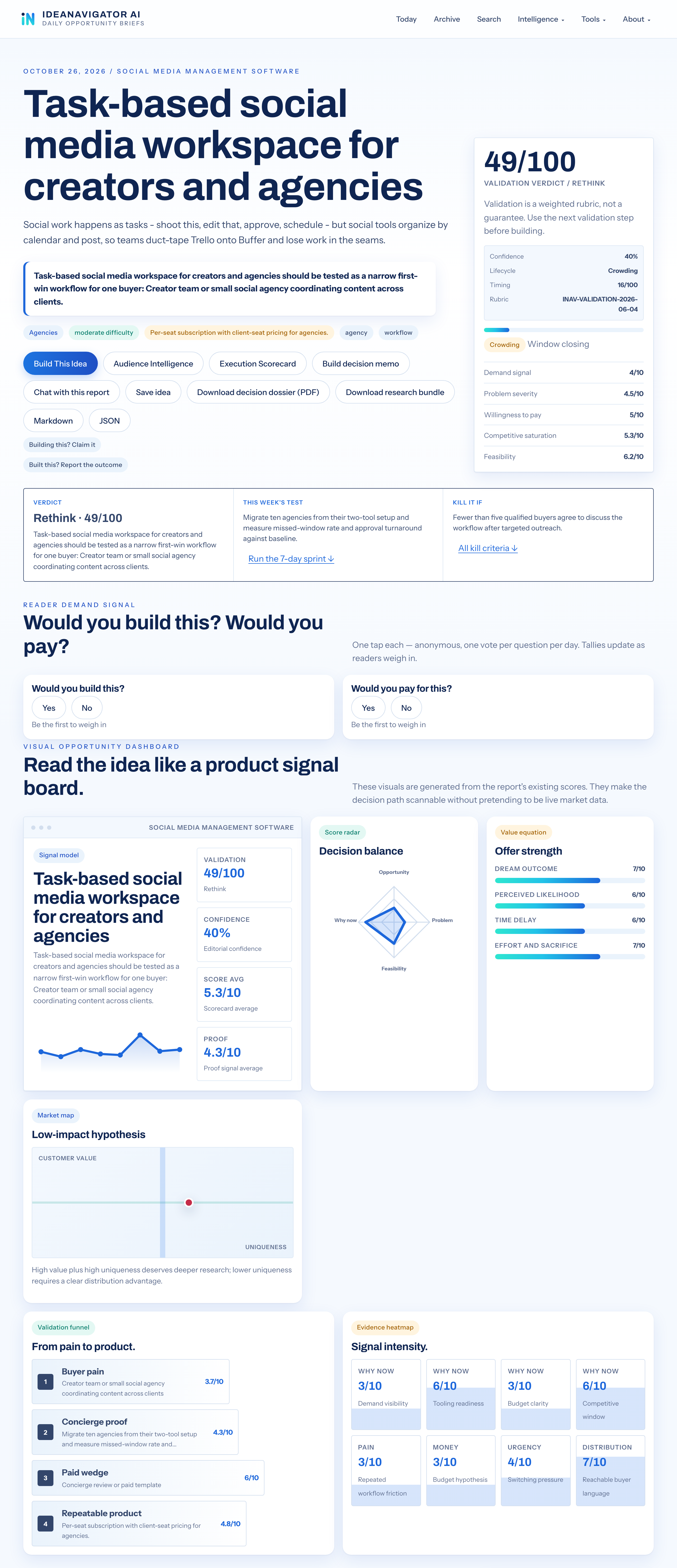
IdeaNavigator AI has outlined a proposed task-based social media workspace for creator teams and small agencies managing content across clients. The concept would combine post tasks, client approvals, asset versioning and scheduling, but it remains a proposal that must be tested with agencies.
IdeaNavigator AI has proposed testing a task-based social media workspace for creator teams and small agencies that coordinate posts across multiple clients. The concept would bring briefs, creative assets, edits, approvals and scheduling into one workflow, addressing a gap the proposal identifies between social publishing tools and general project-management software.
The proposed product treats each social post as a task moving through stages: brief, asset creation, editing, approval and scheduling. It would include client-facing approval links and asset versioning, then schedule a post once it receives approval. The stated aim is to connect an idea to publication without requiring teams to move work between separate systems.
The intended initial buyer is narrow: a creator team or small social agency managing content for several clients. The concept suggests a per-seat subscription, with pricing for client seats at agencies. Those are proposed product and business-model choices, not evidence of a launched service or established pricing.
For validation, IdeaNavigator AI proposes migrating 10 agencies from their existing two-tool setup and comparing missed publishing-window rates and approval turnaround times with each agency’s baseline. No results from that test, participating agencies, product availability or specific performance targets are provided.
One Workflow for Client Content
The proposal focuses on a practical coordination problem: social publishing involves more than selecting a date on a calendar. Teams must brief work, produce and revise assets, collect client decisions and publish on time. When those steps sit in separate tools, a post can be scheduled without the right approval, or a revision can be missed as work moves between systems. A shared post-level workflow could make responsibility and status easier to track.
For agencies, the suggested client approval links and asset versioning could address handoffs that are especially visible when several organizations review work. Native scheduling after approval could also reduce the need to transfer approved posts into a separate scheduler. These are potential benefits of the design, however; the proposal does not report that the product has achieved them.
The suggested agency trial points to measurable questions rather than a general claim that consolidation will improve operations. If tested, missed-window rates and approval turnaround could show whether the workflow makes a difference against each agency’s prior process. The number of agencies proposed for the test is small, and no comparison results are yet available.
Popular right now

Breville Barista Pro Espresso Machine with Grinder, Brushed Stainless Steel

Vitamix Propel Series 510 Professional-Grade Blender, 3 Programs, Black

Ninja Luxe Café Mini Plus Espresso and Drip Coffee Machine with AutoFroth, Stainless Steel, ES351
As an affiliate, we earn on qualifying purchases.
The Gap Between Calendars and Tasks
The idea is based on a mismatch between how social media tools are organized and how teams do the work. The proposal says scheduling products tend to center on calendars and posts, while teams carry out a sequence of tasks such as shooting, editing and securing approval. It characterizes the resulting workaround as pairing a social scheduler with a general-purpose project tool, with work potentially slipping between them.
Its timing rationale is that rising expectations for content volume have increased the complexity of team workflows, while established scheduling products have left work management to generic tools. These are the proposal’s market assumptions; it does not include usage statistics, market-size figures or evidence documenting how widespread the problem is. The plan’s first step is consequently not a broad product rollout, but a test with a defined customer group and existing two-tool process.
Product and Trial Details Remain Open
No launch, operating product or completed agency test is described. The proposal does not identify a product name, development status, release schedule, participating customers or the platforms the workspace would support. It also gives no specific subscription rates or details on how client seats would be counted.
The validation plan does not specify how the baseline would be collected, how long agencies would use the workspace, or what threshold would count as an improvement. It is also unclear how the proposed tool would handle different social networks’ publishing requirements, permissions, analytics or existing integrations. Until those details and test results are available, the concept’s likely efficiency gains remain unverified.
Agency Testing Is the Proposed Next Step
The next step described is to move 10 agencies onto the proposed workflow, replacing their current two-tool arrangement for the test. The stated measures are missed publishing windows and the time taken to secure approvals, compared with each agency’s own baseline. No timeline for recruiting agencies or running the trial is given.
Evidence from such a test would help determine whether the workflow solves a recurring problem for the target buyers and whether the proposed seat-based pricing fits agency operations. Until a trial is reported, the concept remains a product opportunity rather than a confirmed software launch.
Source: IdeaNavigator AI
Key Questions
Is the social media workspace available now?
No availability is reported. The material describes a product concept and validation plan, not a released service.
Who is the proposed product for?
The initial target is creator teams and small social agencies coordinating content across multiple clients.
What would the workspace include?
The proposed features include post tasks with workflow stages, client-facing approval links, asset versioning and scheduling after approval.
How would the concept be tested?
IdeaNavigator AI proposes migrating 10 agencies from a two-tool setup and comparing missed publishing windows and approval turnaround with their baselines. No test results are provided.
Source: IdeaNavigator AI