

🔍 Read the full analysis: A Guide To 15 AI Automation Tools For Small Business Owners on ThorstenMeyerAI.com
TL;DR
ThorstenMeyerAI.com has published a roundup of 15 books for small-business owners learning about AI automation. The titles are learning resources, not software platforms, and the source says buyers should choose based on their workflow needs, technical confidence and existing software.
ThorstenMeyerAI.com has published a guide to 15 books about AI automation for small businesses, comparing learning resources for marketing, sales, customer service and routine operations. The roundup names a broad practical guide as its best overall pick, but stresses that the books teach automation concepts and workflows; they do not provide the software that performs the work, as explained in the original analysis.
The guide recommends AI Automation for Small Businesses: A Practical Guide to Automating Marketing, Sales, Customer Service, Operations, and Everyday Work as its broadest overall option. For readers seeking a clearer beginner route, it points to AI Automation Made Simple for Small Business, whose title signals a no-code focus. It also highlights ChatGPT for Business: The 10X Playbook for workflow ideas that readers can adapt.
The roundup’s comparison is based on the books’ stated audiences, promised formats and named topics, an approach that complements this guide to assessing small-business AI automation software. Its publisher says the available information did not support claims about detailed contents, specific software integrations or business results. Other titles in the 15-book list are presented as options for different needs, including everyday tasks, entrepreneurship, structured plans and use of a particular AI assistant.
The guide advises owners to identify a repetitive task that consumes time before choosing a resource, a useful first step when choosing AI automation software for a small-business workflow. It suggests comparing a book’s stated scope with the business’s actual needs and checking descriptions or sample pages for examples and setup details. Titles alone cannot establish how comprehensive or hands-on a book’s instructions are.
The 15 picks
- 1
 Smart AI for Small Business: 50 Simple Hacks to Grow Revenue, Cut Costs, and…View on Amazon →
- 2
 The Small Business Owner’s AI Handbook: How to Use Artificial Intelligence to…View on Amazon →
- 3
 AI Tools for Small Business: A Practical Guide to Automation, Saving Time, an…View on Amazon →
- 4
 AI-Powered Automation and Workflows for Small Business OwnersView on Amazon →
- 5
 ChatGPT for Business: The 10X Playbook — 100 AI Workflows to Save Time, Grow…View on Amazon →
- 6
 AI Automation for Small Businesses: Build Smarter Workflows, Save Time, Reduc…View on Amazon →
- 7
 Claude AI Made Practical: A Beginner’s Guide to Everyday Work, Small-Business…View on Amazon →
- 8
 AI Automation for Small Businesses: A Practical Guide to Save Time, Work Smar…View on Amazon →
- 9
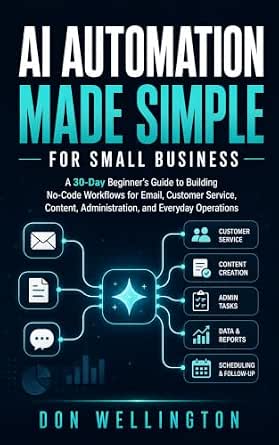 AI Automation Made Simple for Small Business: A 30-Day Beginner’s Guide to No…View on Amazon →
- 10
 AI Automation for Small Business: Simple AI Workflows for Everyday TasksView on Amazon →
- 11
 AI Automation for Small Business: A Practical Guide to Automating Marketing,…View on Amazon →
- 12
 AI for Small Business, Volume I: Getting Started — Set It Up Yourself, No Tec…View on Amazon →
- 13
 AI for Small Business: From Marketing and Sales to HR and OperationsView on Amazon →
- 14
 AI Automation for Small Businesses: Build Semi-Passive Income Systems Without…View on Amazon →
- 15
 AI for Entrepreneurs and Small Business Owners: How to Compete with Larger Bu…View on Amazon →
Choosing a Guide Before a Tool
For a small business, the distinction between learning about automation and implementing it can affect both cost and expectations. A book may help an owner map a workflow or understand possible uses for AI, but the owner still needs suitable software, compatible accounts and a plan for setting up and maintaining the process.
The roundup’s central choice is between broad coverage and a guided starting point. A cross-department guide may help owners surveying several processes, while a no-code or task-focused resource may be easier to apply to one defined problem. Neither format guarantees that a workflow will fit a company’s existing systems or deliver measurable savings.
That distinction matters for customer-facing and sensitive work. The source recommends setting human review rules before generated messages or recommendations are sent or used, and accounting for the time required to check outputs—not only the tasks automation might remove.
Popular right now

Ninja CM401 Specialty Coffee Maker with 10-Cup Carafe and Fold-Away Frother

Dyson V15 Detect Cordless Vacuum Cleaner, Yellow/Nickel

Vitamix Nano Personal Blender with SmoothiePilot, Black
As an affiliate, we earn on qualifying purchases.
How the 15 Books Were Compared
The publisher says it evaluated the 15 titles as business learning resources, not working AI products. Its selection criteria included practical workflow coverage, accessibility for nontechnical owners and relevance to common functions such as marketing, sales, customer service and operations. The roundup favors titles that appear to balance hands-on application with broad business relevance.
Its source material also cautions that the comparison relies on limited information about the books, especially their titles and stated positioning. A title suggesting a 30-day plan, no-code setup or ready-to-adapt workflows can indicate a learning approach, but does not verify the detail, quality or compatibility of the instructions. The guide therefore treats narrower books as possible matches for specific learning preferences rather than as proof of a particular outcome.
Before selecting a resource, the roundup advises owners to document the steps in a process and agree on its desired result. It also suggests listing existing email, calendar, customer database, payment and task-management software, then checking provider documentation for integration details rather than assuming a general workflow will connect automatically.
„These are learning resources, not automation platforms.“
— ThorstenMeyerAI.com guide
What the Titles Cannot Confirm
The supplied material does not provide publication dates, prices, editions or full descriptions for all 15 books. It also does not establish how much step-by-step instruction each contains, which software versions or integrations are covered, or whether the workflows work with a particular business’s systems.
No evidence is provided that the books’ recommendations produce specific time savings, revenue growth or other results. The source says its assessment is based on limited information and stated positioning; readers should check current descriptions, sample pages and software-provider guidance before committing to a workflow.
From Reading to a Small Test
The guide’s next step for owners is to select one frequent, well-defined task, document how it is handled now and decide what a successful result would look like. A reader can then choose a book whose stated scope matches that job, confirm that required software can connect, and test the workflow on a limited basis.
Before any automation affects customers, records or decisions, the source recommends deciding which outputs need human approval. The roundup does not announce a follow-up study or implementation results, so any claims about performance remain for individual businesses to verify.
Key Questions
Are the 15 picks AI automation software?
No. The roundup describes them as books and learning resources. Owners must choose and configure software separately to carry out workflows.
Which book does the guide name as its best overall pick?
It selects AI Automation for Small Businesses: A Practical Guide to Automating Marketing, Sales, Customer Service, Operations, and Everyday Work for its broad functional scope.
Which titles are presented as beginner options?
The guide points to AI Automation Made Simple for Small Business for its no-code framing and to ChatGPT for Business: The 10X Playbook for workflow ideas readers can adapt. The source cautions that titles alone cannot confirm how detailed the instructions are.
How should a business owner choose a book?
Start with a specific repetitive process, then match the book’s stated topics and learning style to that need. Check sample material and verify software compatibility rather than assuming every suggested workflow will connect to existing apps.
Does the roundup show that these books improve business results?
No. The source provides no measured outcomes or guaranteed results. It compares the titles using their stated audiences, formats and topics, and recommends that owners test workflows carefully.
Source: ThorstenMeyerAI.com