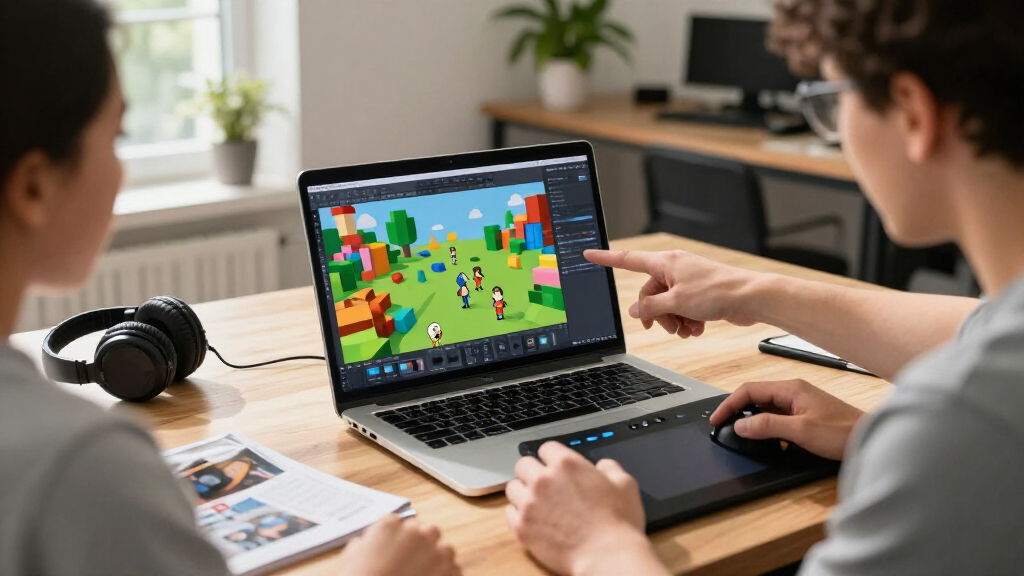

🔍 Read the full analysis: Step Into An AI World: What Google’s Genie 4 Can—and Can’t—Do on ThorstenMeyerAI.com
TL;DR
Google DeepMind demonstrated Genie 4 on October 27, describing it as a real-time AI world model that responds to movement and text prompts while generating sound. The company says access is planned for selected testers, but the demos are vendor-selected, continuous interaction lasts only a few minutes, and details can drift. No public release date, API price or independent benchmark results were provided in the source material.
Google DeepMind demonstrated Genie 4 on October 27, presenting an AI model that generates a changing visual scene as a user moves through it or gives instructions, with sound generated alongside the images. The announcement matters because it points toward AI systems that can create interactive environments rather than only finished video clips, but DeepMind says the worlds can drift and support only a few minutes of continuous interaction; public access has not begun.
In DeepMind’s demonstrations, a user steers a scene with keyboard and mouse controls and can type changes while it runs, such as changing the weather or adding an object. The company says the model generates the next frames in response to those inputs, as well as environmental audio, music and dialogue. These features are described by the company and shown in its own selected clips; the source material provides no independent evaluation or benchmark figures.
DeepMind also describes Gemini 3.8 Flash as an agent that observes the scene, divides a goal into steps and helps guide the simulation. One robotics-related demonstration showed a simulated Apptronik Apollo humanoid playing checkers. According to the source material, no physical robot took part; this was a simulation, not a report of a robot performing the task in the real world.
The company says Genie 4 is available to trusted testers, with access planned “coming soon” for Google AI Ultra subscribers through Project Genie and early Gemini API partners. The source gives no firm launch date or API price. DeepMind’s stated limitation is that objects and details can shift or drift over time, with continuous interaction lasting a few minutes. Some outlets cited in the source report sessions of about two minutes, but that figure is not in DeepMind’s own description.
Infographic 01 · How Genie grew up
From flat sketches to worlds with sound, in under three years.
Each step as Google DeepMind described it. Session limits and consistency are different measures, so read the labels.
- Feb 2024
Genie 1Simple 2D worlds11 billion parameters, learned from unlabelled internet videos - Dec 2024
Genie 23D worlds from a single imageConsistent “for up to a minute”; real time only as a slimmed-down, lower-quality version - Aug 2025
Genie 3First real-time Genie720p at 24 frames per second, consistent “for a few minutes”, memory about one minute back - Jan 2026
Project GenieUS AI Ultra subscribers can play60 seconds per world, partly because of compute costs - May 2026Project Genie goes globalIn the $200 AI Ultra tier, for users 18 and older
- 27 Oct 2026
Genie 4Sound, live steering, more realismResearch preview for trusted testers; Ultra subscribers and API partners “coming soon”
Genie 3 vs. Genie 4
As described by Google DeepMind. Genie 4 column = vendor claims unless marked.
| Feature | Genie 3 (Aug 2025) | Genie 4 (Oct 2026) |
|---|---|---|
| Sound | Genie 3: None | Genie 4: Generated with the picture: ambient noise, music, dialogue |
| Steering | Genie 3: Keys, plus “promptable world events” | Genie 4: Free-form text changes while it runs; Gemini adapts and checks them |
| Look | Genie 3: 720p, 24 fps | Genie 4: “Unprecedented realism”; no resolution or frame rate published |
| How long | Genie 3: “A few minutes”; Project Genie capped at 60 s | Genie 4: “A few minutes” (DeepMind); up to ~2 min consistent scene reported |
| Access | Genie 3: Small preview, then Project Genie | Genie 4: Trusted testers; Ultra and API partners “coming soon” |
Sources: Genie paper, arXiv, 23 Feb 2024; Genie 2 blog, 4 Dec 2024; Genie 3 blog, 5 Aug 2025; TechCrunch, 29 Jan 2026; Google, 19 May 2026; Google DeepMind, Genie 4 blog, 27 Oct 2026; Genie 4 model page (limitations, disclaimer); TechCrunch, 27 Oct 2026. Table wording: Thorsten Meyer.
Powered by Thorsten Meyer AI
Interactive Worlds Beyond Video Clips
Genie 4’s central distinction is interactivity: users can change a scene as it unfolds, rather than receive a fixed video generated from a prompt. If the approach becomes more reliable and broadly available, it could be useful for early-stage game design, film previsualization and experiments that need many simulated scenarios. DeepMind says testers have reported uses in film previsualization and game prototypes, but these are early feedback, not evidence of established commercial results.
The distinction also matters for robotics research, where simulated environments can let teams test plans without putting a machine into every scenario. The source describes the Apollo checkers example as a research demonstration, not proof that Genie 4 can safely or accurately train real-world robots. Waymo, meanwhile, is reported to use the predecessor Genie 3 in its driving simulator; that existing use does not establish that Waymo uses Genie 4.
More realistic visuals paired with sound could also make synthetic clips harder for viewers to identify by sight or hearing alone. DeepMind says Genie 4’s video and audio outputs carry an invisible SynthID watermark. The source does not provide details about how reliably that watermark can be detected or preserved after editing and sharing.
Popular right now

Bose QuietComfort Wireless Bluetooth Headphones with Active Noise Cancellation, Mic, USB‑C Charging, Deep Bass, 24‑Hour Battery – White Smok

KitchenAid Classic Series 4.5 Quart Tilt-Head Stand Mixer K45SS, Onyx Black

Ninja DualZone Air Fryer 10 Qt Smart 6-in-1 Grey (DZ950)
As an affiliate, we earn on qualifying purchases.
From Short Clips to Live Scenes
Genie 4 follows a series of DeepMind models. The first Genie, introduced in February 2024 according to the source, generated simple 2D worlds. Genie 2 followed in December 2024 and could create 3D environments from a single image, with consistency described as lasting up to a minute; its real-time version was lower quality. Genie 3, announced in August 2025, was described as running in real time at 720p and 24 frames per second for a few minutes, with visual memory reaching back about a minute.
Google opened Genie 3 through Project Genie to paying US subscribers in January 2026, according to the source. TechCrunch reported a 60-second limit per world, which it linked partly to computing costs. These figures come from the source’s account of earlier releases and reporting; they do not establish Genie 4’s performance or access limits beyond DeepMind’s stated few minutes of continuous interaction.
A world model differs from a conventional video generator or game engine. Rather than rendering a scene from a stored 3D map, Genie 4 predicts what the next view should look like based on previous frames and user input. That approach can support flexible interaction, but it also helps explain why a scene may not remain consistent when a user moves around or plays for longer.
„Details and objects “can shift or drift over time.”“
— Google DeepMind, describing Genie 4’s limitation
Release Details and Reliability
Several practical details remain unavailable. DeepMind has not given a public launch date for Project Genie access with Genie 4, a price for Gemini API use, or benchmark results that would allow readers to compare its performance with other systems. The source says access is limited to trusted testers and planned for selected subscriber and developer groups, but does not specify how many testers are involved or which partners will participate.
It is also unclear how often scene drift occurs, how performance changes across different prompts, and whether the model can maintain stable characters and objects beyond a few minutes. The demonstrations were selected by DeepMind, so they cannot establish how the system behaves across a broad range of ordinary user sessions. Claims about greater realism, physics and natural human movement remain the company’s descriptions in the material provided.
The source reports that SynthID watermarking is included in generated audio and video, but offers no independent test of the watermark or explanation of how it performs once output is altered. The extent to which Genie 4 is suitable for production work, commercial deployment or robotics training is therefore still unconfirmed.
Access for Testers and Partners
The next stated step is expanded access for Google AI Ultra subscribers through Project Genie and early partners using the Gemini API. DeepMind has not announced when that access will start, set an API price or described a broader public release. Those details, along with any usage limits and technical requirements, will determine who can test the system and for what kinds of work.
Further demonstrations and independent testing could clarify whether Genie 4 can keep scenes coherent, respond consistently to instructions and produce useful audio during longer sessions. Until results beyond the company’s selected clips are available, the clearest confirmed picture is limited: Genie 4 has been demonstrated as an interactive audio-visual world model, but access remains restricted and its reliability and practical uses are still being evaluated.
Key Questions
What is Google Genie 4?
Genie 4 is a Google DeepMind world model that predicts changing visual scenes in response to user movement and text instructions. DeepMind says it generates audio along with the visuals.
Can the public use Genie 4 now?
No public release is described in the source material. DeepMind says it is available to trusted testers and plans access for Google AI Ultra subscribers through Project Genie and early Gemini API partners, with no date specified.
How long can a Genie 4 scene run?
DeepMind says the model supports a few minutes of continuous interaction. Reports of sessions lasting about two minutes are attributed to outside outlets in the source and are not a figure in DeepMind’s own description.
Can Genie 4 train a real robot?
The source describes a robotics simulation demonstration involving a virtual Apptronik Apollo playing checkers. It says no physical robot took part, so the demonstration does not show a real robot being trained or performing the task.
What are Genie 4’s main limitations?
DeepMind says details and objects can shift or drift over time, and describes continuous interaction as lasting only a few minutes. The source also notes that the public cannot yet test the system and that independent benchmark results are not provided.
Source: ThorstenMeyerAI.com