
📊 Full opportunity report: DDR5 Now, DDR6 Soon: A Buyer’s Field Guide on ThorstenMeyerAI.com — validation score, market gap, and execution plan.
TL;DR
With memory prices remaining high through 2026 and DDR6 not arriving until 2027, experts advise buying DDR5 now for current builds. DDR6 offers little immediate benefit and will be significantly more expensive at launch.
Memory prices are unlikely to drop significantly before 2028, and DDR6 won’t be available for mainstream desktops until 2027. Experts advise consumers to purchase DDR5 now for current and near-future builds, as waiting for DDR6 is likely to be costly and unnecessary.
According to industry sources, DDR5-6000 with CL30 timings remains the recommended configuration for mainstream systems through at least 2028. Higher-speed kits, such as DDR5-8000, offer minimal real-world gains and are not cost-effective given current market conditions.
Platform support for DDR5 is solid, with both AMD and Intel platforms optimized around this standard. Capacity planning suggests 32GB is sufficient for most users, while 64GB suits content creators and heavy multitaskers. The common temptation to buy 128GB kits is discouraged, as current high prices lock in excess capacity that may remain unused for years.
Regarding DDR4, experts warn against starting new builds on this outdated standard, as DDR4 production is winding down and costs are aligning with DDR5, making it an inefficient choice for new systems.
DDR6, which promises significantly higher bandwidth through architectural improvements, is not yet available for consumer desktops. It requires new CPUs, chipsets, and modules, with initial releases targeted at enterprise and AI applications around 2026–27. Mainstream adoption is expected no earlier than 2027, with full market penetration possibly delayed until 2030.
DDR5 now, DDR6 soon
A buyer’s field guide. The 20-year instinct — wait for prices to drop, or wait for the next generation — is broken this cycle. Buy the DDR5 you actually need now; don’t wait for DDR6. Here’s the reasoning.
Driven to end-of-life, production slashed. Same money, dead-end socket. Leave a working DDR4 box alone — but never start a new build on DDR4 to „save.“
A framework, not a gamble. Buy the DDR5 you need now, at the sweet spot, in the capacity you’ll actually use — don’t buy DDR4, don’t wait for DDR6. The two costliest mistakes in this market are the ones that feel prudent: waiting for a price drop that isn’t coming, and waiting for a next-gen part that launches dearer than what’s on the shelf. Next: The SSD Squeeze.
Why Purchasing DDR5 Now Is the Smarter Choice
Consumers and builders who buy DDR5 now will avoid the premium and scarcity associated with DDR6’s early adoption. Waiting for DDR6 could mean paying more for early-generation hardware that offers limited benefits for most users, and missing out on platform improvements and CPU advancements in the meantime. For most, investing in DDR5 ensures better value and performance for the next few years.
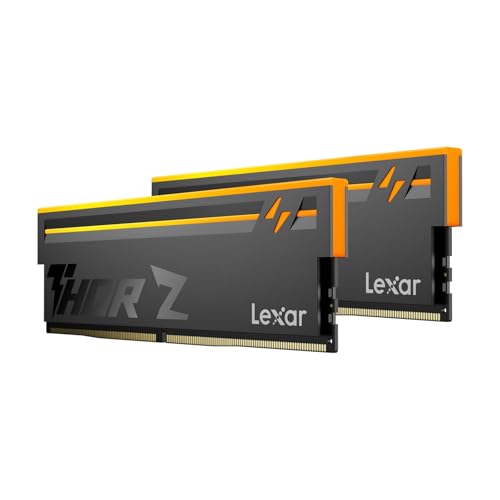
Lexar Thor Z RGB DDR5 RAM 32GB Kit (2x16GB) 6000MHz CL38 DRAM 288-Pin UDIMM
- High-Speed Performance: 6000MHz DDR5 RAM with low latency
- Large Capacity: 32GB (2x16GB) kit for multitasking
- Enhanced Thermal Management: Sandblasted aluminum heatsink for cooling
As an affiliate, we earn on qualifying purchases.
As an affiliate, we earn on qualifying purchases.
Market Trends and Future of Memory Standards
Historically, memory upgrades follow a cycle where new standards arrive approximately every 4–5 years, with DDR4 launched around 2014 and widely adopted by 2018. DDR5 was introduced around 2021, with initial high prices and limited availability. DDR6 is currently in development, with its architecture promising higher bandwidth but requiring new hardware. Its rollout is staged, with enterprise markets leading first, followed by consumer platforms, which are expected to adopt DDR6 around 2027. This timeline mirrors past transitions, emphasizing the long lead time for broad adoption.
Manufacturers are warning that early DDR6 modules will likely be expensive, limited in capacity, and potentially unstable, making them unsuitable for most users in 2026. The transition to DDR6 will be gradual, and early adopters will face challenges typical of first-generation hardware.
„DDR6 offers significant architectural improvements, but it will take several years before it becomes mainstream, and early modules will carry a premium.“
— Hardware manufacturer spokesperson

G.SKILL Flare X5 Series DDR5 RAM (AMD EXPO & Intel XMP 3.0) 32GB (2x16GB) 6000MT/s CL36-36-36-96 1.35V Desktop Computer Memory U-DIMM – Matte Black (F5-6000J3636F16GX2-FX5)
- Series Name: G.SKILL Flare X5 Series
- Memory Capacity: 32GB (2x16GB) kit
- Speed: 6000MT/s DDR5
As an affiliate, we earn on qualifying purchases.
As an affiliate, we earn on qualifying purchases.
Remaining Uncertainties About DDR6 Availability and Performance
It is still unclear how quickly DDR6 modules will mature in terms of stability, capacity, and pricing once they arrive. The exact timeline for broad adoption remains uncertain, and early modules may face compatibility and reliability issues. Additionally, the actual performance gains for typical consumer workloads are yet to be proven in real-world scenarios.

SK Hyn(Hynix) Original 16GB DDR5 5600MHz High-Performance Gaming RAM PC5-44800 UDIMM Unbuffered Non-ECC 1Rx8 CL46 Desktop PC Memory OEM Package
- Capacity: 16GB DDR5 RAM
- Speed: 5600MHz
- Type: UDIMM DDR5
As an affiliate, we earn on qualifying purchases.
As an affiliate, we earn on qualifying purchases.
Next Steps for Consumers and Builders in 2026
Consumers should prioritize purchasing DDR5-6000 CL30 kits for current systems, aligning with platform recommendations. Monitoring JEDEC standards and motherboard compatibility lists for DDR6 developments will be essential for early adopters. Most users should plan to upgrade to DDR6 around 2027, once modules are mature and supported by new CPUs and chipsets. Meanwhile, platform and CPU upgrades should be synchronized with memory plans to maximize performance and value.

Silicon Power Value Gaming DDR5 32GB (2x16GB) 6000MT/s (PC5-48000) 288-pin CL30 1.35V UDIMM Desktop RAM Computer Memory SP032GXLWU60AFDJ
- Heatsink Material: Aluminum for heat dissipation
- Overclocking Support: Supports Intel XMP 3.0 and AMD EXPO
- Speed: Up to 6000 MT/s
As an affiliate, we earn on qualifying purchases.
As an affiliate, we earn on qualifying purchases.
Key Questions
Should I wait for DDR6 before building a new PC in 2026?
No, experts recommend buying DDR5 now, as DDR6 will not be suitable for mainstream use until 2027 and early modules will be expensive and potentially unstable.
Is DDR4 still a good choice for new builds in 2026?
No, DDR4 is being phased out, and building on DDR4 now would be a step backward. DDR5 offers better future-proofing and performance.
What capacity should I buy for DDR5 in 2026?
32GB is sufficient for most users, while 64GB is recommended for heavy multitasking and content creation. Avoid overbuying to prevent paying for unused capacity.
When will DDR6 be affordable and widely available?
It is expected around 2027, with full market penetration possibly delayed until 2030. Early modules will be expensive and limited in capacity.
Will DDR6 significantly improve gaming performance?
No, DDR6’s bandwidth improvements are mainly beneficial for bandwidth-bound workloads like AI and scientific computing, not typical gaming.
Source: ThorstenMeyerAI.com