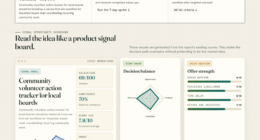

📊 Full opportunity report: IdeaClyst: The Validation Council on ThorstenMeyerAI.com — validation score, market gap, and execution plan.
TL;DR
IdeaClyst has launched a new validation council that uses two AI models to critically assess ideas through a five-step process. This approach aims to prevent costly, plausible-sounding ideas from advancing without proper scrutiny. The system is open source and designed to improve decision-making in innovation pipelines.
IdeaClyst has introduced a ‚Validation Council‘ that employs two AI models—Claude and Codex—to critically evaluate and stress-test ideas before they are approved for development. This new process aims to improve decision quality by ensuring ideas are rigorously challenged, reducing the risk of pursuing plausible but flawed concepts.
The Validation Council is a structured, open-source system designed to assess ideas through a five-step deliberation process, starting with a research pre-step that gathers relevant context and evidence. Two AI models are assigned opposing roles: one to defend the idea and the other to challenge it, fostering structured disagreement rather than simple agreement.
Each idea undergoes five deliberation steps: framing, steel-manning, red-teaming, evidence-checking, and synthesizing a verdict. This process produces an auditable recommendation, highlighting the strongest arguments and potential weaknesses. The system is built to be provider-agnostic, running locally on owned compute, and aims to make idea validation nearly cost-free and repeatable.
IdeaClyst — the validation council
Most ideas don’t die from being bad — they die from being plausible and untested. A research pre-step, then two models cross-examining the idea before it earns a roadmap slot.
Independent commentary, produced with AI assistance under human editorial oversight. The views are the author’s own and may change. IdeaClyst is open source under MIT, provided „as is“ without warranty; see the repository LICENSE. The council’s research, deliberation and verdicts are produced by automated models and may contain errors or shared blind spots — a verdict is auditable reasoning, not validated demand; verify independently before committing. Product and company names are trademarks of their respective owners; mention does not imply endorsement.
Why a Structured AI Council Enhances Decision-Making
By formalizing the idea validation process with a multi-model AI council, organizations can significantly reduce the risk of advancing weak or flawed ideas, saving time and resources. This method introduces structured disagreement, which is more reliable than single-model assessments, and promotes transparent, auditable reasoning. It represents a step toward more disciplined innovation management, especially valuable in high-stakes or resource-constrained environments.

ChatGPT for Business 101: AI-Driven Strategies to Cut Costs, Skyrocket Productivity and Boost Your Bottom Line
As an affiliate, we earn on qualifying purchases.
As an affiliate, we earn on qualifying purchases.
Background on Idea Validation and AI Use in Decision Processes
Traditional idea vetting often relies on individual judgment or informal peer review, which can be biased or insufficiently rigorous. Recent advances in AI have enabled more systematic analysis, but single-model assessments tend to favor agreement and may overlook flaws. IdeaClyst’s approach builds on these developments by integrating multiple AI models and a structured deliberation process to improve reliability. The concept aligns with broader trends toward open-source, provider-agnostic AI tools designed for enterprise decision support.
„Structured disagreement between models is the most reliable way to stress-test ideas before they reach the roadmap.“
— Thorsten Meyer, founder of IdeaClyst

Is it really a Great Idea? WORKBOOK: Workbook Companion to the Textbook (2nd Edition)
As an affiliate, we earn on qualifying purchases.
As an affiliate, we earn on qualifying purchases.
Limitations of AI-Based Idea Validation Systems
It remains unclear how well the Validation Council performs across diverse real-world scenarios, as empirical results and case studies are still emerging. The system’s reliance on two AI models means it can share blind spots and confidently endorse flawed ideas if both models are misled. Additionally, the process could be manipulated or misinterpreted if users do not critically review the underlying arguments.

The AI-Driven Leader: Harnessing AI to Make Faster, Smarter Decisions
As an affiliate, we earn on qualifying purchases.
As an affiliate, we earn on qualifying purchases.
Next Steps for Adoption and Evaluation of IdeaClyst
IdeaClyst plans to open-source the full system and internal documentation, inviting external developers and organizations to trial the Validation Council. Future developments may include integrating additional models, refining the deliberation steps, and conducting empirical studies to measure effectiveness. Monitoring how organizations adopt and adapt this tool will be key to understanding its impact on decision quality.

Data Mining: Practical Machine Learning Tools and Techniques (The Morgan Kaufmann Series in Data Management Systems)
As an affiliate, we earn on qualifying purchases.
As an affiliate, we earn on qualifying purchases.
Key Questions
How does the Validation Council improve idea decision-making?
It introduces a structured, multi-model debate that rigorously challenges ideas, reducing the risk of advancing weak or flawed concepts and providing transparent, auditable reasoning.
What models does the system use, and why?
It uses two models, Claude and Codex, chosen for their differing architectures and blind spots, to foster meaningful disagreement and surface objections that might be missed by a single model.
Is the system open source?
Yes, the full implementation and internal details are available under the MIT license at ideaclyst.com.
Can this system fully replace human judgment?
No, it is designed to augment human decision-making by providing a rigorous, transparent evaluation process, but human oversight remains essential.
What are the limitations of using AI for idea validation?
AI models can share blind spots and confidently endorse flawed ideas if both are misled; the system cannot determine market viability or real-world applicability on its own.
Source: ThorstenMeyerAI.com