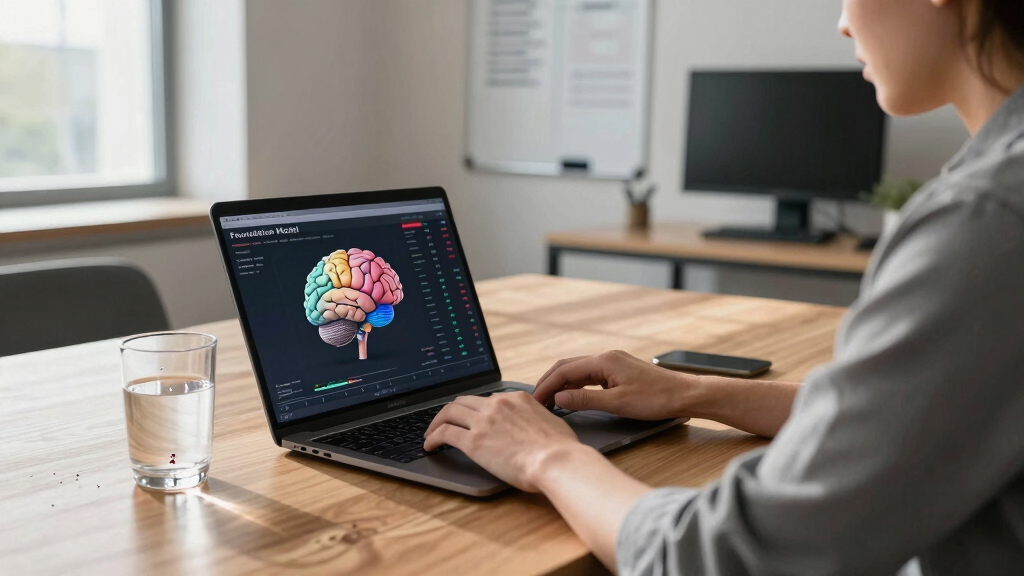

📊 Full opportunity report: Week Three — Foundation model vs Brownian motion. Kronos on five-minute BTC. on ThorstenMeyerAI.com — validation score, market gap, and execution plan.
TL;DR
A recent test comparing Kronos, a foundation model, to a Brownian motion baseline for 5-minute Bitcoin predictions found no statistically significant advantage. The experiment used historical trade data and out-of-sample testing, revealing that Kronos does not outperform the traditional model in this context.
Recent testing of Kronos, an open-source foundation model trained on global crypto data, against a traditional Brownian motion baseline for five-minute Bitcoin predictions showed no statistically significant advantage for Kronos in out-of-sample data.
Over a sample of 497 BTC trades, the Kronos model’s predictive performance was compared to a Brownian motion baseline and market-implied probabilities. The tests incorporated a detailed reconstruction of market conditions leading up to each trade, using historical OHLCV data from multiple exchanges.
Results indicated that Kronos’s Brier score and log-loss metrics were nearly identical to those of the Brownian baseline on out-of-sample data, with differences so small they are within the statistical noise. Specifically, on the last 249 trades, the Brier score difference was only 0.0011, which is considered statistically insignificant. Consequently, Kronos did not demonstrate a clear edge over the traditional model in this setting.
Officials behind the test emphasized that Kronos is a research model, not a trading system, and that the findings suggest it does not currently outperform simple models in short-term crypto prediction at this horizon.
Implications for AI-Driven Crypto Prediction
This outcome challenges the assumption that modern, learned models automatically outperform traditional mathematical models like Brownian motion in short-term crypto forecasting. For traders and researchers, it underscores the difficulty of gaining a predictive edge in highly efficient markets and highlights the importance of rigorous out-of-sample testing.
While Kronos did not show an advantage in this specific test, the results do not negate its potential in other contexts or longer horizons. The findings encourage cautious optimism and emphasize the need for further research before integrating such models into live trading systems.
Bitcoin five-minute prediction tools
As an affiliate, we earn on qualifying purchases.
As an affiliate, we earn on qualifying purchases.
Background on Model Testing and Market Efficiency
Over the past two weeks, a paper-trading bot called Polybot has been used to test various predictive models against Polymarket’s five-minute crypto markets. The bot’s performance showed that most models, including those based on geometric Brownian motion, lacked a consistent edge. This prompted testing of Kronos, a state-of-the-art foundation model trained on millions of candlestick data points from multiple exchanges.
Previous research and market observations suggest that short-term crypto markets are highly efficient, making it difficult for any model to consistently outperform random chance. Kronos, developed by a team with an AAAI 2026 publication, represents the latest attempt to leverage machine learning for market prediction, but its real-world effectiveness remains uncertain.
„The test results indicate that Kronos, despite its sophistication, does not outperform the traditional Brownian motion baseline in this specific short-term prediction task.“
— Thorsten Meyer, researcher and author

Algorithmic Crypto Trading For Beginners: Build, Backtest, and Automate Your AI Bots For Consistent Profits (The Forrest Digitech Collection)
As an affiliate, we earn on qualifying purchases.
As an affiliate, we earn on qualifying purchases.
Unanswered Questions About Model Performance
It remains unclear whether different configurations, longer prediction horizons, or alternative training data could enable Kronos to outperform traditional models. Additionally, the impact of live trading conditions, transaction costs, and market shifts has not been assessed in this test. The long-term potential of foundation models like Kronos in crypto prediction is still an open question.

Day Trading Cryptocurrency: Strategies, Tactics, Mindset, and Tools Required To Build Your New Income Stream
As an affiliate, we earn on qualifying purchases.
As an affiliate, we earn on qualifying purchases.
Next Steps for Model Evaluation and Research
Further testing across different timeframes, market conditions, and real trading environments will be necessary to evaluate Kronos’s true potential. Researchers may also explore hybrid approaches combining machine learning with traditional models or analyze model performance over extended periods. The ongoing development of foundation models will likely continue, with future studies aiming to identify scenarios where they can add value.

The Automated Cryptocurrency Trading – CREATING CRYPTOCURRENCY TRADING BOT: How anyone can make money trading with Python code. Easy step by step guide … in blockchain. (Crypto Investment)
As an affiliate, we earn on qualifying purchases.
As an affiliate, we earn on qualifying purchases.
Key Questions
Does this mean foundation models are useless for crypto prediction?
No, this specific test indicates that Kronos does not outperform a Brownian baseline at five-minute horizons in this context. It does not rule out potential benefits in other settings or longer timeframes.
Could Kronos perform better with different training data or configurations?
Yes, it’s possible that alternative training methods, data sources, or model adjustments could improve performance. Further research is needed to explore these options.
What does this mean for traders using AI models?
It highlights the importance of rigorous out-of-sample testing and skepticism about claims of AI superiority in short-term trading without substantial evidence.
Will Kronos be integrated into live trading strategies?
Based on current results, integration is not justified. Future developments might change this, but further validation is required first.
Source: ThorstenMeyerAI.com