
📊 Full opportunity report: Quiet GPUs for Local AI: Acoustic and Thermal Roundup on ThorstenMeyerAI.com — validation score, market gap, and execution plan.
TL;DR
This article reviews the quietest GPUs suitable for local AI setups in 2026, emphasizing thermal management and noise levels. It highlights the RTX 5090 as the top choice, with practical tips for optimizing cooling and power settings.
The RTX 5090 with 32GB of GDDR7 memory emerges as the quietest and most efficient GPU for local AI in 2026, provided it is power-capped and paired with a high-quality cooling solution. This development matters because noise and heat are critical factors in building sustainable, comfortable AI workstations, especially for long inference sessions. You can learn more about best thermal paste and pads for high-TDP GPUs to improve cooling.
This roundup evaluates GPUs based on their thermal output and acoustic levels, emphasizing that cooler and quieter operation depends heavily on cooler design and power management, not just silicon. The RTX 5090, despite its high TDP of 575W, can be made nearly silent with undervolting and a high-quality triple-fan cooler, making it ideal for large-scale inference tasks at 70B models and beyond.
The RTX 4090 (24GB) and used RTX 3090 are highlighted as cost-effective alternatives, offering reliable performance with lower power draw and heat. For mid-tier needs, the RTX 5080 and RTX 4060 Ti 16GB are recommended for models up to 34B, prioritizing efficiency and minimal noise. The RTX PRO 6000 Blackwell with 96GB VRAM is noted for professional, dense builds, though details on its acoustics remain less certain.
Quiet GPUs
for local AI.
The GPU makes ~70% of your heat and most of your noise. But here’s the secret: the chip doesn’t decide how loud your card is — the cooler design and your power settings do. Match your VRAM tier in Part 2, then make it quiet.
Capping to 70–80% sheds a huge amount of heat for almost no inference loss — because inference is memory-bound. A capped 5090 is dramatically cooler & quieter than stock. Do this first.
Within one GPU model, partner cards differ enormously. For a single card, a large triple-fan open-air with zero-RPM idle runs slow & quiet. For multi-GPU, the calculus flips →
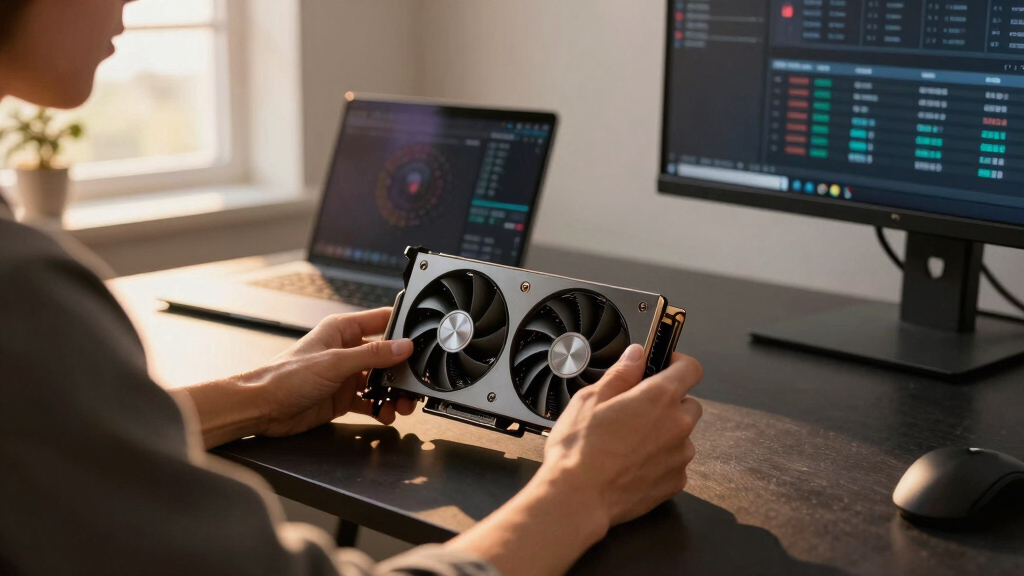
With room to breathe, a large triple-fan open-air cooler spreads heat across a big fin stack and runs its fans slowly. The quietest choice — what most people should buy.
Impact of Quiet GPU Design on Local AI Workstations
Choosing GPUs with optimized thermal and acoustic performance reduces noise pollution and heat buildup in AI work environments. For more insights, see our guide on best thermal paste and pads for high-TDP GPUs. Power-capping and quality cooling solutions enable high-performance cards like the RTX 5090 to operate quietly, making long inference sessions more practical and less disruptive. This influences hardware choices for AI practitioners seeking sustainable, comfortable setups and can extend hardware lifespan by managing heat more effectively.
MSI Geforce RTX 3050 Ventus 2X Xs 8G Oc Graphics Card Nvidia 8, W128564415 (8G Oc Graphics Card Nvidia 8 Gb Gddr6)
- High-Performance Gaming: Powered by Nvidia Ampere architecture
- Enhanced Durability: Reinforced backplate for protection
- Quiet Operation: Zero Frozr fan technology
As an affiliate, we earn on qualifying purchases.
As an affiliate, we earn on qualifying purchases.
2026 GPU Landscape and Cooling Strategies
In 2026, GPU manufacturers have focused on balancing VRAM capacity with thermal and acoustic performance. The emphasis on undervolting and cooling design reflects industry trends toward quieter, more energy-efficient AI hardware. The RTX 5090, RTX 4090, and professional cards like the RTX PRO 6000 Blackwell represent different tiers of this evolving landscape, with cooling solutions playing a pivotal role in user experience. Prior models like the RTX 3090 remain relevant due to their affordability and proven performance."Power-capping the RTX 5090 can reduce its heat output dramatically, allowing it to run near-silent under sustained loads."
— Thorsten Meyer, AI hardware expert

ARCTIC MX-4 (4 g) - Premium Performance Thermal Paste for All Processors
- Consistent Quality: Reliable performance with proven formula
- High Thermal Conductivity: Made of carbon microparticles for efficient heat transfer
- Safe to Use: Metal-free and non-electrical conductive
As an affiliate, we earn on qualifying purchases.
As an affiliate, we earn on qualifying purchases.
Uncertainties in GPU Acoustic Performance and Long-Term Reliability
While power-capping and high-quality coolers can significantly reduce noise, specific acoustic measurements for some professional cards like the RTX PRO 6000 Blackwell are not yet publicly confirmed. Long-term reliability of undervolted configurations under continuous load remains to be fully validated, and real-world noise levels can vary depending on case design and ambient conditions.

Frienda 6 Pcs Thermal Pad 100 x 100 Mm, 0.5, 1, 1.5, 2, 2.5, 3 mm Heat Resistant Conductive Silicone Thermal Pads Conductivity 6.0 W/M for Laptop Heatsink CPU Gpu LED Cooler(Blue)
- Size and Thickness: 100x100mm, multiple thickness options
- High Thermal Conductivity: 6.0 W/m for efficient heat transfer
- Safe and Durable: Electrical insulation, flame retardant, stable
As an affiliate, we earn on qualifying purchases.
As an affiliate, we earn on qualifying purchases.
Future Developments in Quiet GPU Design and AI Hardware
Expect further innovations in cooling technology and power management strategies to enhance quiet operation. Reviewing best thermal paste and pads for high-TDP GPUs can help optimize your GPU cooling setup. Manufacturers may release new models with integrated noise reduction features, and community-driven undervolting and overclocking guides will continue to optimize performance and acoustics. Monitoring real-world performance and long-term stability will be key as these technologies mature.

Gintai 16AWG 12VHPWR GPU Power Cable PSU Sleeved Extension Cable Heavy Duty Braided Wire 4x8Pin to 16Pin (12+4) 15cm for NVIDIA RTX4070 RTX4080 RTX4090 RTX5070 RTX5080 RTX5090
- Designed for PCIe 5.0 GPUs: Compatible with RTX 4070, 4080, 4090, 5070, 5080, 5090
- Supports up to 600W power: Made of 16AWG tin copper wire
- Heavy-duty braided construction: Durable sleeved extension cable
As an affiliate, we earn on qualifying purchases.
As an affiliate, we earn on qualifying purchases.
Key Questions
Can I make any high-power GPU run quietly?
Yes, by undervolting and using a high-quality, large cooling solution with a zero-RPM mode, most GPUs can be made to operate with significantly reduced noise levels.
Is the RTX 5090 suitable for long inference sessions?
Yes, especially if power-capped and paired with an effective cooler, it can run quietly and maintain high performance during extended inference workloads.
How does VRAM size impact heat and noise?
Higher VRAM cards tend to generate more heat and may require more robust cooling solutions, but proper power management can mitigate noise and thermal issues.
Are professional GPUs like the RTX PRO 6000 Blackwell quieter than consumer cards?
It is not yet clear; detailed acoustic data for these professional cards are still emerging, and their noise levels depend heavily on cooling solutions and workload characteristics.
Source: ThorstenMeyerAI.com