For branded business cards made with an existing home or office printer, the best choice depends less on a long feature list than on matching the paper to your printer and workflow. I’d start with Avery 08371 for inkjet users who want a full 250-card pack and double-sided printing, or Avery 05371 for a laser printer. If you need one stock that supports either printer type, Litpoetic’s 250-card pack offers broader compatibility, though it gives up Avery’s stated Sure Feed design and template ecosystem.
The other Avery option, the 90-card Clean Edge pack, is a practical small-batch pick for inkjet users who value easy separation more than a large supply. All four options are printable card stock, not standalone printers: you supply the design and compatible printer, then separate the finished cards from their sheets. I compare them by printer fit, card quantity, print flexibility, and the finishing work each asks of you.
Key Takeaways
- For inkjet printing at a regular volume: Avery 08371 pairs 250 cards with double-sided printing, Sure Feed technology, and Avery design tools.
- For laser printers: Avery 05371 is the dedicated laser option; its listing warns that inkjet printing may smear.
- For mixed printer access: Litpoetic is the only listed stock specified for both inkjet and laser printers, but it has no stated Sure Feed system.
- For a short run: Avery Clean Edge supplies 90 inkjet-compatible cards, avoiding a larger pack when you only need a limited batch.
- For any option here: confirm the printer type and sheet settings before printing, and plan to separate the cards after they come off the printer.
| Avery Printable Business Cards, 2″ x 3.5″, White, 250 Blank Cards, Inkjet, Sure Feed Technology (08371) |  | Best Overall for Inkjet Branding | Card size: 2 x 3.5 inches | Card count: 250 | Sheet count: 250 cards; sheet count not specified in the supplied details | VIEW LATEST PRICE | See Our Full Breakdown |
| Avery Printable Business Cards, 2 x 3.5 Inches, White, 250 Cards, Laser Printer, Sure Feed (05371) |  | Best for Laser Printers | Card size: 2 x 3.5 inches | Card count: 250 | Sheet format: 25 letter-size sheets, 10 cards per sheet | VIEW LATEST PRICE | See Our Full Breakdown |
| 250 Blank Printable Business Cards, 3.5 x 2 Inches, Perforated White Cardstock, 10 per Sheet |  | Best for Mixed Printer Access | Card size: 3.5 x 2 inches | Card count: 250 | Sheet format: 25 letter-size sheets, 10 cards per sheet | VIEW LATEST PRICE | See Our Full Breakdown |
| Avery Clean Edge Printable Business Cards, 2 x 3.5 in, Matte White, 90 Count |  | Best for Small Inkjet Runs | Card size: 2 x 3.5 inches | Card count: 90 | Card stock: Heavyweight matte white cardstock | VIEW LATEST PRICE | See Our Full Breakdown |
| branded business card printer | Card size | Card count | Card stock | Printer compatibility |
|---|---|---|---|---|
| Avery Printable Business Cards | 2 x 3.5 inches | 250 | Matte-coated cardstock, 80 lb / 216 gsm | Inkjet |
| Avery Printable Business Cards | 2 x 3.5 inches | 250 | 80 lb / 216 gsm cardstock | Laser printers |
| 250 Blank Printable Business C | 3.5 x 2 inches | 250 | 170 gsm offset paper | Inkjet and laser |
| Avery Clean Edge Printable Bus | 2 x 3.5 inches | 90 | Heavyweight matte white cardstock | Inkjet |
More Details on Our Top Picks
Avery Printable Business Cards, 2″ x 3.5″, White, 250 Blank Cards, Inkjet, Sure Feed Technology (08371)
I place Avery 08371 first for buyers who already have an inkjet printer and want a practical supply for recurring branded cards. Its combination of 250 cards, double-sided printing, and Sure Feed technology covers the main needs of a small business: a useful run size, room for contact details on one side and a logo or message on the other, and a feature intended to help with feed alignment. Avery templates and design tools can also shorten the setup process if you do not want to build a card layout from scratch.
Compared with the laser-specific Avery 05371, this is the better match for an inkjet workflow and shares the same listed 80 lb / 216 gsm weight. Compared with Litpoetic, it gives up cross-type printer compatibility but adds named Sure Feed support and Avery’s design resources. That makes it a more focused choice rather than a universal one: if your only available machine is a laser printer, Litpoetic or the 05371 makes more sense.
The tradeoff is that this pack still depends on correct printer settings and careful sheet handling; Sure Feed is designed to help, not a guarantee against every misfeed. The cards also have to be separated along their fine perforations after printing, so the process is not as hands-off as ordering finished cards. I would choose it for an at-home brand refresh or repeat batches, but not for anyone seeking preprinted cards or a finish made by a professional print shop.
Pros:- 250-card pack supports repeat batches.
- Double-sided inkjet printing leaves room for contact details and brand messaging.
- Sure Feed technology is designed to help reduce misalignment and paper jams.
- Avery templates and design tools can simplify layout creation.
Cons:- Designed for inkjet printers, limiting its fit for laser-only setups.
- Cards must be separated along perforations after printing.
- Print quality and alignment still depend on printer settings and handling.
Best for: Small businesses and independent professionals with an inkjet printer who need a repeatable batch of double-sided branded cards.
Not ideal for: Buyers with only a laser printer, people seeking finished cards without post-print separation, or anyone who needs a print-shop finish.
- Card size:2 x 3.5 inches
- Card count:250
- Sheet count:250 cards; sheet count not specified in the supplied details
- Card stock:Matte-coated cardstock, 80 lb / 216 gsm
- Printer compatibility:Inkjet
- Printing:Double-sided
- Feed feature:Sure Feed
- Design support:Avery templates and design tools
Our verdict“For inkjet owners who want a substantial, double-sided card supply with feed guidance and template support, Avery 08371 is the most balanced choice in this lineup.”
Avery Printable Business Cards, 2 x 3.5 Inches, White, 250 Cards, Laser Printer, Sure Feed (05371)
Avery 05371 is the clearest choice for a buyer whose card printer is a laser model. The defining point is not merely its paper weight: the stock is optimized for laser printers, and the product details specifically warn that inkjet use may cause smearing. That makes the compatibility limit meaningful. Rather than gamble on an inkjet setup, laser users get a dedicated 250-card pack with Avery templates and Sure Feed technology intended to improve feed reliability and alignment.
Against Avery 08371, the two products share a 250-card quantity, 80 lb / 216 gsm stock, Sure Feed, and Avery design support, but they target opposite printer types. A buyer should choose between them based on the printer first, not assume one is a universal substitute for the other. Litpoetic lists compatibility with both inkjet and laser printers, which is appealing if access to machines changes, but it does not list the same named feed feature or Avery template support.
The real compromises are the laser-only focus and sheet separation. This is not a good fallback if the office switches to inkjet, and each printed sheet still needs to be separated into cards. The product supplies 25 letter-size sheets with 10 cards per sheet, so it offers a clear batch structure, though the perforations are part of the finishing process rather than a ready-made cut-card delivery. I’d pick it for a stable laser workflow and skip it if printer compatibility is uncertain.
Pros:- Purpose-built for laser printer workflows.
- Sure Feed technology is designed to improve feed reliability and alignment.
- 250 cards across 25 sheets gives a defined batch size.
- Avery templates support custom branded layouts.
Cons:- Inkjet printing may cause smearing.
- Printed cards need to be separated from the sheets.
- Less flexible than Litpoetic if users need stock for both printer types.
Best for: Laser-printer owners who want a 250-card batch with Avery template support and a feature designed to help feed alignment.
Not ideal for: Inkjet-only users, shared offices with changing printer types, and buyers who do not want to separate cards after printing.
- Card size:2 x 3.5 inches
- Card count:250
- Sheet format:25 letter-size sheets, 10 cards per sheet
- Card stock:80 lb / 216 gsm cardstock
- Color and brightness:White; brightness 97
- Printer compatibility:Laser printers
- Feed feature:Sure Feed technology
- Template support:Free Avery design templates
Our verdict“For a laser-only setup, Avery 05371 offers a focused 250-card workflow, but its printer restriction makes it a poor all-purpose choice.”
250 Blank Printable Business Cards, 3.5 x 2 Inches, Perforated White Cardstock, 10 per Sheet
Litpoetic earns its place as the most printer-flexible option in this group: its 250 blank cards are specified for both inkjet and laser printers. That is useful for a small business that borrows equipment, shares a workspace, or may change printers before using the whole pack. The familiar letter-size format holds 10 micro-perforated cards per sheet, and the card stock is described as suitable for text and images on both sides.
Compared with Avery 05371, Litpoetic does not make the buyer commit to a laser-only workflow; compared with Avery 08371, it likewise does not lock the stock to inkjet. The Avery options, however, list Sure Feed technology, and Avery offers template tools. Litpoetic’s main advantage is compatibility breadth, not a more guided printing process. If your printer type is settled and you value a named feed feature or established design templates, an Avery product may be a better match.
The 170 gsm stock is lighter than the 216 gsm cardstock listed for both 250-card Avery packs. That does not make Litpoetic unsuitable for branding, but buyers who prioritize a heavier hand should notice the distinction. Micro-perforations make separation possible, though, as with the other full-sheet options, you still finish the cards yourself. Its listed uses also include tags, coupons, and crafts, which adds versatility but does not replace checking the exact printer’s media limits before loading a full sheet.
I would choose this pack when printer flexibility matters more than brand-specific templates or a stated feed system. I would skip it if you have a known inkjet workflow and want Avery’s layout support, or if the heavier stock specified by the Avery 250-card packs is a priority.
Pros:- Listed for both inkjet and laser printers.
- 250 cards supplied across 25 sheets.
- Micro-perforations are designed to ease separation.
- Can support two-sided text and image layouts and other paper projects.
Cons:- 170 gsm stock is lighter than the 216 gsm Avery 250-card options.
- No Sure Feed feature or design-template system is specified in the supplied details.
- Cards still need to be printed and separated by the buyer.
Best for: Small teams and independent sellers who may print on either inkjet or laser equipment and want one stock for multiple uses.
Not ideal for: Buyers who prioritize Avery template support, a named Sure Feed feature, or the heavier 216 gsm stock listed for the two 250-card Avery packs.
- Card size:3.5 x 2 inches
- Card count:250
- Sheet format:25 letter-size sheets, 10 cards per sheet
- Card stock:170 gsm offset paper
- Printer compatibility:Inkjet and laser
- Perforation:Micro-perforated
- Printing:Suitable for text and images on both sides
- Additional uses:Gift tags, coupons, membership cards, notes, and crafts
Our verdict“Litpoetic is the sensible pick when printer type may vary, but it trades Avery’s stated feed and template features for broader compatibility.”
Avery Clean Edge Printable Business Cards, 2 x 3.5 in, Matte White, 90 Count
Avery Clean Edge is the deliberately smaller pick: it supplies 90 inkjet-compatible cards rather than the 250-card batches offered by the other products. That makes it a useful option for a limited event, a new side business testing a card design, or someone who only needs a modest quantity. Clean Edge technology is designed to let cards separate with smooth edges, and the heavyweight matte stock supports printing on both sides.
Compared with Avery 08371, this pack follows a similar inkjet and double-sided approach but has far fewer cards and does not list Sure Feed technology. Its distinguishing strength is Clean Edge separation, paired with a small run that avoids committing to a larger pack. Compared with Litpoetic, it is less printer-flexible and supplies fewer cards, but it offers a specific separation feature and an Avery template number for layout setup.
The important limitation is that inkjet compatibility is narrow: this is not the right choice for a laser-only office. The supplied listing also gives conflicting-looking sheet information—90 cards and 90 sheets—so buyers should confirm the package layout and their software’s template before printing a full batch. As with the other options, this stock is blank and requires both personalization and post-print handling. It suits small jobs, not a business that regularly distributes cards and wants a larger reserve.
I’d choose it over the 250-card Avery 08371 only when a lower quantity better matches the task or when Clean Edge separation is the priority. For regular card production, the larger pack offers a more suitable supply; for printer flexibility, Litpoetic is the stronger alternative.
Pros:- 90-card quantity fits short runs and occasional use.
- Clean Edge technology is designed for smooth card separation.
- Heavyweight matte stock supports two-sided printing.
- Avery template number 28878 can help with layout setup.
Cons:- Inkjet-only compatibility limits printer options.
- Smaller quantity than either 250-card Avery pack or Litpoetic.
- Cards still need printing and personalization before use.
Best for: Inkjet users making a short run for a small event, new business, or occasional branding need.
Not ideal for: Laser-printer owners, businesses that need a substantial recurring supply, or buyers who want a stated Sure Feed feature.
- Card size:2 x 3.5 inches
- Card count:90
- Card stock:Heavyweight matte white cardstock
- Printer compatibility:Inkjet
- Printing:Two-sided
- Separation feature:Clean Edge technology
- Template:Avery template 28878
- Brightness:110
Our verdict“For a limited inkjet batch where easy separation matters more than volume, Avery Clean Edge is the focused small-run choice.”
How We Picked
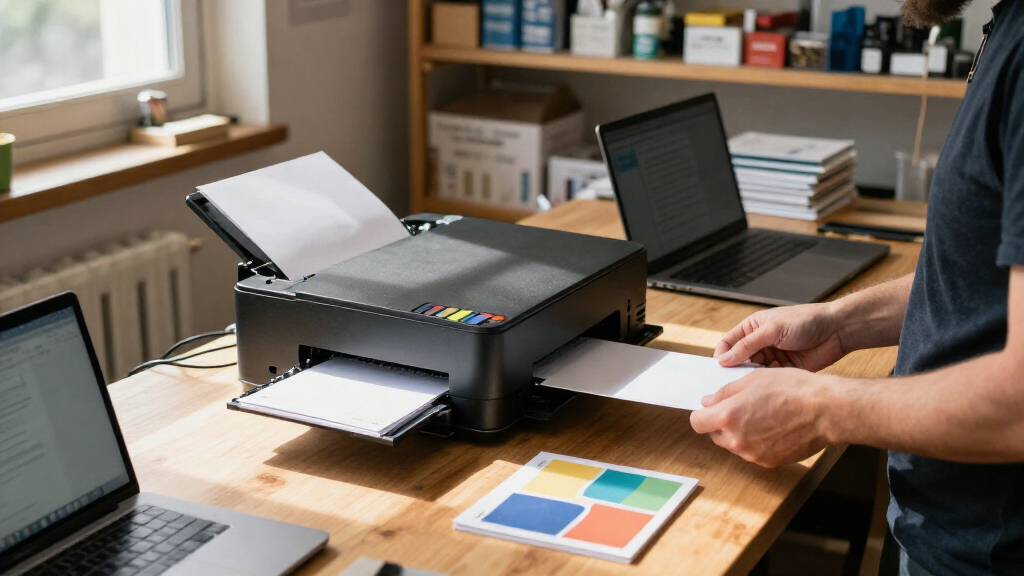
I ranked these products as printable supplies for branded business cards, not as machines. None is a standalone printer: each provides blank card stock that needs a compatible inkjet or laser printer, a design, and a print setup. That distinction matters because the most useful pick for a buyer is usually the paper that matches the printer already on the desk, rather than a card pack with attractive specifications that cannot run through that printer.
My order gives the lead position to the most balanced option for a common small-business workflow: an inkjet-compatible 250-card pack with double-sided printing, feed guidance, and design tools. I then weigh the laser-specific Avery pack against the dual-compatible Litpoetic stock. The former offers a named feed feature and Avery’s template support, while the latter is more flexible when printer type varies. The 90-card Avery pack fills a different need: a smaller inkjet run with Clean Edge separation, rather than a full recurring supply.
I also compare quantity and post-print finishing. A larger pack can suit repeat orders, but does not help a buyer who only needs a handful of cards. Perforations and Clean Edge or Sure Feed features can make the sheet-to-card process more manageable, yet every option still calls for separating cards after printing. I do not treat these features as proof of a particular print result; actual color, alignment, and feed behavior depend on the printer, settings, and design.
Finally, I favor clear compatibility claims and useful flexibility while treating limitations as real. The Avery 05371 is optimized for laser printers and may smear on inkjet machines; the two inkjet Avery options are not presented as universal stock. Litpoetic lists both inkjet and laser compatibility, but its product details do not name a feed-reliability feature. The rankings therefore reflect fit for a defined buyer, not a claim that one paper is best for every printer or brand identity.
| branded business card printer | Printer compatibility | Printing | Feed feature |
|---|---|---|---|
| Avery Printable Business Cards | Inkjet | Double-sided | Sure Feed |
| Avery Printable Business Cards | Laser printers | — | Sure Feed technology |
| 250 Blank Printable Business C | Inkjet and laser | Suitable for text and images on both sides | — |
| Avery Clean Edge Printable Bus | Inkjet | Two-sided | — |
Factors to Consider When Choosing Branded Business Card Printers
These products are sheets of blank, printable business cards, so the decision starts with your printer and ends with the kind of finishing work you are willing to do. I would narrow the choice in this order: printer compatibility, quantity, print layout, and separation. A card stock that matches your design but not your machine is not a useful branding tool.
Match the card stock to your printer
Check whether your machine is inkjet or laser before choosing a pack. Avery 08371 and Avery Clean Edge are specified for inkjet; Avery 05371 is optimized for laser and may smear with inkjet printing. Litpoetic lists both printer types, making it the most flexible option if equipment access changes. Even with a compatibility claim, consult your printer’s manual for supported paper weight and feed instructions, then follow the product template and sheet settings. Printer fit comes before brand design: it reduces the chance of choosing stock that does not suit your setup.
Choose a batch size that fits the job
The two 250-card Avery packs and the 250-card Litpoetic pack suit recurring use, networking events, or keeping a supply ready for new customers. Avery Clean Edge’s 90-card quantity is better for an occasional run, a small event, or a design trial. A large pack gives you more cards on hand but does not automatically make sense if your contact details may soon change. I’d weigh how quickly you expect to use the cards against the likelihood that your branding or information will be revised.
Decide whether double-sided printing matters
Two-sided printing can separate basic contact information from a logo, service list, QR code, or appointment details. Avery 08371 and Clean Edge explicitly support double-sided printing, and the Litpoetic description says its stock is suitable for printing on both sides. If your design is simple, a single-sided card may be enough; extra content can make a small card harder to scan quickly. Plan the layout at the actual 2 x 3.5-inch size, keep key information away from edges, and print a test sheet before committing the full batch.
Compare feed support and separation features
Sure Feed on the 250-card Avery packs is designed to improve feed reliability and alignment. That can matter when a sheet has several cards and a small shift would affect multiple designs, though it does not promise perfect results with every printer. Clean Edge is aimed at easy separation with smooth edges, while the Litpoetic stock uses micro-perforations. All of these require the buyer to separate cards after printing. If a finished, cut-card result with no home finishing is essential, printable sheets may not fit your workflow.
Consider paper weight and the impression you want
The Avery 250-card products list 80 lb / 216 gsm cardstock, while Litpoetic lists 170 gsm. The heavier specification may appeal if you want a more substantial hand, but paper weight alone does not decide how a finished card feels or prints; coating, printer capability, color settings, and handling also matter. Clean Edge is described as heavyweight, but its supplied details do not state a gsm value. I would compare the stated stock and your printer’s media limits rather than infer identical results across products.
Plan the design and test the alignment
A branded card has little room for clutter. Use a clear name or business name, one or two useful contact methods, and a logo that remains legible at card size. Avery’s templates can help users of its products start with the correct layout; Clean Edge also provides template number 28878. Before printing the full pack, check the matching template, select the proper paper type, and print a test. Confirm that text stays within safe margins and that both sides align as intended. A test page is a small step that can save a full sheet run.
Remember that printable cards need hands-on finishing
These are blank sheets, not completed cards. You need to create or adapt the design, print it, and separate each card. Perforated edges are intended to help, but the process still takes time and careful handling. If you need cards immediately, require very high volumes, or want finishing treatments beyond what a home printer supports, a commercial print service may be a better fit. For small business batches and frequent edits, printable stock offers more control over timing and content in exchange for that extra work.
Frequently Asked Questions
Are these products business card printers?
No. They are blank printable business card sheets, not printer machines. You need a compatible inkjet or laser printer, a design or template, and a way to separate the cards after printing. I would treat the printer compatibility listed for each product as a key selection point rather than assuming all four work in every machine.
Which option works with both inkjet and laser printers?
Litpoetic’s 250-card stock is the only product in this comparison specified for both inkjet and laser printers. Avery 08371 and Clean Edge are intended for inkjet, while Avery 05371 is optimized for laser and may smear in an inkjet printer. Check your printer’s supported media and settings before loading any card stock, especially if you have not printed on heavyweight sheets before.
Which product is best for double-sided branded cards?
Avery 08371 is my strongest all-around pick for an inkjet user who wants double-sided printing and a 250-card supply. Clean Edge also supports two-sided inkjet printing, but its 90-card quantity makes it a better match for a small run. Litpoetic is described as suitable for printing on both sides and offers broader printer compatibility, while buyers should verify their layout and printer setup before producing the full batch.
Do the cards come ready to hand out?
No. Each option supplies blank card stock that you personalize by printing or, where appropriate, handwriting. The cards are arranged on sheets and must be separated after printing. Avery lists Sure Feed technology on its 250-card packs and Clean Edge on its smaller pack; Litpoetic lists micro-perforations. These features are designed to assist feeding or separation, but they do not remove the need for finishing the cards yourself.
How should I choose between 90 and 250 cards?
Choose 90 cards if you only need a short run, are trying a design, or expect your contact details to change soon. Choose a 250-card pack if you distribute cards regularly or want a larger supply ready for customer and networking use. The smaller Avery Clean Edge pack is inkjet-only; the 250-card options include an inkjet Avery pack, a laser Avery pack, and dual-compatible Litpoetic stock, so printer fit should guide the final choice.
Conclusion
My recommendations follow the buyer’s setup rather than treating these sheets as interchangeable. For a regular inkjet workflow, I’d choose Avery 08371 for its 250-card supply, double-sided printing, Sure Feed feature, and Avery design tools. For a laser-only printer, Avery 05371 is the targeted option, provided you are comfortable separating the cards after printing. If your team uses different printer types or may change equipment, Litpoetic’s inkjet-and-laser compatibility is the deciding advantage, with lighter stated stock and no listed Sure Feed feature as the tradeoffs.
For an occasional short run, Avery Clean Edge makes more sense than buying a larger pack you may not use; its 90-card format and separation design suit limited needs. Whichever you pick, match the stock to the printer, use the correct template, and test alignment before printing the complete batch. These printable options offer control over your branded card design, but they all require your own printing and finishing.