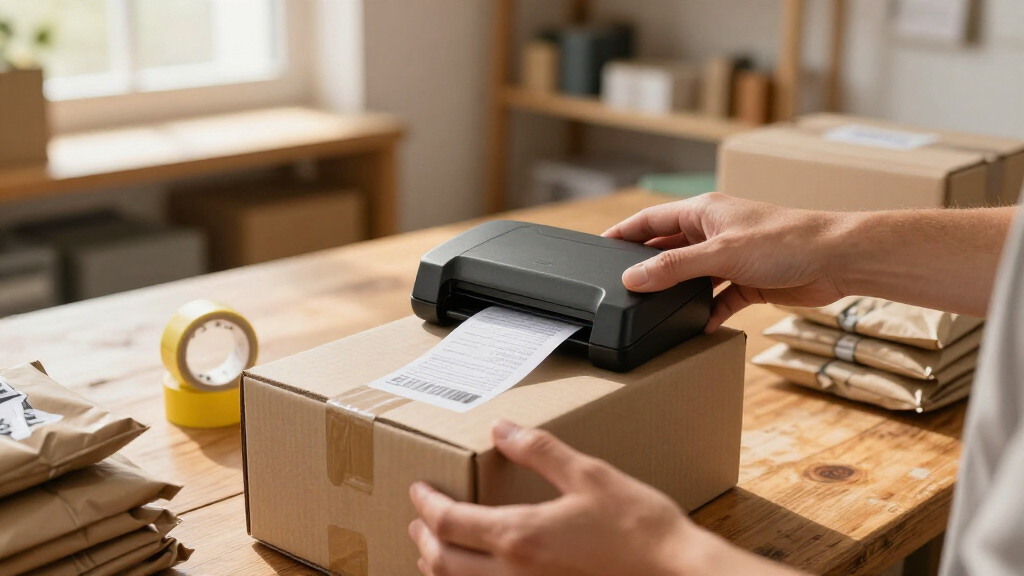
For most small businesses, the Phomemo M110 is my best overall pick because its portable thermal format and built-in display suit everyday product and organization labels. The KNAON 4×6 is a better fit for shipping workflows, while the Brother P-touch PT-D210 offers a keyboard-based option for buyers who want a straightforward setup. The main tradeoff is between dedicated 4×6 shipping printers and smaller label makers designed for varied short labels. I also weigh phone dependence, label format, and how much flexibility each device gives a growing business. Read on for how all 15 options compare and which one matches your work.
Key Takeaways
Shipping volume changes the shortlist: KNAON, NULLTONEX, Rongta RP425, and Phomemo 241BT are 4×6 shipping printer options, while most other picks handle smaller labels.
The M110 stands out for day-to-day flexibility: its display gives it a different role from phone-led models such as the M108 and P21.
Keyboard models reduce phone dependence: Brother PT-D210 and SUPVAN E11 offer physical typing, which can suit shared workspaces or users who prefer standalone input.
Included supplies vary: several bundles list tape or label rolls, but buyers should check the exact media format and compatibility before treating starter supplies as a long-term plan.
Portability has workflow limits: compact 2-inch models save space, but they cannot replace a 4×6 printer when a shipping carrier requires standard parcel labels.
| KNAON Portable 4×6 Thermal Shipping Label Printer, Bluetooth & USB, White |  | Best for Flexible Shipping Workflows | Printer type: Monochrome direct thermal, print only | Connectivity: Bluetooth and USB | Supported media width: 1.38 to 4.41 inches | VIEW LATEST PRICE | See Our Full Breakdown |
| NIIMBOT B1 Bluetooth Label Maker, 2-Inch Thermal Label Printer (Blue) |  | Best for Portable Inventory Labels | Printer type: Monochrome thermal | Label width: 2 inches | Print resolution: 203 dpi | VIEW LATEST PRICE | See Our Full Breakdown |
| Nelko P21 Bluetooth Label Maker, White |  | Best for Phone-Only Microbusinesses | Printing technology: Direct thermal | Print resolution: 203 dpi | Print color: Monochrome black text | VIEW LATEST PRICE | See Our Full Breakdown |
| Phomemo Bluetooth Thermal Label Printer 241BT with 20 Label Sheets |  | Best for High-Volume Shipping | Model: 241BT | Print technology: Direct thermal | Connectivity: Bluetooth and USB | VIEW LATEST PRICE | See Our Full Breakdown |
| Brother P-touch PT-D210 Label Maker Bundle with 4 Tapes |  | Best for Durable Narrow Labels | Model: PT-D210 | Tape widths: 3.5 mm, 6 mm, 9 mm, and 12 mm | Included tapes: Four black-on-white tapes: one sample and three full-length | VIEW LATEST PRICE | See Our Full Breakdown |
| TYPONOS PM240 Bluetooth Thermal Label Maker with 3 Label Rolls |  | Best for Batch Inventory Labels | Print method: Thermal, monochrome | Resolution: 203 DPI | Connectivity: Bluetooth and USB | VIEW LATEST PRICE | See Our Full Breakdown |
| Phomemo M108 Bluetooth Label Maker Machine, 2 Inch Portable Thermal Printer |  | Best for Frequent Mobile Printing | Print method: Thermal, black and white | Print width: 20–50mm (¾–2 inches) | Connectivity: Bluetooth 4.0 and USB-C | VIEW LATEST PRICE | See Our Full Breakdown |
| Phomemo M110 Portable Bluetooth Thermal Label Maker with Display |  | Best for Small Retail Labels | Print method: Thermal, monochrome | Label width: 20–50mm (0.78–2 inches) | Resolution: 203 dpi | VIEW LATEST PRICE | See Our Full Breakdown |
| NULLTONEX 4×6 Bluetooth Thermal Shipping Label Printer |  | Best for E-commerce Shipping | Print method: Direct thermal | Resolution: 203 DPI | Print speed: Up to 150mm/s (72 labels per minute) | VIEW LATEST PRICE | See Our Full Breakdown |
| Rongta RP425 Bluetooth Thermal Shipping Label Printer |  | Best for Mixed-Device Shipping Setups | Print method: Direct thermal | Resolution: 203 dpi | Print speed: Up to 150mm/s | VIEW LATEST PRICE | See Our Full Breakdown |
| SUPVAN T50M Pro Bluetooth Label Maker Machine with Tape, Black |  | Best for Custom Label Designs | Label width: 3/4–2 inches | Connectivity: Bluetooth | Fonts: 30+ | VIEW LATEST PRICE | See Our Full Breakdown |
| Ponek M100 Bluetooth Label Maker with Tape, 2-Inch, Black |  | Best for Mixed Phone and PC Workflows | Model: M100 | Connectivity: Bluetooth for Android and iOS; USB for PC | Printing technology: Direct thermal | VIEW LATEST PRICE | See Our Full Breakdown |
| Rongta R22 Bluetooth Thermal Label Maker |  | Best for Narrow Labels and Phone-Only Setups | Connectivity: Bluetooth | Compatible devices: iOS and Android phones and tablets | Label width range: 0.63–2.13 inches | VIEW LATEST PRICE | See Our Full Breakdown |
| NIIMBOT B2 Label Maker Machine with Tape for Home Office, Green White |  | Best for Shared Small-Business Teams | Printer type: Thermal, inkless | Print resolution: 203 DPI | Label width support: 20–50 mm | VIEW LATEST PRICE | See Our Full Breakdown |
| SUPVAN E11 Keyboard & Bluetooth Label Maker Machine with 4 Tapes |  | Best for Standalone Quick Labels | Battery: 1,200 mAh rechargeable | Battery life: Up to 1 month per charge | Weight: 0.5 lb | VIEW LATEST PRICE | See Our Full Breakdown |
| portable label makers for small business | Connectivity | Weight |
|---|---|---|
| KNAON Portable 4×6 Thermal Shi | Bluetooth and USB | — |
| NIIMBOT B1 Bluetooth Label Mak | Bluetooth and USB | 293 g |
| Nelko P21 Bluetooth Label Make | Bluetooth | — |
| Phomemo Bluetooth Thermal Labe | Bluetooth and USB | — |
| Brother P-touch PT-D210 Label | — | — |
| TYPONOS PM240 Bluetooth Therma | Bluetooth and USB | 207g |
| Phomemo M108 Bluetooth Label M | Bluetooth 4.0 and USB-C | 184g |
| Phomemo M110 Portable Bluetoot | Bluetooth 4.0, up to 33 ft | 222.8g |
| NULLTONEX 4×6 Bluetooth Therma | Bluetooth and USB | — |
| Rongta RP425 Bluetooth Thermal | Bluetooth and USB Type-C | 0.65kg |
| SUPVAN T50M Pro Bluetooth Labe | Bluetooth | — |
| Ponek M100 Bluetooth Label Mak | Bluetooth for Android and iOS; USB for PC | 0.6 pounds |
| Rongta R22 Bluetooth Thermal L | Bluetooth | 250 g |
| NIIMBOT B2 Label Maker Machine | Bluetooth and USB | 352 g |
| SUPVAN E11 Keyboard & Bluetoot | — | 0.5 lb |
More Details on Our Top Picks
KNAON Portable 4×6 Thermal Shipping Label Printer, Bluetooth & USB, White
Wide label support and broad device compatibility make the KNAON a strong fit for small sellers who print shipping labels alongside price tags or other wider labels. It handles media up to 4.41 inches and connects by Bluetooth or USB across phones and several computer systems. Its templates and icons also give it more design flexibility than the shipping-focused Phomemo 241BT. The tradeoff is a less direct workflow: wireless printing goes through the FlashLabel Pro app, and shipping PDFs must be imported there. ChromeOS also needs a separate extension. I’d choose this when a compact printer needs to serve several labeling jobs; sellers who want a simpler shipping setup may prefer a model with a more straightforward print flow.
Pros:- Supports 4×6 shipping labels and media up to 4.41 inches wide
- Bluetooth and USB connectivity across phones, tablets, and multiple computer systems
- Templates and icons support custom labels beyond shipping
- Compact body is easy to store between packing sessions
Cons:- Bluetooth printing requires the FlashLabel Pro app
- Shipping PDFs must be saved and imported into the app
- ChromeOS requires a separate browser extension
Best for: Small online sellers who print 4×6 shipping labels and occasional price, inventory, or DIY labels from different devices
Not ideal for: Sellers who want to send shipping labels directly to a printer without importing PDFs into a companion app
- Printer type:Monochrome direct thermal, print only
- Connectivity:Bluetooth and USB
- Supported media width:1.38 to 4.41 inches
- Shipping label format:4×6 inches supported
- Print resolution:203 dpi
- Print speed:Up to 180 mm/s
- Dimensions:7.3 x 2.56 x 3.15 inches
- Required app:FlashLabel Pro
Our verdict“Choose the KNAON if one compact printer needs to handle shipping and varied small-business labels across several devices.”
NIIMBOT B1 Bluetooth Label Maker, 2-Inch Thermal Label Printer (Blue)
For a seller who needs small inventory, shelf, or packaging labels away from a desk, the NIIMBOT B1 pairs a rechargeable battery with a compact 2-inch format. Its app detects label size and offers plenty of text and symbol options, so routine labeling can be handled from an iOS or Android phone. That makes it more self-contained on the move than the USB-connected Brother PT-D210, though the Brother works without a phone and supports laminated tape. The B1’s narrow media is the key limit: it is not a 4×6 shipping-label printer, and it does not support tablets. I’d pick it for portable product organization, but sellers building shipping workflows should look to the KNAON or Phomemo 241BT instead.
Pros:- Rechargeable 1500 mAh battery supports portable use
- App detects label size and offers fonts, borders, and symbols
- Bluetooth works with iOS and Android phones
- USB connection supports PC use with a separate driver
Cons:- Two-inch label width does not suit standard 4×6 shipping labels
- Not compatible with tablets
- PC setup requires a manufacturer driver download
Best for: Market vendors and small retailers who need phone-based inventory, shelf, or product labels at changing work locations
Not ideal for: Online sellers printing 4×6 shipping labels or teams that need tablet support
- Printer type:Monochrome thermal
- Label width:2 inches
- Print resolution:203 dpi
- Connectivity:Bluetooth and USB
- Compatible devices:iOS and Android phones; PC via USB
- Battery:Rechargeable 1500 mAh with 15-minute auto-shutoff
- Dimensions:2.4 x 3.6 x 5.2 inches
- Weight:293 g
- Included labels:Two 1.18-inch white label rolls
Our verdict“Choose the NIIMBOT B1 for phone-based product and inventory labels on the go, provided you do not need shipping-size labels.”
Nelko P21 Bluetooth Label Maker, White
The Nelko P21 is designed around a phone-first workflow: its small fixed-length labels suit quick marks for bins, product batches, or packaging details, and the rechargeable body can move between work areas. Its app has an extensive library of icons, templates, and materials, giving it more label-design variety than the simpler NIIMBOT B1 app offerings described here. The limits matter for business use, though. The P21 works only with iOS and Android phones, has no continuous tape, and cannot print from a computer. That makes it less adaptable than the Brother PT-D210 for varied tape lengths or the shipping-capable KNAON. I’d reserve it for a phone-based microbusiness with predictable, short label formats.
Pros:- Compact rechargeable design is easy to carry between work areas
- Direct thermal printing avoids ink and toner
- App includes templates, icons, borders, and multiple languages
- Several fixed label lengths suit repeatable small labeling tasks
Cons:- Does not work with computers
- Does not support continuous label tape
- Charging adapter is not included
Best for: Solo makers who use an iPhone or Android phone to print short, fixed-size labels for products, bins, or packaging
Not ideal for: Businesses that print from computers, need continuous tape, or produce 4×6 shipping labels
- Printing technology:Direct thermal
- Print resolution:203 dpi
- Print color:Monochrome black text
- Connectivity:Bluetooth
- Compatible devices:iOS and Android phones
- Label sizes:Fixed lengths including 14 x 40 mm, 14 x 50 mm, and 14 x 75 mm
- Battery:Built-in rechargeable
- Computer compatibility:Not compatible
Our verdict“Choose the Nelko P21 for short, repeatable labels made from a phone, and skip it if your workflow depends on computers or flexible tape lengths.”
Phomemo Bluetooth Thermal Label Printer 241BT with 20 Label Sheets
When a small business ships orders regularly, the 241BT’s 4×6 support and stated speed of up to 72 sheets per minute put the focus on getting parcels labeled efficiently. It accepts labels from 1 to 4.6 inches wide and connects wirelessly to phones or by USB to common computer systems. Compared with the more app-dependent KNAON, the Phomemo offers a broad device range and a defined shipping-oriented workflow; the KNAON, by contrast, lists a wider set of DIY templates and icons. Both are monochrome thermal printers, so this is a practical packing tool rather than a color product-label solution. The package includes 20 sheets, while best results call for genuine Phomemo paper. PC printing also requires a separate driver.
Pros:- Supports 4×6 shipping labels and media widths from 1 to 4.6 inches
- Bluetooth and USB support phones and several computer systems
- Direct thermal printing requires no ink or toner
- Includes 20 label sheets
Cons:- Prints black and white only
- PC printing requires downloading a separate driver
- Best results are specified with genuine Phomemo label paper
Best for: Small e-commerce teams printing batches of 4×6 carrier labels from phones or computers
Not ideal for: Businesses that need color labels, long-term archival labels, or a driver-free PC setup
- Model:241BT
- Print technology:Direct thermal
- Connectivity:Bluetooth and USB
- Compatible systems:iOS, Android, Windows, Mac OS, Chrome OS, and Linux
- Label width:1 to 4.6 inches
- Print speed:150 mm/s
- Print color:Black and white
- Included labels:20 sheets
Our verdict“Choose the Phomemo 241BT if shipping-label batches are your main need and monochrome output fits your workflow.”
Brother P-touch PT-D210 Label Maker Bundle with 4 Tapes
The PT-D210 takes a different approach from the Bluetooth thermal printers: it has a built-in display and physical controls, and prints onto Brother TZe laminated tape. For a small business labeling equipment, storage, or supplies, that can be more useful than the app-based portability of the NIIMBOT B1, especially when water and fading resistance matter. Its four included black-on-white tapes help get a basic labeling setup started, and fonts, frames, and symbols allow some customization. The tradeoff is format and power: tape tops out at 12 mm, so this cannot replace the KNAON or Phomemo 241BT for shipping labels. It also needs six AAA batteries, sold separately, or an optional AC adapter. I’d choose it for durable organization labels, not high-volume parcel output.
Pros:- Laminated TZe tape is described as water-resistant and fade-resistant
- Display preview and physical controls allow standalone label creation
- Includes four black-on-white tapes
- Offers 14 fonts, 98 frames, and more than 600 symbols
Cons:- Six AAA batteries are sold separately
- Optional AC adapter and protective case add separate equipment needs
- Tape width is limited to 12 mm, so it cannot print shipping labels
Best for: Small shop owners labeling tools, storage, and supplies with narrow laminated tape, including in areas where labels may get wet
Not ideal for: Online sellers who need 4×6 shipping labels or workers seeking a rechargeable Bluetooth phone printer
- Model:PT-D210
- Tape widths:3.5 mm, 6 mm, 9 mm, and 12 mm
- Included tapes:Four black-on-white tapes: one sample and three full-length
- Fonts:14
- Styles:10
- Frames:98
- Symbols:Over 600
- Power:Six AAA batteries sold separately or optional AD-24 AC adapter
Our verdict“Choose the Brother PT-D210 for durable narrow labels created directly on the device, rather than for shipping or phone-based workflows.”
TYPONOS PM240 Bluetooth Thermal Label Maker with 3 Label Rolls
The TYPONOS PM240 suits small shops that need to make batches of product or storage labels from a phone or computer. Its app supports Excel import and batch printing, which can cut repetitive entry when labeling stock, while OCR and templates give a small operator more ways to build labels without desktop design software. Compared with the Phomemo M110, the PM240 includes three differently shaped rolls and RFID size detection, making it easier to switch among those supplied label types. That convenience comes with a supply constraint: reliable detection and print quality depend on compatible TYPONOS labels. It prints monochrome only, and the power adapter is not included. The compact 207g body and rechargeable battery support moving between work areas, though the 100-day figure is standby time, not a measure of active printing.
Pros:- Excel import and batch printing help process lists of products or inventory
- Includes three rolls in different sizes and shapes
- Bluetooth and USB connections support mobile and PC workflows
- Rechargeable, 207g design is easy to move around a counter or stockroom
Cons:- Monochrome output cannot reproduce colored logos or label designs
- Reliable size detection and print quality depend on compatible TYPONOS labels
- Power adapter is not included
Best for: Small retailers who regularly print batches of product, shelf, or inventory labels from spreadsheets.
Not ideal for: Businesses needing color branding, broad third-party media flexibility, or a power adapter in the box.
- Print method:Thermal, monochrome
- Resolution:203 DPI
- Connectivity:Bluetooth and USB
- Compatible label sizes:1–2 inches; square, round, and transparent labels
- Battery:1500mAh rechargeable
- Standby time:Up to 100 days
- Weight:207g
- Included labels:Three rolls: 40 × 30 mm white, 50 × 80 mm white, and 50 × 50 mm round pink
Our verdict“Choose the PM240 if spreadsheet-based batch labeling and its included mix of label rolls matter more than flexible label sourcing or color output.”
Phomemo M108 Bluetooth Label Maker Machine, 2 Inch Portable Thermal Printer
For a small business owner printing labels throughout the day, the Phomemo M108 pairs a light 184g body with a stated capacity of up to 6,000 prints per charge. That makes it a stronger fit for a mobile packing station or shared work area than a printer whose listing emphasizes standby time, such as the TYPONOS PM240. Its 20–50mm print width handles compact product and organization labels, and Bluetooth plus USB-C gives phone and computer users a wired option. The Print Master app adds templates, OCR, and voice input, which can speed up basic label creation. The tradeoff is a strict two-inch ceiling: it cannot replace a 4×6 shipping printer like the NULLTONEX. Output is black and white, and thermal labels may fade over time.
Pros:- Lightweight 184g design is convenient for moving between workstations
- Rated for up to 6,000 prints per charge
- Bluetooth and USB-C support phones and computers
- App includes templates, OCR, and voice input
Cons:- Maximum 50mm width rules out standard 4×6 shipping labels
- Black-and-white printing limits branded label designs
- Thermal labels can fade over time
Best for: Market sellers and small retailers who print many narrow product or stock labels away from a fixed desk.
Not ideal for: Online sellers who need 4×6 carrier labels or businesses whose labels must retain color or resist fading over long periods.
- Print method:Thermal, black and white
- Print width:20–50mm (¾–2 inches)
- Connectivity:Bluetooth 4.0 and USB-C
- Battery:1200mAh rechargeable
- Weight:184g
- Compatible devices:Android, iOS, Chrome OS, Mac OS 10+, and Windows 7+
- Included labels:40 × 30mm thermal labels, 100 pieces
Our verdict“Pick the M108 for frequent, portable printing of narrow business labels, and choose a 4×6 model if shipping labels are your main job.”
Phomemo M110 Portable Bluetooth Thermal Label Maker with Display
The Phomemo M110 is aimed at small businesses that need compact labels for products, office supplies, or retail organization rather than parcel dispatch. Its 20–50mm media width covers many shelf and item labels, while the Print Master app’s Excel batch printing and OCR can help turn lists or photographed text into print-ready content. That makes it more useful for varied small-label tasks than a dedicated 4×6 machine such as the NULLTONEX, which is built around shipping. The M110 also connects over Bluetooth and weighs about 223g, so it is easy to carry between a sales floor and back room. It remains monochrome and is explicitly not intended for shipping labels. Some templates, icons, and fonts require a paid membership, which can limit the app’s appeal if you want its full design library.
Pros:- 20–50mm label range suits many compact retail and stockroom uses
- Excel batch printing and OCR support faster label preparation
- Bluetooth connection works with phones, tablets, laptops, and PCs
- Compact 222.8g body is portable between work areas
Cons:- Not intended for shipping labels
- Monochrome output cannot print color branding
- Some templates, icons, and fonts require a paid membership
Best for: Independent retailers who need app-created product, shelf, and office labels in sizes up to two inches.
Not ideal for: E-commerce sellers focused on carrier shipping labels, or users who want every app design feature without a membership.
- Print method:Thermal, monochrome
- Label width:20–50mm (0.78–2 inches)
- Resolution:203 dpi
- Connectivity:Bluetooth 4.0, up to 33 ft
- Battery:1500mAh
- Weight:222.8g
- Control method:Companion app
- Warranty:Limited
Our verdict“The M110 fits small retailers who value flexible app-made item labels, while shipping-focused sellers should choose a wider printer.”
NULLTONEX 4×6 Bluetooth Thermal Shipping Label Printer
When a small business’s main label workload is outbound parcels, the NULLTONEX 4×6 is the clearest fit in this group. It accepts labels up to 4.3 inches wide and lists compatibility with Amazon, Shopify, Etsy, and major carriers, so it can handle standard shipping labels that the two-inch Phomemo M108 cannot. The stated speed of up to 150mm/s is useful when orders are moving in batches, and Bluetooth or USB gives a choice between mobile and computer workflows. Its direct thermal method avoids ink and toner, but the output remains black and white. Mobile Bluetooth printing requires the FlashLabel Pro app, adding a software step for phone-first sellers. It can also print narrower labels, but its broad media capacity is less specialized for the small retail stickers that the Phomemo M110 targets.
Pros:- Supports standard 4×6 shipping labels and widths from 1.57 to 4.3 inches
- Works with listed marketplaces and major shipping carriers
- Bluetooth and USB provide mobile and computer connection options
- Includes 25 sheets of 4×6 thermal labels
Cons:- Bluetooth printing requires the FlashLabel Pro app
- Black-and-white output does not support color branding
- Its shipping-oriented format is less tailored to very small retail labels than the Phomemo M110
Best for: Small online shops printing 4×6 parcel labels for orders from marketplaces and carrier services.
Not ideal for: Retailers focused on small product stickers, color labels, or Bluetooth printing outside the FlashLabel Pro app.
- Print method:Direct thermal
- Resolution:203 DPI
- Print speed:Up to 150mm/s (72 labels per minute)
- Connectivity:Bluetooth and USB
- Supported label width:1.57–4.3 inches
- Maximum label size:4×6 inches
- Included media:25 sheets of 4×6 thermal labels
- Color output:Black and white
Our verdict“Choose the NULLTONEX if parcel labels are central to your order workflow and you are comfortable using its app for Bluetooth printing.”
Rongta RP425 Bluetooth Thermal Shipping Label Printer
The Rongta RP425 makes sense for a small business that prints shipping labels from a mix of phones and computers. It supports iOS and Android over Bluetooth, plus Windows, Mac, and Chrome OS, and its 0.98–4.37-inch media range covers both narrow labels and the 4×6 shipping format. Compared with the NULLTONEX, the RP425 lists wider computer operating-system compatibility and automatic label identification and feeding, which can reduce manual setup when switching rolls. Both are monochrome thermal printers with 203 dpi resolution and speeds up to 150mm/s. Mobile Bluetooth printing requires the RONGTA app, so it is less convenient for teams that prefer one shared print workflow. The listed dimensions also conflict between the description and product information, making its precise footprint unclear for a crowded packing bench.
Pros:- Supports phones, tablets, and several computer operating systems
- Media width from 0.98 to 4.37 inches includes 4×6 shipping labels
- Automatic label identification and feeding can simplify roll changes
- Prints at up to 150mm/s with 203 dpi resolution
Cons:- Bluetooth printing from mobile devices requires the RONGTA app
- Monochrome thermal output does not support color labels
- Product data lists conflicting dimensions, so the footprint is uncertain
Best for: Small shipping teams that print from both mobile devices and a mix of Windows, Mac, or Chrome OS computers.
Not ideal for: Buyers who need verified physical dimensions before fitting a printer into a tight workspace, or who want app-free mobile printing.
- Print method:Direct thermal
- Resolution:203 dpi
- Print speed:Up to 150mm/s
- Label width:0.98–4.37 inches
- Maximum media size:4×6 inches
- Connectivity:Bluetooth and USB Type-C
- Compatible systems:iOS, Android, Windows 7+, Mac OS 10.11+, and Chrome OS
- Weight:0.65kg
Our verdict“The RP425 is a flexible pick for mixed-device shipping teams, provided its app requirement and unclear listed dimensions suit your setup.”
SUPVAN T50M Pro Bluetooth Label Maker Machine with Tape, Black
The SUPVAN T50M Pro suits small shops that want branded-looking labels for files, cables, jewelry, or packaging without keeping ink in stock. Its app offers 30+ fonts, 50+ frames, and 660+ icons, and it handles several label shapes, giving it more design range than the keyboard-led SUPVAN E11. The free app requires no registration, which makes setup simpler for staff who just need to make a label. Its 3/4-to-2-inch tape range is useful for product details and shelf organization, though it cannot handle wider shipping labels. The tradeoff is phone, tablet, or PC dependence: unlike the E11, it has no built-in keyboard for quick standalone typing. I’d choose it when design flexibility matters more than on-device operation.
Pros:- Free companion app does not require registration
- Supports square, round, address, cable, jewelry, and file label formats
- Large selection of fonts, frames, and icons for customized labels
- Thermal printing needs no ink or toner
Cons:- Requires a smartphone, tablet, or PC to operate
- Maximum label width of 2 inches rules out standard wide shipping labels
Best for: Small retailers and makers who create varied product, jewelry, cable, and file labels from a phone or tablet
Not ideal for: Businesses that need wide shipping labels or want to type directly on the printer without a connected device
- Label width:3/4–2 inches
- Connectivity:Bluetooth
- Fonts:30+
- Frames:50+
- Icons:660+
- Ink or toner:Not required
- App registration:Not required
- Color:Black
Our verdict“Choose the T50M Pro if your small business needs flexible, customized labels and already has a device ready for app-based printing.”
Ponek M100 Bluetooth Label Maker with Tape, 2-Inch, Black
The Ponek M100 is the most flexible fit here for a small business that switches between mobile label design and desktop work. It connects to Android and iOS over Bluetooth and to PCs by USB, while the Rongta R22 is phone-and-tablet only. Its 203 DPI output and 20 mm/s speed are suited to routine product, inventory, and barcode labels, and the app supports QR codes as well. At 0.6 pounds, it is easy to carry between a counter and stockroom. The stated capacity of up to 4,200 labels per charge can reduce interruptions during batch work, though actual results depend on use. One limitation is that some app templates require a premium membership, and it needs charging before first use. I’d favor it when computer compatibility matters more than offline controls.
Pros:- Bluetooth support for Android and iOS plus USB connection to PCs
- Print Master app includes barcode and QR code options
- Lightweight at 0.6 pounds for moving between work areas
- Thermal printing requires no ink or toner
Cons:- Some app templates require a premium membership
- Must be charged before first use
Best for: Small business owners who design labels on phones but also need to print from a Windows PC
Not ideal for: Teams seeking a ready-to-use device straight out of the box or fully unrestricted access to every app template
- Model:M100
- Connectivity:Bluetooth for Android and iOS; USB for PC
- Printing technology:Direct thermal
- Supported label width:0.78–2 inches
- Print resolution:203 DPI
- Print speed:20 mm/s
- Labels per charge:Up to 4,200
- Weight:0.6 pounds
- Software:Print Master app; Labelife PC software
Our verdict“Pick the M100 if your labeling workflow spans phones and PCs and you can work around membership-gated templates.”
Rongta R22 Bluetooth Thermal Label Maker
The Rongta R22 starts at 0.63-inch label width, giving small businesses room to print narrow identifiers for cables, small containers, or compact inventory. That range is broader at the narrow end than the Ponek M100, which starts at 0.78 inches, while the R22 also reaches 2.13 inches. Its 250 g body and rechargeable battery make it practical to carry around a shop, and the RONGTA app provides templates and design controls from iOS or Android. The cost of that focused mobile setup is clear: it does not connect to computers, and its output is black and white only. Charging takes 3.5 hours, and no adapter is included. I’d choose it for phone-based labeling where narrow formats matter more than desktop support.
Pros:- Supports label widths from 0.63 to 2.13 inches
- Lightweight 250 g design is easy to carry
- App includes fonts, icons, borders, and templates
- Rechargeable thermal printer needs no ink or toner
Cons:- Does not work with computers
- Prints only in black and white
- Charging adapter is not included
Best for: Mobile-first sellers and workshop teams who need narrow cable or small-item labels from iOS or Android devices
Not ideal for: Businesses that print from computers, need color output, or want a charging adapter included
- Connectivity:Bluetooth
- Compatible devices:iOS and Android phones and tablets
- Label width range:0.63–2.13 inches
- Print resolution:203 dpi
- Printing:Black-and-white thermal
- Battery capacity:1,500 mAh
- Continuous printing runtime:Up to 4 hours
- Charging time:3.5 hours
- Weight:250 g
Our verdict“Choose the R22 for portable, phone-based work that benefits from narrow labels, provided desktop printing is not part of your workflow.”
NIIMBOT B2 Label Maker Machine with Tape for Home Office, Green White
The NIIMBOT B2 stands out for small businesses where several people need to print recurring labels. It supports up to 10 phones and has one-button offline printing for dates, records, and templates, so a worker can repeat common tasks without building each label in the app. Its Bluetooth and USB connections cover phones and Windows PCs, while supported label materials include white, colored, round, and transparent stock. Compared with the SUPVAN T50M Pro, the B2 adds offline controls and Windows support, but its iPad incompatibility narrows device choice. At 352 g, it remains portable, though its monochrome output is a limit for businesses that rely on color coding. I’d put it ahead for shared, repeatable shop tasks, not elaborate color labeling.
Pros:- One-button offline printing for dates, records, and templates
- Connects by Bluetooth or USB and supports up to 10 phones
- Works with label widths from 20 to 50 mm and several label materials
- Portable 352 g body with rechargeable power
Cons:- Incompatible with iPad
- USB printing requires driver installation
- Monochrome output cannot provide color-coded labels
Best for: Small retail, school, and office teams that share a printer and repeat date, record, or template labels
Not ideal for: Businesses whose staff primarily use iPads or need color printing for product identification
- Printer type:Thermal, inkless
- Print resolution:203 DPI
- Label width support:20–50 mm
- Weight:352 g
- Dimensions:4.96 × 3.58 × 2.64 inches
- Connectivity:Bluetooth and USB
- Compatible devices:iOS, Android, and Windows PC; incompatible with iPad
- Multi-device support:Up to 10 phones
- Output:Monochrome
Our verdict“Choose the B2 if multiple staff need to print recurring labels from supported phones or Windows PCs, and monochrome output is sufficient.”
SUPVAN E11 Keyboard & Bluetooth Label Maker Machine with 4 Tapes
The SUPVAN E11 is the easiest pick in this group for quick labels when pulling out a phone would slow a task down: its built-in keyboard handles direct entry, while Bluetooth app editing adds more options when needed. That combination gives it a practical advantage over the app-dependent SUPVAN T50M Pro for a back room where staff make frequent, simple labels. It is compact at 0.5 pounds, and the 0.2-inch margins leave less blank tape around each print. Its battery is rated for up to a month per charge, though real life will vary with use. The tradeoff is that advanced customization still depends on the app, and tapes remain consumables. I’d choose it for routine shelf, pantry, garage, or file labels rather than wider business shipping labels.
Pros:- Built-in keyboard prints without a phone connection
- Bluetooth app offers 30+ fonts, 50+ frames, and 660+ icons
- Compact 0.5-pound design is easy to carry
- 0.2-inch print margins reduce unused tape
Cons:- Label tapes must be replenished as consumables
- Advanced customization requires the companion app
Best for: Small shop operators and makers who frequently print short text labels and want a built-in keyboard for fast entry
Not ideal for: Businesses that need labels wider than the supported tape format or depend on app-free access to advanced layouts
- Battery:1,200 mAh rechargeable
- Battery life:Up to 1 month per charge
- Weight:0.5 lb
- Dimensions:5.7 × 2.9 × 1.3 inches
- Print margin:0.2 inches
- Input and connectivity:Built-in keyboard and Bluetooth app
- App features:30+ fonts, 50+ frames, 660+ icons, 17 languages
- Included:4 tapes
- Label compatibility:Continuous and die-cut labels
Our verdict“Pick the E11 if you value fast standalone typing for routine narrow labels and want app editing available when you need it.”
How We Picked
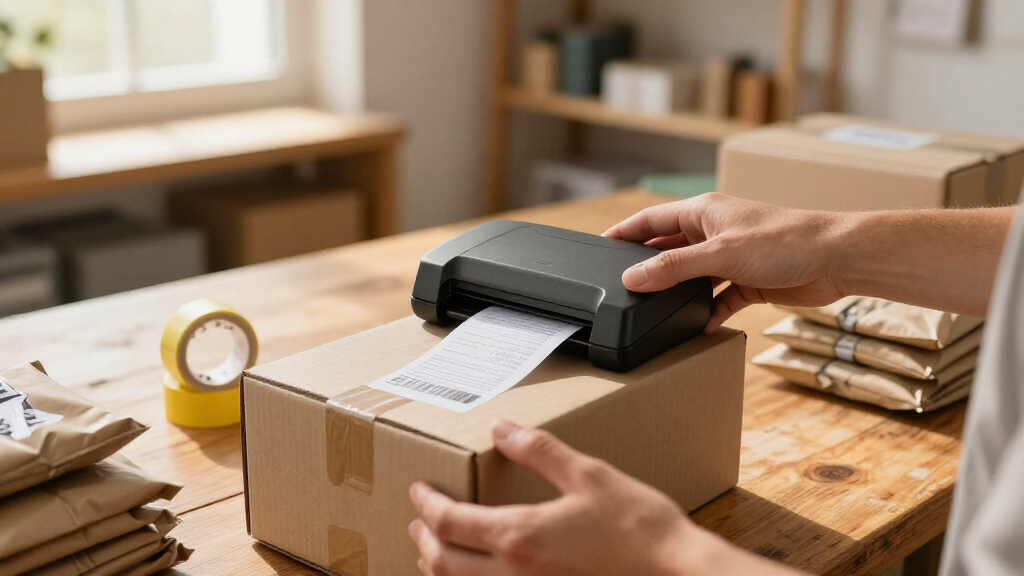
I ranked these models for the jobs small businesses commonly need to handle at a counter, packing table, market stall, or shared office: shipping parcels, labeling products, organizing stock, and making repeatable identification labels. I gave weight to the label formats each device supports, how it connects and accepts input, its stated portability, and whether the listing includes starter media. A compact printer may be easy to move, but that alone does not make it a good fit for a business that prints carrier labels all day.
The order reflects practical fit and versatility across small-business tasks, with specialized shipping printers grouped behind the strongest general-purpose choice unless the buyer’s main need is 4×6 output. Models with keyboard input offer a useful alternative to phone-led printing, while display-equipped and bundled options may simplify particular workflows. Product listings do not establish long-run durability, print speed under sustained use, or full compatibility with every app and label roll, so I treat those as points for buyers to verify before choosing.
| portable label makers for small business | Connectivity |
|---|---|
| KNAON Portable 4×6 Thermal Shi | Bluetooth and USB |
| NIIMBOT B1 Bluetooth Label Mak | Bluetooth and USB |
| Nelko P21 Bluetooth Label Make | Bluetooth |
| Phomemo Bluetooth Thermal Labe | Bluetooth and USB |
| Brother P-touch PT-D210 Label | — |
| TYPONOS PM240 Bluetooth Therma | Bluetooth and USB |
| Phomemo M108 Bluetooth Label M | Bluetooth 4.0 and USB-C |
| Phomemo M110 Portable Bluetoot | Bluetooth 4.0, up to 33 ft |
| NULLTONEX 4×6 Bluetooth Therma | Bluetooth and USB |
| Rongta RP425 Bluetooth Thermal | Bluetooth and USB Type-C |
| SUPVAN T50M Pro Bluetooth Labe | Bluetooth |
| Ponek M100 Bluetooth Label Mak | Bluetooth for Android and iOS; USB for PC |
| Rongta R22 Bluetooth Thermal L | Bluetooth |
| NIIMBOT B2 Label Maker Machine | Bluetooth and USB |
| SUPVAN E11 Keyboard & Bluetoot | — |
Factors to Consider When Choosing Portable Label Makers For Small Business
I’d start with the label job that causes the most friction in your business, then check the device’s media and connection requirements against that workflow. A small printer can be useful in many settings, but the wrong format or app dependency can add extra steps every time you print.
Match the Printer to Your Main Label Size
Start with the dimensions of the label you need to produce most often, not the printer’s headline claim of portability. Standard 4×6 parcel labels call for a shipping printer such as the KNAON, NULLTONEX, or Rongta RP425; smaller product, shelf, and bin labels point toward compact models like the NIIMBOT B1 or Phomemo M110. A business that ships occasionally and labels products daily may need to decide which task deserves the dedicated device. Trying to use a small-format maker for shipping can leave you with awkward workarounds, while a 4×6 unit can take up unnecessary space for tiny labels. Check that your shipping platform can send the right label format before buying.
Check Media Compatibility Before Ordering
Label makers can use different widths, roll formats, and proprietary media, so an included starter roll does not prove that ongoing supplies will be easy to source. Before committing, find the printer’s supported label dimensions and confirm that the exact rolls or sheets you plan to buy fit its feed system. This matters most when you rely on a specific material, adhesive, or label shape for packaging. A low-effort setup with a supplied roll may be handy at first, but recurring supply constraints can interrupt a busy packing day. Keep a sample of your current labels nearby while comparing specifications.
Choose an Input Method That Fits Your Team
Bluetooth models usually shift label design and printing to a phone app, while keyboard-equipped options such as the Brother PT-D210 and SUPVAN E11 provide physical typing. App-based control can make it easier to adjust templates or print from a mobile device, but it adds a phone and app to the workflow. A keyboard can be more direct for simple text labels, though it may be less convenient for a team already managing designs on phones. In a shared workspace, decide who will own the app account, template library, and device pairing before several people depend on it. Verify supported phones and operating systems as part of that decision.
Account for Repeat Work, Not Just Portability
Moving a printer between a desk, stall, and packing bench is useful only if setup stays manageable in each location. Think through where the printer will sit, how labels feed from a roll, and whether there is enough room to store media and keep charging or connection routines simple. A compact model may suit mobile work, while a stationary packing station can benefit more from a dedicated shipping unit. For recurring tasks, a saved template can reduce retyping and help keep labels consistent across staff. Before purchase, check whether the software supports the templates and fields your routine actually needs.
Decide Whether Thermal or Tape Labels Suit the Job
Thermal printing avoids ink cartridges, which can simplify the supply list, but the finished label and available media still need to suit the surface and environment. Tape-based makers such as the Brother PT-D210 or SUPVAN T50M Pro may be better for durable identification and organization tasks than for high-volume parcel dispatch. Consider whether labels face sunlight, moisture, handling, or long storage, and look for media specifications that address those conditions. Do not assume every thermal label has the same resistance or lifespan. If a label supports compliance or product information, confirm legibility and retention requirements before standardizing on a format.
Pay for the Capability You Will Use
A premium feature is only useful when it removes a real bottleneck, such as reducing phone handling or making a recurring print task easier. Compare the cost of the printer, compatible media, and any required app or workflow setup over the period you expect to use it. A bundle with several rolls may lower the effort of getting started, but it should not outweigh long-term media fit. For occasional inventory labels, a compact basic model may cover the job without extra controls. For daily shipping, prioritize correct 4×6 output and platform compatibility before convenience features.
Frequently Asked Questions
Can a 2-inch label maker print the shipping labels my carrier requires?
Usually, a compact 2-inch model is intended for smaller labels and cannot substitute for a printer that supports standard 4×6 shipping labels. Check the carrier or shipping platform’s required label dimensions before ordering. In this lineup, KNAON, NULLTONEX, and Rongta RP425 are among the products listed as 4×6 shipping printers. If you also need product labels, you may prefer a separate compact maker rather than resizing shipping labels and risking unreadable barcodes.
Should I choose a Bluetooth model or one with a built-in keyboard?
Choose based on who will create labels and how often designs change. Bluetooth models suit teams that already work from phones and want app-led templates, while keyboard models can handle straightforward text without relying on a phone for every print. A keyboard may help at a shared packing station, but it can be less convenient for more involved layouts. Check whether the app works on your devices and whether the printer can be shared across staff before deciding.
Are the included labels or tapes enough to judge ongoing supply costs?
No. Included media shows what may come in the box, but it does not tell you how easy it will be to source compatible replacements or whether the material suits your products. Confirm supported widths, roll or tape format, adhesive type, and any restrictions on third-party supplies. If you print every day, estimate recurring media needs using your typical weekly volume. That check can matter more over time than a larger starter bundle.
Can I use one portable label maker for shipping, products, and inventory?
One device can cover several jobs only if it supports the different label sizes and media those tasks require. The 4×6 printers in this roundup are focused on shipping labels, while compact thermal and tape models are aimed at smaller formats. Some businesses can standardize around one small label size for products and shelves, then use a separate shipping printer for parcels. List your label dimensions and surfaces first, then see whether a single model supports all of them without compromises.
What should I verify before buying for a shared small-business workspace?
Check that each staff member can connect using a supported device, and find out whether templates can be saved or shared through the printer’s app or software. Confirm media compatibility and keep replacement rolls or tapes available at the workspace. If several people print at once, consider whether the connection and setup process will cause delays. A keyboard model may reduce phone pairing steps for simple jobs, while an app-based unit may fit a team that already manages label templates digitally.
Conclusion
For the broadest mix of small-business labeling, I’d start with the Phomemo M110 as my best overall choice. The Phomemo P21 is a sensible value pick for compact, phone-led labels, while the Brother PT-D210 is my beginner choice for buyers who want keyboard input and a familiar tape-label workflow. For a premium shipping-focused setup, compare the Rongta RP425 with the other listed 4×6 models and verify platform compatibility before ordering. Choose the KNAON 4×6 or another 4×6 printer when parcel labels are the priority; choose a compact 2-inch model for stock, product, and shelf labels. Match the printer to your most frequent task, then confirm that its supplies fit the rest of your workflow.