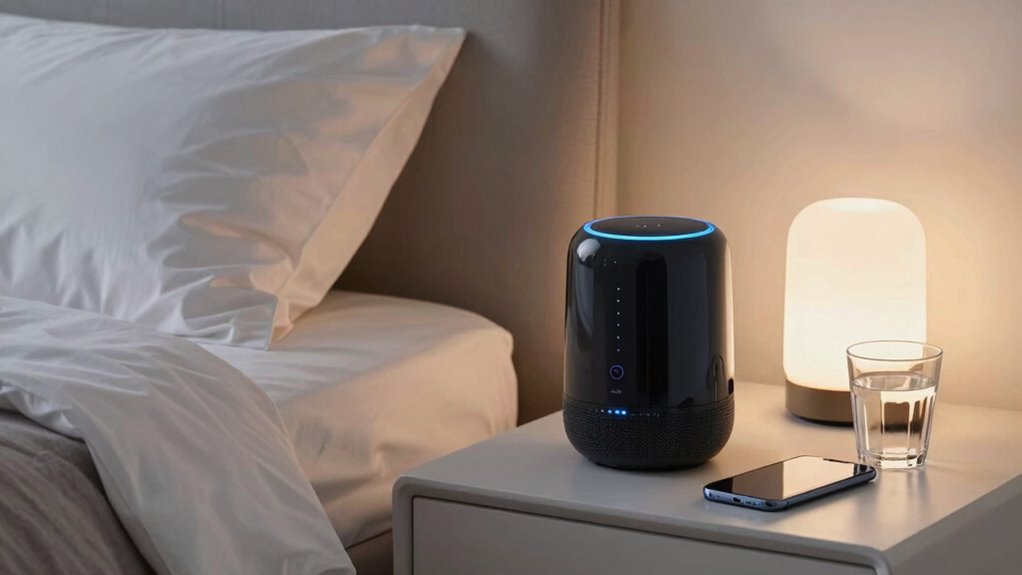

For smart speakers for bedtime routines, my best overall pick is the Amazon Echo Spot, which pairs Alexa controls with a clock-style display suited to a bedside table. The Hatch Restore 3 stands out for people who want a dedicated sleep and sunrise routine, while the Echo Dot (5th Gen) offers a simpler smart-speaker approach. The main tradeoff is whether you want a flexible voice assistant or sleep-focused features such as soundscapes and a sunrise alarm. Screen brightness, app dependence, and how much control you want without speaking can also shape the choice. Read on for how all eight options compare and which fits your nighttime habits.
Key Takeaways
- The Echo Spot is the strongest all-around bedside fit among the general-purpose Alexa speakers because its clock-like display combines time checks with voice control.
- The Hatch Restore 3 is the sleep-first choice; it is more tailored to structured wind-down and wake-up routines than the general-purpose speakers.
- The Echo Dot (5th Gen) and Google Nest Mini are compact assistant picks, but buyers should choose based on their existing voice-assistant ecosystem.
- The Hotmoon Cocoon Pro and Divoom Flowtoo put sound and atmosphere first, making them alternatives for people who care less about a full smart-home assistant.
- A bedside display is a tradeoff, not an automatic upgrade: the Echo Show 5 and Divoom’s calming display add visual information, but some sleepers may prefer a darker, screen-free setup.
| Amazon Echo Show 5 Smart Display with Alexa, Cloud Blue |  | Best for Bedside Smart-Home Control | Display: 5.5 inches | Camera: 2 MP | Voice assistant: Alexa | VIEW ON AMAZON | See Our Full Breakdown |
| Amazon Echo Dot (4th Gen) – Charcoal |  | Best Value Alexa Bedside Speaker | Generation: 4th Generation | Color: Charcoal | Voice control: Alexa | VIEW ON AMAZON | See Our Full Breakdown |
| Amazon Echo Dot (5th Gen) Smart Speaker, Deep Sea Blue |  | Best for Alexa Bedtime Routines | Generation: 5th Gen | Dimensions: 3.9 × 3.9 × 3.5 in (100 × 100 × 89 mm) | Weight: 10.7 oz (304 g) | VIEW ON AMAZON | See Our Full Breakdown |
| Amazon Echo Spot Smart Alarm Clock with Alexa, Glacier White |  | Best Smart Bedside Alarm Clock | Display: 2.83-inch touchscreen, 240 × 320 pixels | Camera: None | Dimensions: 4.5 × 4.1 × 4.4 in (113 × 103 × 111 mm) | VIEW ON AMAZON | See Our Full Breakdown |
| Hotmoon Smart Sound Machine for Sleep Cocoon Pro 3, 117 Sounds, Plug-in |  | Best Dedicated Sleep-Sound Machine | Sound library: 117 sounds | Noise colors: White, pink, green, blue, red, gray, and brown | Night light: RGBW, 16 million colors | VIEW ON AMAZON | See Our Full Breakdown |
| Divoom Flowtoo White Noise Machine with Bluetooth Speaker, Alarm Clock & Calming Screen Display |  | Best for Sound Variety | Sleep sounds: 90+ soothing sleep sounds | Speaker power: 10W | Connectivity: Bluetooth, USB-C, TF card | VIEW ON AMAZON | See Our Full Breakdown |
| Hatch Restore 3 Sleep and Sunrise Alarm Clock, Putty |  | Best for a Screen-Free Wind-Down | Color: Putty | Audio: 80+ sleep sounds | Lighting: Customizable, dimmable circadian lighting | VIEW ON AMAZON | See Our Full Breakdown |
| Google Nest Mini 2nd Generation Smart Speaker with Google Assistant – Charcoal |  | Best Compact Voice Assistant | Color: Charcoal | Dimensions: 4.0 inches (H x W) | Weight: 1.6 pounds | VIEW ON AMAZON | See Our Full Breakdown |
| smart speakers for bedtime routine | Color |
|---|---|
| Amazon Echo Show 5 Smart Displ | Cloud Blue |
| Amazon Echo Dot | Charcoal |
| Amazon Echo Dot | — |
| Amazon Echo Spot Smart Alarm C | — |
| Hotmoon Smart Sound Machine fo | — |
| Divoom Flowtoo White Noise Mac | — |
| Hatch Restore 3 Sleep and Sunr | Putty |
| Google Nest Mini 2nd Generatio | Charcoal |
More Details on Our Top Picks
Amazon Echo Show 5 Smart Display with Alexa, Cloud Blue
The Echo Show 5 suits bedtime routines built around seeing as well as hearing Alexa: its 5.5-inch screen can show the time, photos, streaming, and compatible camera feeds, while voice control can manage supported bedroom devices. Compared with the screen-free Echo Dot (5th Gen), it gives you a visual way to check information without reaching for a phone. That screen and video-calling camera make it more versatile by day, too, though the compact display is less suited to extended viewing than a larger screen. For a bedroom, the camera shutter and microphone/camera-off control offer useful privacy choices. Some controls and camera views depend on compatible devices or services, so this is a better fit for an Alexa-connected home than for someone seeking a standalone sleep sound machine.
Pros:- 5.5-inch display shows useful information, photos, and compatible camera feeds
- Alexa voice control can operate compatible smart-home devices
- Built-in camera supports video calls
- Camera shutter and microphone/camera-off button provide physical privacy controls
Cons:- Small screen is limiting for longer video viewing
- Some smart-home and camera features require compatible devices or services
- Video-call camera may not suit people who prefer a camera-free bedside device
Best for: Alexa households that want a bedside display for routines, quick visual checks, and compatible smart-camera viewing.
Not ideal for: Buyers who want a screen-free sleep speaker, a larger display for video, or built-in sleep sounds without relying on services.
- Display:5.5 inches
- Camera:2 MP
- Voice assistant:Alexa
- Smart-home control:Compatible smart-home devices
- Privacy controls:Camera shutter and microphone/camera-off button
- Color:Cloud Blue
- Recycled materials:Fabric uses 100% post-consumer recycled polyester yarn; aluminum is 100% recycled
- Packaging:100% recyclable
Our verdict“Choose the Echo Show 5 if bedtime means checking a screen and controlling compatible Alexa devices, rather than using a dedicated sound machine.”
Amazon Echo Dot (4th Gen) – Charcoal
The Echo Dot (4th Gen) is a straightforward pick for buyers who want Alexa timers, music, and compatible-device control without a bedside screen. Its compact speaker design keeps attention on voice-led routines, unlike the Echo Show 5, which adds visual checks and video calls but also brings a camera and display into the bedroom. This Dot also lists Wi-Fi extender and smart-home hub capabilities, which may add value in a compatible setup, though those features depend on device and network support. For sleep routines, its practical strengths are hands-free control and a mic-off button; it is not a dedicated sound machine with a stated library of sleep sounds. Setup can feel more involved if you plan to use its network or smart-home functions, and full functionality relies on Wi-Fi.
Pros:- Compact, screen-free format suits voice-led bedtime routines
- Provides music playback and voice control for compatible smart devices
- Wi-Fi extender and smart-home hub capabilities can serve a compatible setup
- Mic-off button offers a direct privacy control
Cons:- Full functionality requires Wi-Fi
- Smart-home and network features are limited to compatible devices and setups
- Setup may be complex for buyers who want only a basic bedtime speaker
Best for: Alexa users who want a compact, screen-free bedside speaker for timers, music, and compatible smart-home routines.
Not ideal for: People who want a visible clock, built-in sleep-sound selection, or a simple offline device that works without Wi-Fi.
- Generation:4th Generation
- Color:Charcoal
- Voice control:Alexa
- Smart-home features:Smart-home hub capabilities for compatible devices
- Network feature:Wi-Fi extender capability
- Privacy control:Microphone-off button
- Connectivity requirement:Wi-Fi required for full functionality
- Audio:Vibrant sound quality for its size
Our verdict“Pick this Echo Dot if you want an Alexa bedside speaker without a screen and can use its connected features.”
Amazon Echo Dot (5th Gen) Smart Speaker, Deep Sea Blue
The Echo Dot (5th Gen) earns this spot for bedtime routines that depend on scheduled voice control: Alexa handles timers, music, audiobooks, podcasts, and compatible smart-home commands, while its motion and temperature sensors can trigger routines in supported setups. That gives it a more automation-focused role than the Echo Dot (4th Gen), whose listed features emphasize general smart-home and network functions. Unlike the screen-equipped Echo Show 5, this model keeps the bedside footprint visual-free and camera-free, but it cannot show a clock or information at a glance. Its mono, single-driver audio suits everyday listening rather than room-filling stereo. The eero extension feature may help in the right network setup, but it requires a compatible eero router; some skills and services may also carry separate fees.
Pros:- Alexa supports timers, routines, and hands-free control of compatible devices
- Motion and temperature sensors add options for automated routines
- Plays music, audiobooks, and podcasts from multiple services
- Can extend a compatible eero network
Cons:- eero extension requires a compatible eero router and linked accounts
- Mono playback from one full-range driver is not a stereo setup
- Some skills and services may require subscriptions or fees
Best for: Alexa users who want a compact speaker for scheduled routines, voice-controlled listening, and sensor-triggered actions in a compatible smart home.
Not ideal for: Buyers who need a visible bedside clock, stereo sound, a camera, or smart-home features that work without compatible equipment.
- Generation:5th Gen
- Dimensions:3.9 × 3.9 × 3.5 in (100 × 100 × 89 mm)
- Weight:10.7 oz (304 g)
- Driver:1.6-inch full-range driver
- Playback:Mono
- Audio bandwidth:62 Hz–19 kHz
- Wi-Fi:Dual-band 802.11a/b/g/n/ac, 2.4 and 5 GHz
- Smart-home compatibility:Wi-Fi, Bluetooth Low Energy Mesh, and Matter
- Sensors and eero:Built-in motion and temperature sensors; eero coverage up to 1,000 sq. ft. with a compatible router
Our verdict“Choose the Echo Dot (5th Gen) for Alexa-led, sensor-aware bedtime routines, but not if you want a screen or dedicated sleep-sound library.”
Amazon Echo Spot Smart Alarm Clock with Alexa, Glacier White
The Echo Spot is the clearest fit for a bedside where seeing the time matters more than having a full smart display. Its 2.83-inch touchscreen shows clock faces, weather, and song titles, while Alexa routines can connect wake-up lighting and other compatible smart-home actions. Compared with the Echo Dot (5th Gen), the Spot adds a purpose-built visual alarm-clock experience; compared with the Echo Show 5, it has a smaller display and no camera. That camera-free design is a meaningful bedroom advantage, though the screen is best for quick glances, not video viewing. The built-in speaker handles music, podcasts, and audiobooks, but buyers seeking extensive sleep-noise choices may prefer the Hotmoon Cocoon Pro 3. Network extension needs a compatible eero router, and some Alexa services may require subscriptions.
Pros:- Customizable touchscreen displays the time, weather, and song titles
- Alexa routines can control compatible devices, including gradual wake-up lighting
- Camera-free design with a microphone-off button suits privacy-conscious bedrooms
- Built-in speaker plays music, podcasts, and audiobooks
Cons:- Small screen is intended for quick glances rather than extended viewing
- eero extension requires a compatible router and linked accounts
- Some Alexa skills and services may require a subscription
Best for: People who want an Alexa bedside alarm clock with a small visual display, camera-free design, and smart-light routines.
Not ideal for: Buyers who want a larger screen, a camera for calls, extensive dedicated sleep sounds, or eero features without a compatible router.
- Display:2.83-inch touchscreen, 240 × 320 pixels
- Camera:None
- Dimensions:4.5 × 4.1 × 4.4 in (113 × 103 × 111 mm)
- Weight:14.3 oz (405 g)
- Speaker:1.73-inch full-range built-in speaker
- Wi-Fi:Dual-band 802.11a/b/g/n/ac, 2.4 and 5 GHz
- Bluetooth:A2DP audio streaming and AVRCP support
- eero Built-in:Up to 1,000 sq. ft. additional coverage with a compatible eero router
- Materials and color:36% recycled materials; Glacier White
Our verdict“Choose the Echo Spot if you want a camera-free visual alarm clock with Alexa routines, rather than a larger display or dedicated sound machine.”
Hotmoon Smart Sound Machine for Sleep Cocoon Pro 3, 117 Sounds, Plug-in
The Hotmoon Cocoon Pro 3 is the specialist choice for people who want bedtime audio, not a general-purpose voice assistant. Its 117 curated sounds span seven noise colors, and customizable routines plus a gentle fade-in alarm focus on sleep and relaxation. That makes it a closer match for sound masking than the Echo Dot (5th Gen), which plays music and podcasts and offers Alexa routines but does not list a dedicated library of sleep sounds. The Cocoon also adds an RGBW night light and dual speakers with a passive radiator, giving it a distinct wind-down role. The tradeoff is fewer connected-assistant functions than the Echo options: full customization relies on its app, and plug-in-only power means it cannot be moved freely or rely on a battery backup during an outage.
Pros:- 117 sounds include white, pink, green, blue, red, gray, and brown noise
- Customizable routines and a gentle fade-in alarm support a sleep-focused setup
- RGBW night light offers adjustable color choices
- Dual speakers with a passive radiator are designed for fuller sound
Cons:- Plug-in-only power limits portability
- No built-in battery backup
- Full customization depends on using the app
Best for: Sleep-focused buyers who want varied noise sounds, a customizable wind-down routine, and an adjustable night light in one plug-in device.
Not ideal for: People who want Alexa or Google Assistant, portable operation, or battery backup for power interruptions.
- Sound library:117 sounds
- Noise colors:White, pink, green, blue, red, gray, and brown
- Night light:RGBW, 16 million colors
- Speakers:Dual speakers with passive radiator
- Alarm:Fade-in alarm with 30 tones
- Routines:Customizable routines
- Controls:App or manual control
- Power:Plug-in only
- Battery backup:None
Our verdict“Pick the Cocoon Pro 3 if sleep sounds and a wind-down light matter more than having a general-purpose smart assistant.”
Divoom Flowtoo White Noise Machine with Bluetooth Speaker, Alarm Clock & Calming Screen Display
The Flowtoo suits bedtime routines built around choosing a soundscape, rather than relying on a voice assistant. Its 90+ soothing sounds give it a broader sleep-audio focus than the Google Nest Mini, while Bluetooth, USB-C, and TF card connectivity add ways to play other audio. The customizable clock display offers more than 60 faces, so it can double as a bedside clock with a look you can tailor to your room. An alarm and Pomodoro timer extend its use beyond winding down.
The tradeoff is a more feature-packed interface that may take time to learn. Its 10W speaker is better suited to bedside listening than filling a large room, and it needs USB-C power. Choose this over a simpler speaker if dedicated sleep sounds and visual customization matter more than hands-free assistant features.
Pros:- More than 90 soothing sounds support varied bedtime soundscapes
- Over 60 clock faces let buyers customize the bedside display
- Bluetooth, USB-C, and TF card connectivity offer several audio sources
- Alarm and Pomodoro timer add uses beyond sleep audio
Cons:- The interface may take time to learn
- The 10W speaker is better suited to bedside use than large spaces
- Requires USB-C power, limiting placement away from an outlet
Best for: Bedside listeners who want a wide choice of sleep sounds, a customizable clock display, and Bluetooth playback in one device
Not ideal for: People who want a simple voice-controlled speaker, need sound to fill a large room, or want a battery-powered device
- Sleep sounds:90+ soothing sleep sounds
- Speaker power:10W
- Connectivity:Bluetooth, USB-C, TF card
- Display:Calming screen visuals with 60+ clock faces
- Alarm:Yes
- Additional features:Pomodoro timer and bedside clock
Our verdict“Choose the Flowtoo if you want abundant sleep sounds and a customizable bedside display more than a straightforward smart assistant.”
Hatch Restore 3 Sleep and Sunrise Alarm Clock, Putty
The Hatch Restore 3 is the most routine-focused choice here: it pairs customizable sleep audio with dimmable circadian lighting and a sunrise alarm, rather than centering bedtime on a general-purpose smart speaker. That screen-free approach may suit people who want a consistent sequence of softer light, sleep sounds, and gradual waking. Compared with the Divoom Flowtoo, it offers a more dedicated lighting-and-wake-up experience, while the Flowtoo gives you a larger stated sound library and a customizable clock display.
The main tradeoff is access to premium content and features after the 30-day Hatch+ trial, which requires a subscription for new subscribers. Buyers who want a straightforward speaker for music and voice requests may find the Google Nest Mini a better fit. Pick Hatch when guided bedtime and sunrise lighting matter more than broad speaker utility.
Pros:- Customizable sleep audio and lighting can support a consistent wind-down routine
- More than 80 sleep sounds provide options for bedtime listening
- Sunrise alarm offers a gradual alternative to an abrupt wake-up
- Dimmable clock helps limit light in a dark bedroom
Cons:- Premium content and features require a subscription after the trial
- Its routine-focused design is less suited to buyers seeking a versatile general-purpose speaker
Best for: People who want a screen-free nightly routine with sleep audio, adjustable light, and a gradual sunrise wake-up
Not ideal for: Buyers who want all sleep content without a subscription or primarily need a general-purpose voice-assistant speaker
- Color:Putty
- Audio:80+ sleep sounds
- Lighting:Customizable, dimmable circadian lighting
- Alarm:Sunrise alarm clock
- Subscription trial:30 days of Hatch+ for new subscribers
- Clock:Dimmable clock
Our verdict“Choose the Hatch Restore 3 if a screen-free wind-down and sunrise alarm matter more than avoiding a subscription or having a general-purpose speaker.”
Google Nest Mini 2nd Generation Smart Speaker with Google Assistant – Charcoal
The Nest Mini is the compact, assistant-led pick for bedtime: use it for voice requests and audio without dedicating the bedside table to a sleep machine or display. Its small 4-inch form and table-top or wall-mount placement make it easier to fit into a crowded room than the more feature-heavy Divoom Flowtoo. The Flowtoo is the stronger match for people who specifically want many built-in sleep sounds and a customizable clock; the Nest Mini is better suited to buyers who value a compact smart speaker and its listed multiple-language support.
There are clear limits for bedtime use. It has no built-in battery, so it must stay near an outlet, and the product data does not list a dedicated sleep-sound library, dimmable clock, or sunrise alarm like the Hatch Restore 3. Its stated sound is rich and punchy, but it is still a single-speaker indoor device, not a portable option.
Pros:- Compact 4-inch design fits small bedside tables
- Can be placed on a table or wall-mounted
- Described as delivering rich sound with enhanced bass
- Supports multiple languages and includes a universal power adapter
Cons:- Requires a wall outlet and has no built-in battery
- Product data does not list a dedicated sleep-sound library or sunrise alarm
- Limited to indoor use
Best for: Buyers who want a compact, voice-assistant speaker for bedtime audio and everyday requests, with multiple-language support
Not ideal for: Sleep-focused buyers who want built-in sleep sounds, bedside lighting, a sunrise alarm, or battery-powered portability
- Color:Charcoal
- Dimensions:4.0 inches (H x W)
- Weight:1.6 pounds
- Power source:Corded electric
- Speaker type:Single
- Mounting type:Table top or wall mount
- Language support:Multiple languages
- Use:Indoor
Our verdict“Choose the Nest Mini if you want a compact voice-assistant speaker by the bed, not a dedicated sleep machine with lighting and wake-up features.”

How We Picked
I ranked these eight devices by how well they support the repeated steps of a bedtime routine: starting calming audio, setting alarms or timers, checking the time, and controlling the device without adding friction. I gave weight to sleep-specific tools, bedside usability, voice-assistant usefulness, sound options, and how well each product’s design suits a bedroom rather than a shared living space.
The order reflects a balance of routine support and flexibility, not a claim that every buyer needs the same features. The Echo Spot leads as a capable bedside assistant; the Hatch Restore 3 ranks highly for a sleep-centered routine, while compact speakers such as the Echo Dot and Nest Mini are better for simple voice control. Dedicated sound machines earn a place for their focused audio and atmosphere, but rank behind the most versatile picks for buyers who also want an assistant. Display-based models carry a bedroom-specific tradeoff: useful visual controls can add light and distraction.
| smart speakers for bedtime routine | Color |
|---|---|
| Amazon Echo Show 5 Smart Displ | Cloud Blue |
| Amazon Echo Dot | Charcoal |
| Amazon Echo Dot | — |
| Amazon Echo Spot Smart Alarm C | — |
| Hotmoon Smart Sound Machine fo | — |
| Divoom Flowtoo White Noise Mac | — |
| Hatch Restore 3 Sleep and Sunr | Putty |
| Google Nest Mini 2nd Generatio | Charcoal |
Factors to Consider When Choosing Smart Speakers For Bedtime Routines
Choosing a bedtime speaker is less about collecting the most features and more about matching the device to the routine you will actually repeat. I would start with how you want to control audio and alarms, then weigh sleep-specific functions against general smart-home flexibility.
Decide Whether You Want an Assistant or a Sleep Device
A voice assistant can handle more than bedtime, including reminders, smart-home commands, and general questions, but that flexibility may bring extra prompts and connected features you do not need at night. A dedicated sleep device usually places sound, dimming, and wake-up habits closer to the center of its design. Before buying, write down the two or three actions you want at bedtime and the first one you want in the morning. If those actions are mostly playing audio and setting an alarm, a general-purpose smart speaker may be enough. If you want a repeatable wind-down and wake-up sequence, a sleep-focused model may better match the routine. Avoid paying for broad assistant features if you will not use them in the bedroom.
Think About Light, Screens, and Where the Device Will Sit
A clock display can make quick time checks easier, yet a bright screen may be unwelcome in a dark room. Consider whether you look at a clock during the night or prefer to keep visual cues out of sight. Also measure the available surface: bedside tables often need room for a lamp, phone, water, and other essentials. A compact speaker may fit where a display or larger sleep device does not. Look for clear controls for dimming or turning off visual elements rather than assuming a screen can be made unobtrusive. The best bedside layout is the one that keeps routine controls reachable without making the device the room’s main source of light.
Check How You Will Start and Stop Bedtime Audio
Voice commands are handy when your hands are occupied, but they can be awkward if you share a room or want to avoid speaking after lights-out. Physical controls, app controls, and scheduled routines offer different ways to manage playback quietly. Think about whether you need audio to stop automatically, play for a set period, or continue through the night. Do not assume every sound library or playback service works the same way across devices. Check which audio sources and controls matter to you before choosing a platform. A routine that is easy to start but hard to stop can become a nightly annoyance.
Match the Speaker to Your Existing Smart-Home Ecosystem
Choosing a speaker that fits the assistant you already use can reduce setup work and keep commands consistent across rooms. If your household relies on Alexa or Google Assistant, a different platform may create a second app, separate routines, or unfamiliar voice commands. That mismatch matters most when bedtime routines involve lights, plugs, or other connected devices. On the other hand, a dedicated sound machine may make sense if you want a bedroom device that works independently of a broader smart-home setup. Check how routines are created and whether other household members can control them. The simplest ecosystem is often the one your family already knows.
Choose Sound Variety for Your Actual Sleep Preferences
More sound choices are only helpful when they include the kind of audio you can comfortably listen to night after night. Some people want steady masking noise, while others prefer nature sounds, music, or spoken audio. A dedicated sound machine may offer a more focused set of sleep sounds, while a smart speaker can provide wider access to assistant-linked audio. Think about whether you want a sound to mask household noise or create a short wind-down cue. If you are sensitive to changes in a loop or interruptions, check how playback behaves over longer sessions. Choose for the sounds and listening pattern you already prefer, not the largest feature list.
Prioritize Routine Reliability Over Extra Features
A bedtime routine depends on the alarm, schedule, and playback working as expected each day. Before committing, check whether key functions depend on an app, an internet connection, an account, or a paid service. More connected features can make routines flexible, but they may add setup steps or create extra points of failure. Consider who will maintain the device and whether another household member can adjust alarms or sounds without help. A simple, dependable routine is often more useful than a long chain of automations. If a feature is not part of your nightly or morning habit, treat it as a bonus rather than a reason to choose the device.
Frequently Asked Questions
Is a smart speaker or a dedicated sleep sound machine better for bedtime?
I would choose a smart speaker if you want voice control, alarms, general assistant features, or integration with other connected devices. A dedicated sleep sound machine makes more sense when a focused sound experience and a bedroom-oriented routine matter more than broad voice-assistant functions. The Hotmoon Cocoon Pro and Divoom Flowtoo lean toward sound and atmosphere, while the Echo and Nest models offer assistant-centered use. The Hatch Restore 3 is a fit for buyers who want a device built around sleep and waking habits. Decide which jobs you want the device to handle before comparing features.
Should I choose the Echo Spot or the Echo Show 5 for a bedside table?
The Echo Spot is the more clock-like bedside option, while the Echo Show 5 is a broader smart display. I would lean toward the Spot if your main visual need is checking the time and managing a bedtime routine from the bedside. The Show 5 may suit someone who wants a more general display experience in the bedroom. Both bring a screen into a space where some people prefer darkness, so plan to manage display light before making either your bedside choice. If visual information is not useful to you at night, a screen-free compact speaker may be a better match.
Do I need the same voice assistant as the rest of my home?
Matching your existing assistant is usually the simplest path when you want bedtime routines to control lights, plugs, or other connected devices. It can also help household members use familiar commands rather than learn a second system. A different assistant may still make sense if the bedroom device serves a separate purpose, such as playing sound or setting a standalone alarm. The Echo models use Alexa, while the Nest Mini uses Google Assistant, so ecosystem preference is a meaningful dividing line in this roundup. Check compatibility with your current devices and routines before choosing based on speaker design alone.
Will a bedside display disrupt sleep?
It depends on your sensitivity to light and how the display behaves in your room. A clock or calming screen can be useful for quick visual checks, but even a small illuminated display may bother people who sleep in darkness. Look for controls that let you dim or switch off the screen, and place the device where its light does not point toward your pillow. If you do not need visual information, a screen-free speaker avoids that particular tradeoff. The Echo Show 5 and Divoom Flowtoo offer visual elements, while a compact speaker keeps the bedside setup less display-focused.
What should I check before relying on a speaker for alarms and routines?
Check how alarms are set, whether routines depend on an app or internet access, and how easily you can confirm that a schedule is active. Make sure the wake-up behavior suits your household, especially if more than one person shares the room or uses the device. Test the routine while you are awake before relying on it for a morning commitment. Consider a backup alarm if a missed wake-up would create a serious problem. Keeping the routine short and easy to verify can reduce setup errors and nightly frustration.
Conclusion
For the best overall bedside balance, I recommend the Amazon Echo Spot for buyers who want Alexa and a clock-style display in one device. The Echo Dot (5th Gen) is my best value-style choice for a compact, assistant-led routine without a bedside screen, while the Hatch Restore 3 is the best premium, sleep-first pick for people who want a device centered on wind-down and wake-up habits. For beginners, the Echo Dot (4th Gen) offers a straightforward entry into voice-controlled bedtime basics; choose the Google Nest Mini instead if Google Assistant already anchors your home. For specific needs, pick the Hotmoon Cocoon Pro or Divoom Flowtoo when focused sound and atmosphere matter more than a broad assistant, and the Echo Show 5 if you want a more general bedside display. The right choice comes down to whether your routine needs an assistant, dedicated sleep tools, or simply calming audio at a convenient bedside control.