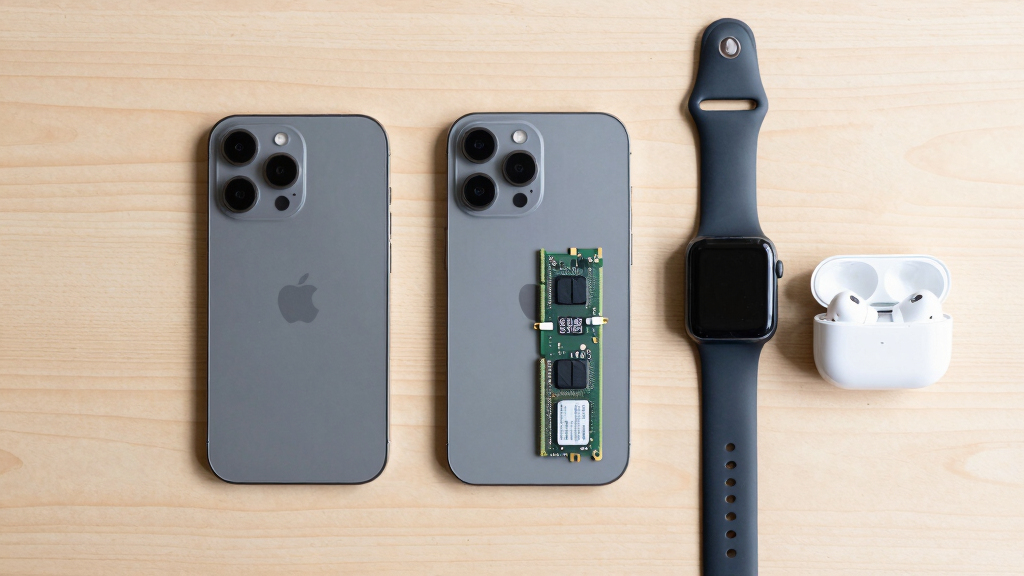

📊 Full opportunity report: Apple Is Reaching for Chinese Memory. Europe Doesn’t Even Have That Option. on ThorstenMeyerAI.com — validation score, market gap, and execution plan.
TL;DR
Apple is lobbying Washington to purchase memory chips from Chinese company CXMT, exposing its dependence on China. Europe has no comparable options, revealing a strategic vulnerability in its tech supply chain.
Apple is lobbying Washington for permission to buy memory chips from Chinese manufacturer CXMT, a move that underscores its strategic dependence on China amid ongoing global chip shortages. This development is significant because it reveals the lengths Apple is willing to go to secure supply, whereas Europe lacks similar options, exposing a broader vulnerability in its tech supply chain.
This week, reports confirmed that Apple is actively lobbying the U.S. government to allow purchases of memory chips from CXMT, a Chinese company on the Pentagon’s blacklist. The move follows Apple’s recent price increases on Macs and iPads, attributed to a global memory shortage. Apple’s ability to consider China as an alternative supplier is rooted in its extensive influence and existing supply chain relationships in the region.
In contrast, Europe has no comparable domestic memory manufacturing capability. The European Union produces less than 10 percent of the world’s semiconductors by value, with memory chips like DRAM and high-bandwidth memory (HBM) almost entirely fabricated outside Europe, mainly in East Asia or the U.S. European manufacturers have diminished significantly, with only a few players like STMicroelectronics and Infineon remaining, none of which dominate the memory sector.
European policymakers face structural limitations: subsidies, regulation, and certification tools are insufficient to build or expand memory fabrication capacity at the scale needed. Major global players like TSMC, Samsung, and SK Hynix control the supply, with limited room for Europe to influence prices or allocations. The EU’s „tech sovereignty“ initiatives aim to bolster upstream capabilities but cannot address the immediate shortages or the entrenched global supply chain dependencies.
Apple is reaching for Chinese memory. Europe doesn’t even have that option.
The shortage exposes America’s dependence — and Europe’s far more brutally. Apple has a domestic supplier, political weight, and the China option. Europe has no memory of its own, no seat at the table, no leverage on what counts.
- EU makes < 10% of the world’s semiconductors
- Effectively no DRAM, no HBM from Europe
- 3–4 memory makers worldwide — none European
- Pure price-taker: memory ~4× in 3 quarters
- ASML: EUV monopoly — no leading-edge chip without it
- Zeiss: precision optics, unrivalled worldwide
- imec · CEA-Leti · Fraunhofer: world-class research
- Infineon, NXP, STMicro: automotive · power · SiC
The shortage is a sovereignty test — Europe fails on supply but still holds the leverage in its hand. If even Apple can’t buy its way out, Europe’s answer isn’t to buy its way in, but to run two tracks: press the unique chokepoints as real leverage — and cut dependence wherever it can without Brussels: local-first, open weights, quantization, right-sized hardware. Bury the 20% dream, defend what’s yours, need less.
Implications of Europe’s Lack of Memory Manufacturing
The situation highlights Europe’s strategic vulnerability in the semiconductor supply chain, especially in memory chips crucial for AI, data centers, and consumer electronics. Without domestic production or meaningful leverage over global suppliers, Europe remains a price-taker, exposed to supply disruptions and price fluctuations. Apple’s move to consider Chinese sources demonstrates how dependence on external suppliers can become a national security concern, especially if geopolitical tensions escalate. The broader consequence is that Europe’s ambition for technological sovereignty faces significant hurdles unless it develops its own manufacturing capacity or builds resilient chokepoints.
As an affiliate, we earn on qualifying purchases.
Europe’s Semiconductor Industry and Global Supply Chain Dependence
Europe’s semiconductor manufacturing is heavily concentrated in upstream equipment and design, with minimal fabrication capacity. The EU produces less than 10% of global semiconductors by value, and its memory chip sector is almost entirely dependent on East Asian and U.S. manufacturers. The 2023 EU Chips Act aimed to double Europe’s market share to 20% by 2030 but is widely seen as unlikely to meet that goal, with estimates suggesting a need for over €250 billion in investment. Major projects like Intel’s Magdeburg plant and the GlobalFoundries fab in Crolles face delays or cancellations, illustrating the difficulty of building domestic capacity at scale.
Meanwhile, global giants like TSMC and Samsung dominate fabrication, controlling critical supply lines for memory and logic chips. Europe’s control over key chokepoints, such as ASML’s EUV lithography machines, provides strategic leverage but does not substitute for full manufacturing independence. The existing supply chain dependencies leave Europe vulnerable to external shocks and geopolitical conflicts, especially with U.S.-China tensions affecting access to advanced chips and equipment.
„Europe’s semiconductor industry remains heavily reliant on external supply chains, making self-sufficiency a long-term challenge.“
— European Commission official
As an affiliate, we earn on qualifying purchases.
Unclear Impact of U.S. Policy and Future Supply Risks
It remains unclear how U.S. government decisions regarding Chinese chip suppliers will evolve and what specific restrictions or permissions will be granted to Apple. Additionally, the extent to which Europe can accelerate its domestic capacity or develop alternative supply routes in the short to medium term is still uncertain. The potential for geopolitical conflicts or trade restrictions to further disrupt supply chains adds to the unpredictability.
As an affiliate, we earn on qualifying purchases.
Next Steps for Europe and Apple in Semiconductor Strategy
Apple’s lobbying efforts will continue to shape U.S. policy on Chinese chip imports, with potential implications for global supply chains. For Europe, policymakers are likely to focus on advancing the Chips Act, investing in key chokepoints like EUV lithography, and fostering strategic partnerships. However, significant capacity expansion or diversification of supply sources is unlikely before 2030, leaving Europe vulnerable to ongoing shortages and external shocks.
As an affiliate, we earn on qualifying purchases.
Key Questions
Why is Apple lobbying the U.S. government to buy Chinese memory chips?
Apple is seeking to secure supply amid global shortages and believes Chinese chips can serve as an alternative source, especially given its influence and existing supply chain relationships in China.
What does Europe lack that Apple has in terms of memory chip supply?
Europe has no significant domestic memory chip manufacturing capacity, making it dependent on external suppliers mainly in East Asia and the U.S., with limited influence over global supply and prices.
Could Europe develop its own memory chip industry to avoid dependence?
While technically possible, building large-scale memory fabrication capacity would require over €250 billion and decades of development, which is currently unrealistic given existing supply chain dependencies and high costs.
How might geopolitical tensions affect global chip supplies?
Trade restrictions, export controls, and conflicts between the U.S. and China could further limit access to advanced chips and manufacturing equipment, increasing Europe’s vulnerability.
Source: ThorstenMeyerAI.com