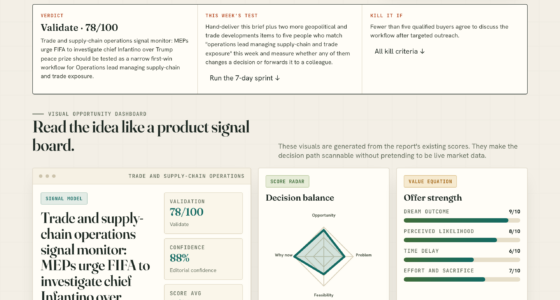

📊 Full opportunity report: The Security Implications of AI Black Boxes for International Alliances on ThorstenMeyerAI.com — validation score, market gap, and execution plan.
TL;DR
Recent discussions focus on the security risks posed by AI black boxes within NATO alliances. Experts warn that lack of transparency and control over AI systems could threaten military and civilian infrastructure. The issue raises questions about supply chain trust and strategic dependencies.
Concerns are mounting over the security risks posed by AI black boxes in critical infrastructure used by NATO and allied nations. Experts warn that these opaque AI systems could undermine strategic control, especially if their internal operations cannot be inspected or controlled by authorized parties, raising fears of vulnerabilities in military and civilian networks. The August 1 AI Benchmark Deadline And Its Security Implications For The U.S.
Recent reports indicate that NATO and partner countries are increasingly reliant on AI systems with proprietary, opaque algorithms—often called black boxes—for military decision-making, logistics, and civilian infrastructure management. The August 1 AI Benchmark Deadline And Its Security Implications For The U.S. These systems, which often lack transparency, could become points of strategic vulnerability if their internal processes cannot be inspected, repaired, or controlled without external permission.
Officials highlight that the core issue is control—whether the alliance can operate and maintain these AI systems independently of potential adversaries. The concern is that dependencies on proprietary AI components, especially those whose software or hardware origins are uncertain, could be exploited if the supply chain is compromised or influenced by hostile nations.
Historically, dependency on foreign technology—such as Huawei in telecommunications—has demonstrated how supply chain vulnerabilities can threaten national security. The August 1 AI Benchmark Deadline And Its Security Implications For The U.S. Experts warn similar risks exist with AI systems, where control over algorithms and data flow is crucial for safeguarding military and civilian assets.
Friendly fire at alliance scale: what Chinese equipment in NATO networks actually means
Yesterday: Ukraine may have turned a Russian unit’s identification layer against its own jet. Today’s question doesn’t require that to be true. It requires only that the concept be plausible — and then asks what it means when NATO’s own identification layer is built on equipment from a country whose law compels its companies to cooperate with intelligence on demand.
Any Chinese entity — any company, any employee, anywhere — must assist national intelligence work when asked. No carve-out for foreign deployments. No judicial review. No refusal option. When Beijing asks Huawei for access, Huawei must provide it. The law doesn’t distinguish between Shenzhen and Stuttgart. It doesn’t distinguish between civilian and NATO. This is not theoretical. It is operational law.
Requires no reconnaissance. The companies manufactured and installed the equipment. They have the source code, firmware, manufacturing tolerances, and update pipeline — the reconnaissance was completed before the adversary was even identified as one. A stronger position than what InformNapalm claims Ukraine achieved.
The question isn’t whether China will use this access. It’s whether NATO can afford to assume it won’t. Three things follow. Replacement is genuinely hard — banning without building the supply chain produces capability gaps, not security. The identification layer is where the exposure is sharpest — a Chinese motor is a supply-chain risk; a Chinese sensor or processor in an IFF system is an identification-layer risk, the same class the BARS Moscow story made visible. And the open-weight argument applies here — but stops short: open weights give you visibility into the classification model; they don’t give you visibility into the silicon it runs on. NATO has thirty-two members, each with its own procurement history. Together they’ve built an identification layer with distributed, unaudited, legally-accessible dependencies on a potential adversary. BARS Moscow required weeks of reconnaissance. The reconnaissance for NATO’s version was completed in the factory.
Implications of AI Black Boxes for NATO Security
The security of NATO’s infrastructure increasingly depends on AI systems whose inner workings are opaque, raising concerns about control, transparency, and potential exploitation. If adversaries gain influence over these AI components, they could manipulate critical systems, disrupt communications, or compromise military operations. This dependency on proprietary, uncontrollable AI raises strategic risks similar to those seen with telecommunications vendors like Huawei, but now in the realm of AI-driven decision-making and infrastructure management.
Understanding and mitigating these risks is vital for maintaining alliance cohesion and operational security. The challenge lies in ensuring that AI systems can be inspected, maintained, and controlled without external interference, especially when supply chains involve non-allied countries or unknown origins.
As an affiliate, we earn on qualifying purchases.
Growing Concerns Over AI Supply Chain Security
Within the last year, NATO and European allies have increasingly recognized the vulnerabilities posed by supply chains for critical technology. The controversy over Huawei’s role in 5G networks exemplified how dependencies on foreign, potentially hostile vendors can threaten national security. The European Commission and the UK government have both moved to restrict or phase out Huawei equipment, citing risks related to control and influence.
Experts note that the same logic applies to AI systems—if a black box’s software or hardware components are sourced from or influenced by adversarial nations, the entire system’s security could be compromised. The challenge is compounded by the complexity of AI supply chains, which often involve multiple offshore developers, proprietary algorithms, and cloud-based data exchanges.
As NATO expands its cooperation with non-member allies like Australia, Japan, and South Korea, questions about trust, control, and supply chain integrity become more urgent. The core issue is whether the alliance can maintain operational independence over AI systems that are increasingly embedded in both military and civilian infrastructure.
„Control over supply chains and proprietary technology is essential for safeguarding our strategic interests against potential adversaries.“
— Minister Hans Müller, German Defense Ministry
As an affiliate, we earn on qualifying purchases.
Unresolved Questions About AI Black Box Risks
It remains unclear how widespread the use of truly opaque AI black boxes is within NATO’s critical infrastructure. There is also uncertainty about the technical feasibility of inspecting or controlling these systems once deployed, especially if they are built with proprietary algorithms or cloud-based dependencies. Additionally, the exact impact of potential adversarial influence over AI components is still being studied, with no definitive assessments yet available.
critical infrastructure AI security
As an affiliate, we earn on qualifying purchases.
As an affiliate, we earn on qualifying purchases.
Next Steps in Securing AI-Dependent Infrastructure
NATO and allied nations are expected to develop standards and protocols for AI transparency and control, including supply chain vetting and independent testing. Discussions are also underway to establish international cooperation frameworks for AI security, aiming to prevent adversaries from gaining influence over critical systems. Further research and policy development are anticipated over the next year to address these vulnerabilities effectively.
As an affiliate, we earn on qualifying purchases.
Key Questions
Why are AI black boxes considered a security risk?
Because their internal decision-making processes are opaque, making it difficult to verify, control, or repair them without external permission, which could be exploited by adversaries.
How does supply chain influence relate to AI security?
If components or software originate from or are influenced by hostile nations, they could be manipulated or compromised, creating vulnerabilities in critical infrastructure.
What can NATO do to mitigate these risks?
NATO can develop standards for AI transparency, conduct supply chain audits, and promote the use of open or verifiable AI systems to ensure control and security.
Are all AI systems used in NATO infrastructure black boxes?
No, but many proprietary AI systems lack transparency, and the extent of their use in critical infrastructure is still being assessed.
What is the timeline for addressing these risks?
Expect ongoing policy discussions and standards development over the next 12 to 24 months, with potential implementation of new controls and protocols.
Source: ThorstenMeyerAI.com