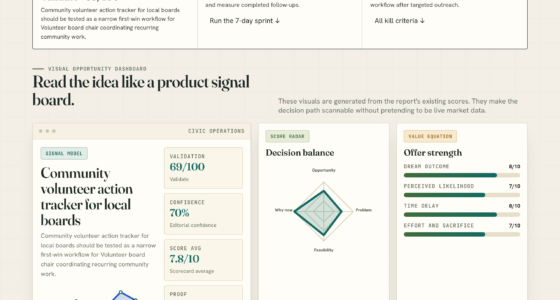

📊 Full opportunity report: Cross-Domain Attacks: The Invisible Threat To AI Stability on ThorstenMeyerAI.com — validation score, market gap, and execution plan.
TL;DR
Cross-domain attacks combine cyber, physical, and informational tactics to create unpredictable cascades, challenging AI stability and decision-making. Defense hinges on rapid detection and attribution.
Security experts warn that multi-domain, cross-sector attacks are an emerging and largely invisible threat to AI stability. These attacks leverage the interconnectedness of modern infrastructure across cyber, physical, and informational domains to create cascading effects that are difficult to detect and attribute, potentially paralyzing decision-making processes at the strategic level.
Recent assessments, including insights from Thorsten Meyer, emphasize that the strategic impact of cross-domain attacks does not reside in the initial physical or cyber damage but in the cascade effects across interconnected systems. These cascades can propagate through dependencies such as satellite communications, undersea cables, energy grids, and financial networks, amplifying the initial impact beyond expectations.
Furthermore, attackers often engineer these actions to stay below response thresholds and create attribution ambiguity. This makes it difficult for defenders and decision-makers to confidently determine whether an act qualifies as an attack, thus blunting the response and potentially undermining alliances’ cohesion.
Finally, the cognitive and political impact of such attacks targets the shared consensus within alliances, eroding trust and unity without necessarily inflicting physical damage. This strategic undermining can weaken collective decision-making, making multi-domain attacks a potent form of hybrid warfare.
Its potency is in the cascade between domains and the ambiguity that jams the response. Grade the threat one domain at a time and you miss the thing living in the seams.
Implications for AI and Strategic Stability
This emerging threat poses significant challenges for AI systems tasked with monitoring and responding to complex, multi-domain incidents. The cascading effects and attribution ambiguity can hinder timely responses, increasing the risk of escalation or unintended consequences. For nations and organizations reliant on AI for defense and infrastructure management, understanding and mitigating these risks is critical to maintaining strategic stability.
Moreover, the ability of adversaries to manipulate perceptions and undermine alliance cohesion could weaken collective security frameworks, making coordinated responses to threats more difficult. The threat emphasizes the need for advanced fusion and detection capabilities to identify coordinated multi-domain actions before they reach the response threshold.
cybersecurity monitoring tools for AI systems
As an affiliate, we earn on qualifying purchases.
As an affiliate, we earn on qualifying purchases.
Evolution of Multi-Domain Warfare and Infrastructure Interdependence
The concept of multi-domain operations has become central to modern military doctrine, emphasizing the integration of land, air, maritime, cyber, space, and information domains. As NATO and other alliances adapt their strategies, the interconnectedness of critical infrastructure has increased, creating a complex web of dependencies that can be exploited in cross-domain attacks.
Recent analyses, including those by Thorsten Meyer, highlight that the strategic shift from attacking specific targets to producing effects across multiple domains fundamentally alters the threat landscape. Attackers no longer need to cause direct damage; instead, they can produce political and systemic effects through carefully calibrated, ambiguous actions.
This evolution underscores the importance of developing detection systems capable of recognizing patterns indicative of coordinated multi-domain efforts, rather than isolated incidents.
"The impact of a serious cross-domain attack is not measured primarily in territory taken or casualties inflicted. It's measured in the response threshold, alliance cohesion, and systemic resilience."
— Thorsten Meyer
physical and cyber attack detection devices
As an affiliate, we earn on qualifying purchases.
As an affiliate, we earn on qualifying purchases.
Uncertainties in Detection and Attribution Capabilities
It remains unclear how quickly and accurately current detection systems can fuse signals across multiple domains to identify coordinated attacks in real time. The effectiveness of existing AI-driven fusion and attribution tools in countering these sophisticated, multi-layered threats is still under evaluation, and there is ongoing debate about whether defenses can keep pace with evolving attack strategies.
AI system intrusion detection software
As an affiliate, we earn on qualifying purchases.
As an affiliate, we earn on qualifying purchases.
Advancing Detection and Response Strategies
Next steps involve developing more sophisticated fusion algorithms and real-time analytics to improve early warning capabilities. Additionally, international cooperation and intelligence sharing will be crucial to establishing norms and response frameworks that address the ambiguity and cascade risks posed by cross-domain attacks. Research into AI resilience and robustness against hybrid threats is also expected to accelerate in the coming months.
cross-domain attack prevention hardware
As an affiliate, we earn on qualifying purchases.
As an affiliate, we earn on qualifying purchases.
Key Questions
What are cross-domain attacks?
Cross-domain attacks involve coordinated efforts across multiple operational domains—cyber, physical, informational, space, and electromagnetic spectrum—to produce systemic effects that are difficult to detect and attribute.
Why are these attacks difficult to defend against?
They are designed to stay below response thresholds and create attribution ambiguity, making it hard for defenders to identify, attribute, and respond in time.
How do these attacks threaten AI systems?
They challenge AI's ability to rapidly fuse signals from different domains, recognize coordinated patterns, and provide timely, confident attribution to inform responses.
What can be done to improve detection?
Developing advanced fusion algorithms, increasing real-time analytics, and enhancing international cooperation are key steps toward better detection and mitigation of cross-domain threats.
What is the strategic significance of this threat?
It can undermine alliance cohesion, delay responses, and escalate conflicts, making it a critical concern for national and global security frameworks.
Source: ThorstenMeyerAI.com