
📊 Full opportunity report: A Property Owner’s Guide To Backyard ADU Possibilities on IdeaNavigator AI — validation score, market gap, and execution plan.
TL;DR
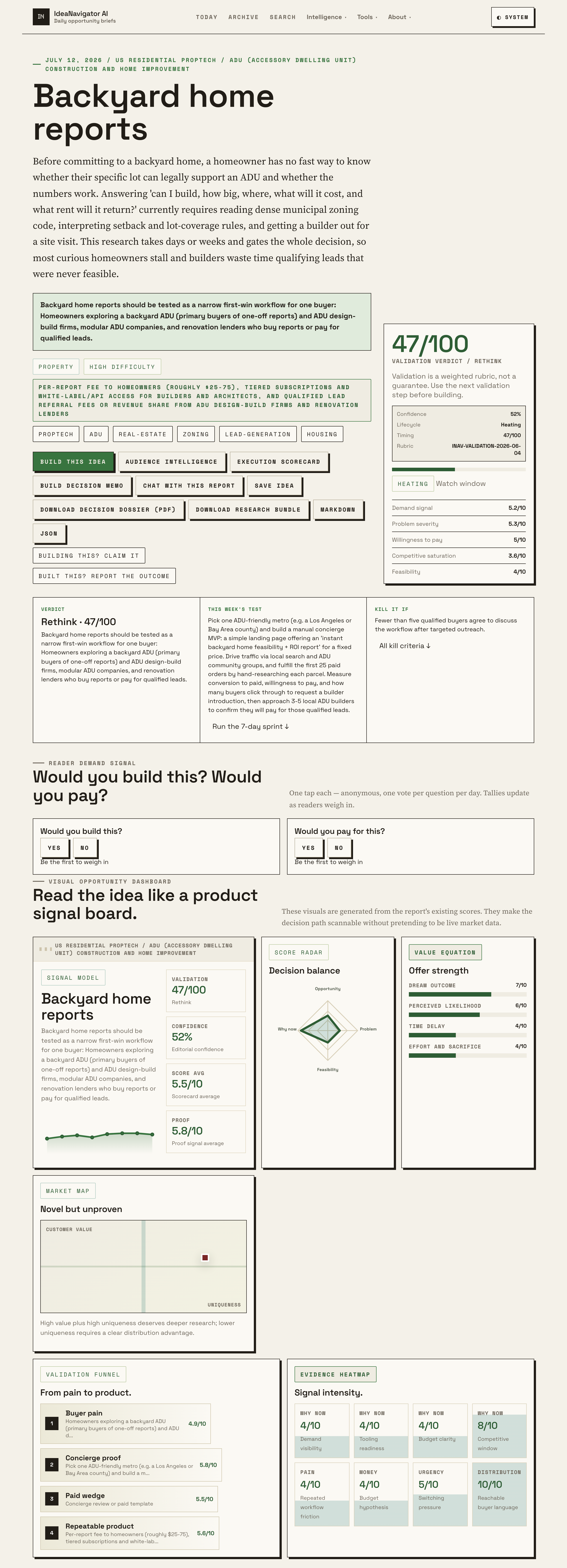
IdeaNavigator AI has proposed testing paid, address-specific reports that estimate whether a backyard ADU may fit a property and what it could cost or earn in rent. The concept is at the validation stage: no launch, customer results or builder commitments are reported.
IdeaNavigator AI has proposed testing a paid report that would assess whether a specific property may support an accessory dwelling unit, or ADU, and estimate potential construction costs and rent. The proposed service is aimed at homeowners weighing a backyard home, but no customer results, operating product or builder commitments are reported.
The concept addresses an early decision that can require homeowners to combine municipal zoning rules, parcel information, contractor input and local rent data. IdeaNavigator AI says this research can take days or weeks, leaving some owners unsure whether to proceed and prompting builders to spend time qualifying properties that may not work.
The proposed minimum product would begin in one metro area, with zoning rules curated by hand for that market. A homeowner would enter an address and pay for a PDF covering permitted ADU types, possible size, setbacks and lot coverage, an estimated buildable area, a construction cost range and projected rent based on local comparisons. The report would be an initial estimate; the proposal does not establish that it would replace municipal review or a builder’s site assessment.
IdeaNavigator AI suggests testing demand through a landing page and manually researching the first 25 paid orders. The test would track purchases and requests for builder introductions, followed by outreach to three to five local builders to ask whether they would pay for qualified leads. Suggested revenue streams include individual report fees of about $25 to $75, subscriptions or white-label access for industry firms, and referral fees. These are proposed prices and models, not reported sales.
Potential Uses for an Early ADU Estimate
An address-specific report could give homeowners preliminary information before they seek professional plans and quotes. Builders could use similar information to assess inquiries against local rules and site constraints. These uses have not been demonstrated: the proposal provides no evidence about report accuracy, homeowner willingness to pay or builder demand for leads.
The proposed report would provide preliminary information rather than formal project review. Parcel data and zoning rules may help identify possibilities, while construction feasibility and final permissions can depend on details the report does not settle. Its reliability would depend on how it communicates assumptions and uncertainty and how frequently local rules and data are updated.
California’s ADU Policy Push
IdeaNavigator AI points to California’s statewide ADU legislation beginning in 2016 and subsequent rule changes as part of the opportunity. It says ADU permitting has increased, citing more than 45,000 ADUs permitted in Los Angeles County in 2023 and estimating that ADUs account for roughly one in five new housing units produced in California. The proposal gives no underlying datasets or definitions for those figures, so they are presented here as claims in its market rationale.
The proposal also cites a US housing shortage estimated in the millions of units and the availability of parcel and zoning data, along with language-model tools that may help parse codes. It argues these conditions could make address-level reports practical. However, it does not identify the initial county, show a completed analysis or describe how rule interpretations would be checked against local authorities.
Demand and Accuracy Remain Untested
There is no reported evidence that homeowners have paid for these reports or that builders and lenders would pay for referrals. The proposed concierge test is a plan, not a completed pilot. It is also unclear which metro would launch first, how often estimates would match official determinations, and how the service would handle missing or outdated parcel and zoning information.
The suggested construction cost and rent figures would also need transparent assumptions and local data. No methodology, accuracy results, customer feedback or regulatory review is provided. A report could inform an early inquiry, but the proposal does not show that it can determine final approval or project economics for an individual property.
The Proposed Test Starts Locally
The next step described by IdeaNavigator AI is to choose an ADU-friendly county or metro and publish a landing page offering the report at a fixed price. The team would research the initial 25 orders by hand, measure paid conversion and builder-introduction requests, then speak with three to five local ADU firms about lead fees. No launch date or results are given, so whether the service moves beyond the proposal remains unknown.
If the test proceeds, its findings would indicate whether homeowners pay for the reports and whether local firms consider the resulting inquiries useful. The service remains a business concept, with no availability reported.
Source: IdeaNavigator AI
Key Questions
Is the backyard ADU report service available now?
No availability is reported. IdeaNavigator AI describes a proposed service and a possible manual test, not a launched product.
What would a homeowner receive?
The proposed PDF would estimate allowed ADU types, possible size, setbacks, lot coverage, buildable area, construction costs and rent based on local comparisons.
How much might a report cost?
The proposal suggests a fee of about $25 to $75 per report. This is a proposed price range; no paid sales are reported.
Would a report confirm that an ADU can be built?
No such guarantee is described. The report would be an early estimate based on parcel data and curated rules; final feasibility and approval are not established by the proposal.
How would the idea be tested?
IdeaNavigator AI proposes researching the first 25 paid orders manually, tracking requests for builder introductions and asking three to five local builders whether they would pay for qualified leads.
Source: IdeaNavigator AI