
🔍 Read the full analysis: What Ring’s Flying Home Drone And Patrol Robot Could Mean For Homeowners on ThorstenMeyerAI.com
TL;DR
Ring announced two mobile security devices: an indoor drone priced at $249.99 and a business patrol robot priced at $999.99. The robot is scheduled to ship in December 2026 and the drone in January 2027, but Ring says the drone cannot be sold until it receives required FCC authorization. Privacy safeguards and dependence on internet access are among the questions prospective customers may weigh.
Amazon’s Ring announced two mobile security cameras on November 10: a drone designed to fly inside homes and a wheeled patrol robot aimed at businesses. The products extend Ring’s security system beyond fixed cameras, but the $249.99 drone cannot be sold until it receives required FCC authorization, according to Ring.
Ring calls the product line Ring Robotics. Its Drone Cam is listed at $249.99, with U.S. shipping scheduled for January 27, 2027. The Rover Cam, intended for business premises, is listed at $999.99, with U.S. shipping scheduled for December 16, 2026. Ring says scheduled patrols require a compatible Ring Protect plan.
Both devices use a system Ring calls AI Pilot. Ring says it maps spaces, proposes patrol points and steers around obstacles using cameras, vision models, sensors and cloud processing. If another Ring camera, sensor or alarm is triggered, the mobile device can go to investigate. These are functions described by Ring; their real-world performance has not been independently established in the supplied announcement.
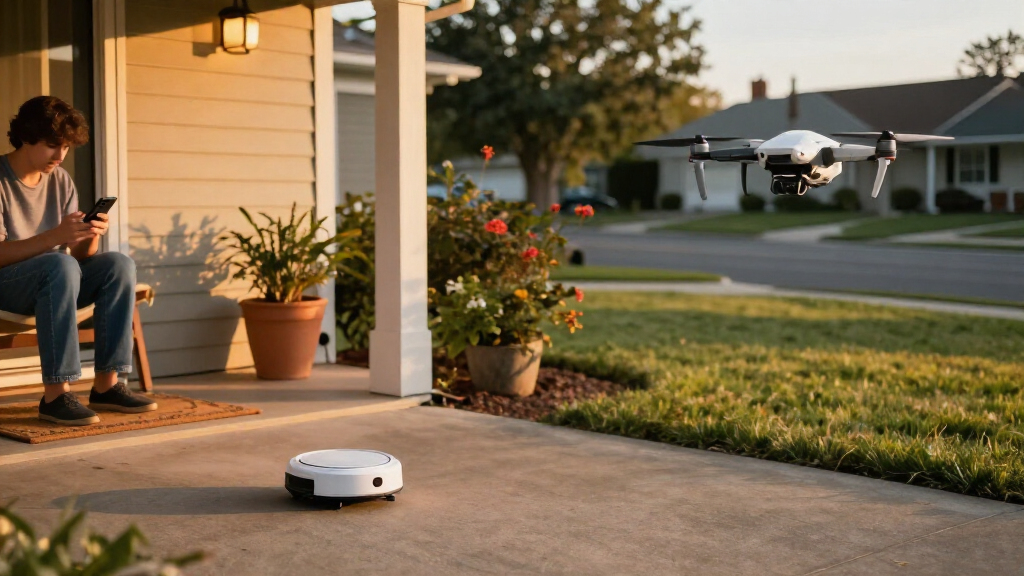
The Drone Cam can fly along scheduled routes or on demand, and Ring says it can launch after another Ring device detects an event. The company lists a 148-degree field of view, 360-degree rotation, 2K video and two LED lights. Ring says the camera is off while the drone is docked. The Verge reported that the drone weighs 165 grams and that Ring claims it can fly for five to eight minutes per charge. It also reported that the device depends on an internet connection and can only land if Wi-Fi is unavailable.
Ring describes Rover Cam as a business security robot that can patrol on a schedule, respond to alerts from other Ring devices and scan 360 degrees when it arrives at a location. It has a raised periscope camera, siren, light tower and two-way audio. Ring says it records in up to 4K while moving or patrolling, and can record motion detected in its view even when docked. The Verge reported an estimated coverage area of about 5,000 square feet, roughly 30 minutes of battery life and operation on a single floor.
Ring’s Mobile Cameras What Buyers Should Know
Ring announced an indoor drone for homeowners and a patrol robot for businesses. Their usefulness depends on performance, connectivity, privacy terms and, for the drone, FCC authorization.
Two devices, different settings
Ring’s mobile cameras extend security beyond fixed viewpoints.
Drone Cam
Flies indoors on scheduled routes or after an alert, potentially checking places fixed cameras cannot see.
Rover Cam
A wheeled robot patrols business premises; scheduled patrols require a compatible Ring Protect plan.
Planned U.S. shipping
Ring’s stated dates put the business robot first, with the drone’s timing subject to authorization.
What homeowners should weigh
A camera that moves through the home changes both coverage and privacy.
- Can investigate alerts from other Ring devices.
- May check rooms and angles fixed cameras cannot cover.
- Ring says the camera is off while docked.
- Short reported flight time and reliance on Wi-Fi may limit use.
- Navigation and obstacle avoidance have not been independently established.
- Buyers should understand cloud processing, access to recordings and outage behavior.
Authorization and privacy
The announcement leaves important launch and data-handling details unresolved.
What the announcement establishes
Ring describes the devices’ features, but supplied material does not include independent performance results.
The system is said to map spaces, suggest patrol points and steer around obstacles.
Ring says a mobile camera can investigate when another Ring camera, sensor or alarm is triggered.
The announcement does not show that either device reduces losses or replaces existing security equipment or staff.
Mobile Cameras Change Security Coverage
For homeowners, the drone’s central difference from a fixed camera is that it can move to a location after an alert, potentially checking spaces a wall-mounted camera cannot see. That may offer another way to verify an alarm or monitor parts of a home, but the short reported flight time and reliance on Wi-Fi may limit how useful it is in practice. The announcement does not establish how well it handles varied floor plans, pets, clutter or repeated alerts.
The product also changes the privacy trade-off. A camera that travels through a home could record rooms and angles that owners did not intend to monitor, as well as capture household members or visitors. Ring says the drone’s camera is off in its dock and that users can see when recording is underway. Those safeguards matter, but customers will also need to understand what is processed in the cloud, who can access recordings and how the product behaves when connectivity fails.
Rover is directed at shops and offices rather than households, but its launch signals Ring’s attempt to make security systems more active. For businesses, a robot that patrols between locations could supplement fixed cameras; the listed price, subscription requirement for scheduled patrols and reported limits on coverage are relevant to any cost comparison. Ring has not provided results showing that either device reduces losses or replaces existing security staff or equipment.
Popular right now

KitchenAid Classic Series 4.5-Quart Tilt-Head Stand Mixer, Onyx Black

Sony BRAVIA 6 65-Inch OLED 4K HDR Smart Google TV with Gemini (K-65A60)

De'Longhi Magnifica Duo Fully Automatic Espresso Machine with Hot and Cold Milk Frother
As an affiliate, we earn on qualifying purchases.
Ring’s Earlier Mobile Camera Plans
The announcement builds on an idea Ring has pursued for years. Ring first previewed an indoor drone in 2020 under the name Always Home Cam. The Verge reported that founder Jamie Siminoff said development began in 2016. The new Drone Cam is therefore a renewed product effort, rather than Ring’s first public proposal for a camera that flies through a home.
Ring says Rover draws on work associated with Amazon Astro and feedback from Astro customers who valued its roving security features. The Verge reported that Amazon launched Astro for Business in 2023 and discontinued it about a year later. That history provides a relevant caution for businesses considering Rover, though it does not establish how Ring’s new product will perform or how long it will remain available.
Ring has also introduced a new encryption approach called Throw Away the Key, or TAKE, announced August 26, 2026. Ring says its servers can temporarily access encryption keys for cloud features such as smart alerts, then delete them. The company describes TAKE as inspired by end-to-end encryption; full end-to-end encryption, under which only a customer’s devices hold the keys, remains an optional setting.
„For years, customers told us they wanted eyes in the places a fixed camera couldn’t reach, and peace of mind in the spots they’d never want one.“
— Jamie Siminoff, Ring founder and chief inventor, in the company announcement
FCC authorization is the clearest obstacle for the Drone Cam. Ring says the device has not been authorized as required by Federal Communications Commission rules and may not be sold until that authorization is obtained. The announcement does not say when approval might come or whether the planned January shipping date will change.
Ring’s privacy assurances also have to be viewed alongside its record. In May 2023, the Federal Trade Commission charged Ring with compromising customer privacy by allowing employees or contractors to access private videos and by failing to put basic privacy and security protections in place. The FTC’s statement described allegations in its complaint; it is not evidence that the new devices have repeated the same conduct. The Electronic Frontier Foundation has separately argued that TAKE falls short of end-to-end encryption because Ring servers can temporarily access keys.
Several practical details remain unconfirmed in the supplied material, including independent testing of navigation and obstacle avoidance, how often the drone can fly under ordinary conditions, and how the devices handle outages or missed alerts. Ring’s announcement also does not establish the full ongoing cost of ownership, including any plan requirements beyond scheduled patrols. Prospective buyers will need final product terms and hands-on reviews to judge those questions.
FCC Review and Shipping Dates
The next stated milestones are Rover Cam’s planned U.S. shipping date of December 16, 2026, followed by the Drone Cam’s planned date of January 27, 2027. Ring’s stated restriction means the drone’s timeline depends on receiving required FCC authorization. The company has not provided an approval date in the source material.
Before either product reaches customers, more information may clarify compatibility, subscription costs, device performance and data handling. For homeowners weighing the drone, the main practical questions are whether it can reliably navigate their home, how it functions without Wi-Fi and what happens to video recorded during an investigation. For businesses, Rover’s coverage, battery life and ongoing service requirements will shape whether it fits alongside existing cameras and alarms.
Key Questions
What did Ring announce?
Ring announced Ring Robotics, a product line that begins with the indoor Drone Cam and the business-focused Rover Cam, a wheeled patrol robot.
How much do the devices cost, and when are they scheduled to ship?
Ring lists Drone Cam at $249.99, with U.S. shipping scheduled for January 27, 2027. Rover Cam is listed at $999.99, with U.S. shipping scheduled for December 16, 2026. Ring says scheduled patrols require a compatible Ring Protect plan.
Can Ring sell the Drone Cam now?
Not according to Ring’s announcement. The company says the drone has not received required Federal Communications Commission authorization and may not be sold until it does. The timing of authorization is not stated.
What privacy protections does Ring say the devices have?
Ring says Drone Cam’s camera is off while docked, Rover has a Sleep Mode that retracts its periscope and turns off its microphone, and both devices have recording indicators. Ring also says video is protected by its TAKE encryption; the Electronic Frontier Foundation argues that it does not provide the same protections as end-to-end encryption.
Does the Drone Cam work without Wi-Fi?
The Verge reported that the Drone Cam depends on an internet connection and can only land if Wi-Fi is unavailable. Ring’s announcement, as summarized in the source material, does not describe broader offline functions.
Source: ThorstenMeyerAI.com