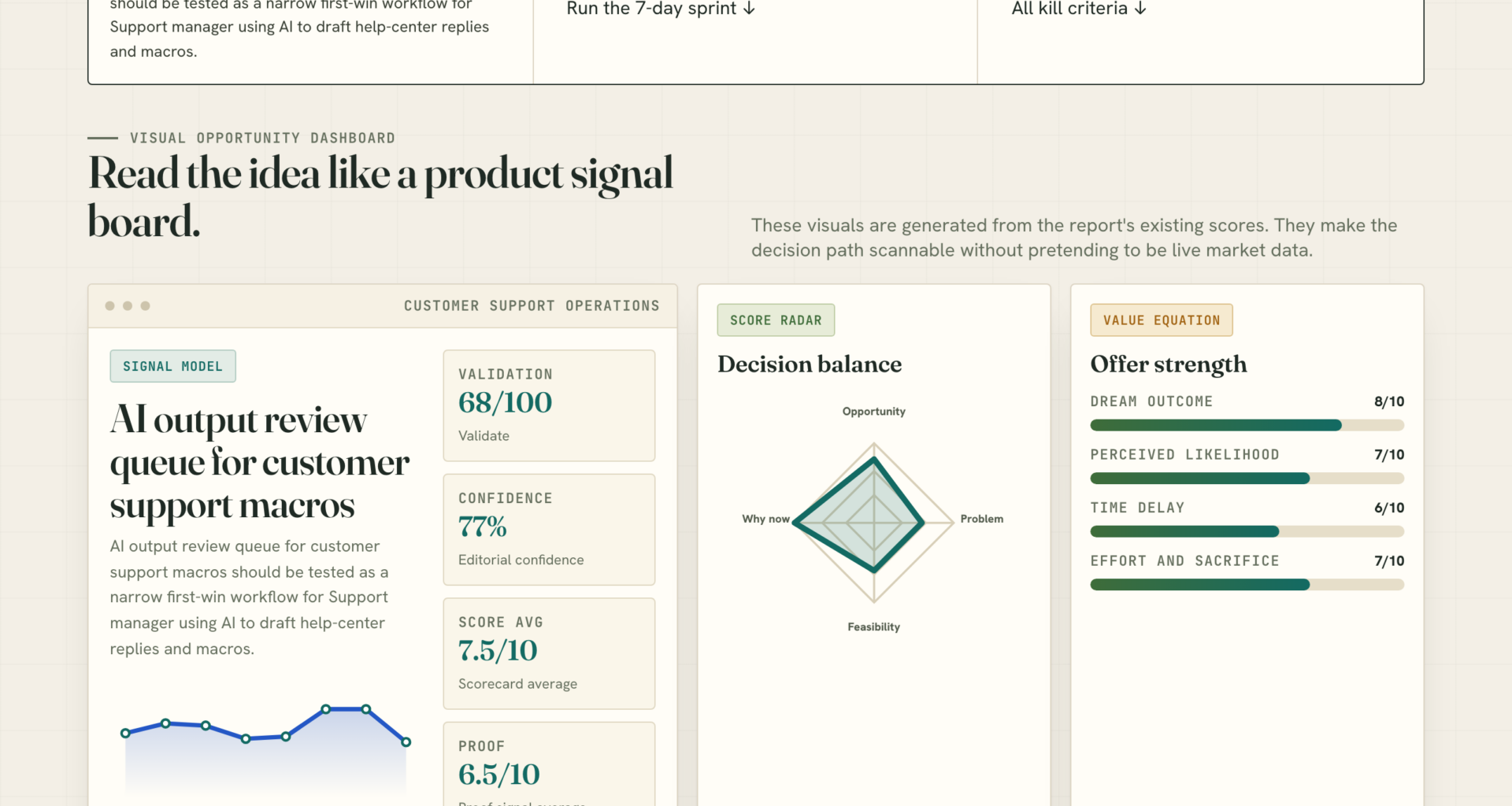
📊 Full opportunity report: AI output review queue for customer support macros on IdeaNavigator AI — validation score, market gap, and execution plan.
TL;DR
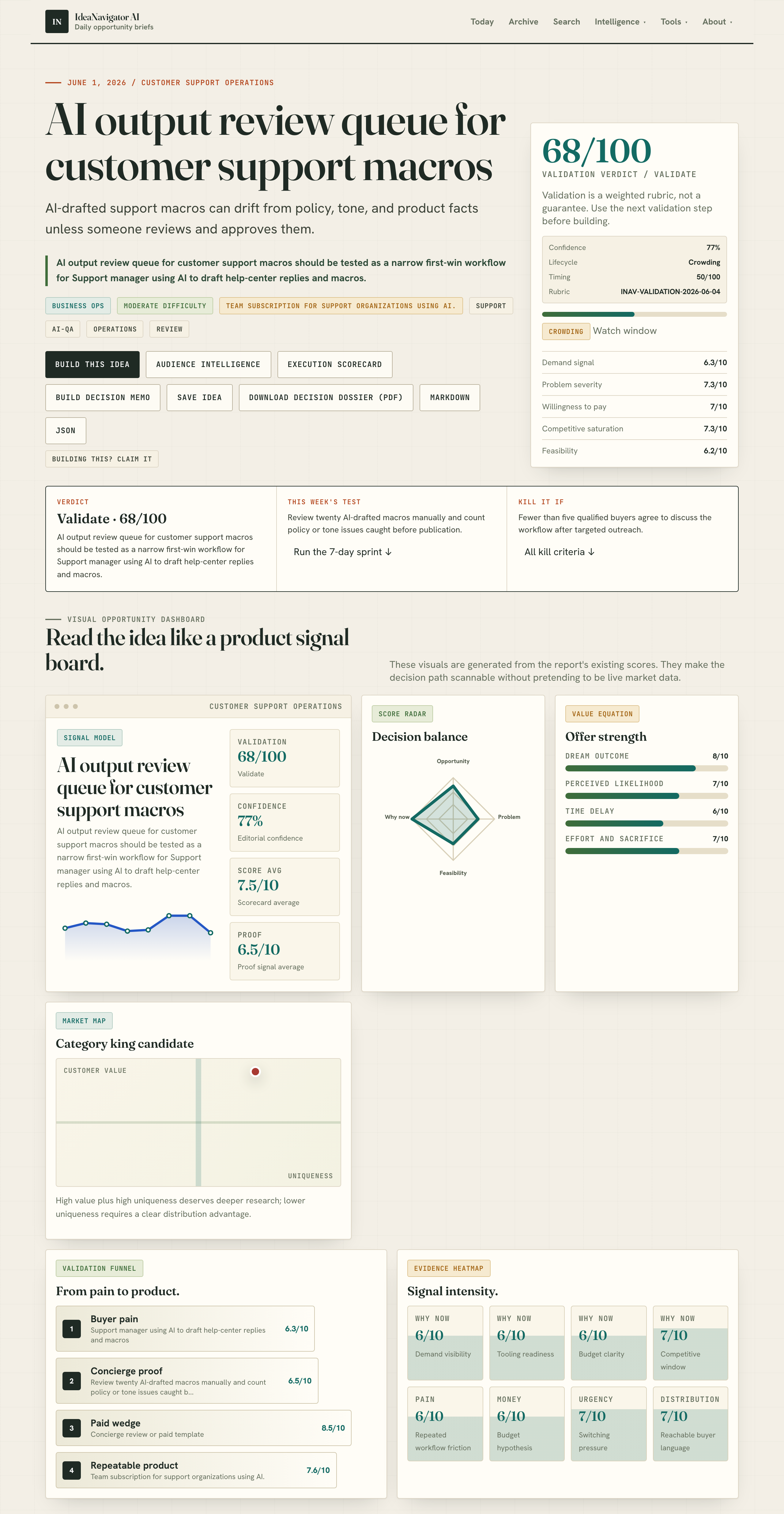
Support managers are trialing a new AI output review queue designed to automatically evaluate drafts of customer support macros. This aims to improve quality control amid rapid AI adoption. The initiative is in early testing, with validation ongoing.
Support teams are beginning to test a new AI output review queue for customer support macros, aiming to automatically evaluate AI-generated drafts for policy compliance, tone, and accuracy. This development responds to the rapid adoption of AI tools in customer service, where ensuring quality remains a challenge. The review queue is designed as an initial step to formalize approval workflows and prevent drift from company policies and product facts.
The proposed review queue assesses AI-drafted support macros based on several criteria, including policy alignment, tone appropriateness, source support, and risk of making misleading promises, according to sources familiar with the project. The system assigns scores to drafts, flagging those that require human review before publication. This approach aims to streamline support workflows and reduce manual review time while maintaining quality standards.
Support managers testing the system are currently reviewing around twenty AI-generated macros manually, to measure how many policy or tone issues the system detects. The goal is to validate the effectiveness of the scoring algorithm and identify areas for improvement. The initiative is part of a broader effort by customer support organizations to formalize AI use and ensure compliance as adoption accelerates.
The review queue is offered as a subscription service targeted at support teams, with the potential to scale as companies increase their AI integration. The project is still in early testing, and detailed performance metrics are yet to be published, but initial feedback indicates promise in reducing manual oversight while maintaining quality control.
Impact of Automated Macro Quality Control in Customer Support
This development is significant because it addresses a key challenge in AI-assisted customer support: ensuring that automatically generated macros adhere to company policies, maintain appropriate tone, and do not make false promises. By implementing an automated review process, support organizations can better control quality, reduce errors, and increase trust in AI tools. This step could also influence industry standards for AI governance in support workflows, promoting wider adoption of similar validation systems.
As an affiliate, we earn on qualifying purchases.
Rapid Adoption of AI in Customer Support and Quality Challenges
Customer support teams have increasingly integrated AI tools to draft responses and support macros, driven by the need for faster response times and scalable operations. However, many organizations lack formal workflows for reviewing AI outputs, leading to risks of policy violations, inconsistent tone, or inaccurate information. Currently, most teams manually review AI-generated content, which can be time-consuming and inconsistent. The new review queue aims to formalize this process, providing an automated layer of quality control. This initiative builds on broader trends of AI deployment in support functions, where balancing efficiency and quality remains a key concern.
„The review queue is designed to score drafts for policy fit, tone, and risk, helping support teams catch issues before they reach customers.“
— an anonymous researcher
customer support macro validation tool
As an affiliate, we earn on qualifying purchases.
As an affiliate, we earn on qualifying purchases.
Uncertainties About Effectiveness and Adoption Pace
It is not yet clear how accurately the review queue will identify issues across diverse support macros or how much it will reduce manual review time in practice. The system is still in early testing, and performance metrics are pending. Additionally, it remains uncertain how support teams will adapt to integrating this automated step into existing workflows, and whether the system will scale effectively across different organizations and support platforms.
AI quality control for customer service
As an affiliate, we earn on qualifying purchases.
As an affiliate, we earn on qualifying purchases.
Next Steps in Validating and Scaling the Review System
Support organizations will continue testing the review queue with larger sample sizes, refining the scoring algorithms based on initial results. They plan to monitor the rate of issues caught and the impact on review efficiency. If successful, the system could be expanded to broader support workflows and offered as a standard feature in customer support AI toolkits. Further developments may include integrating feedback loops to improve scoring accuracy and expanding criteria for evaluation.
support team macro approval system
As an affiliate, we earn on qualifying purchases.
As an affiliate, we earn on qualifying purchases.
Key Questions
How will the review queue improve support macro quality?
The review queue automatically scores AI-drafted macros for policy compliance, tone, and accuracy, helping support teams identify and correct issues before publication.
Is this system currently fully operational?
No, it is in the testing phase, with ongoing validation of its effectiveness and accuracy based on initial manual reviews.
Will this reduce manual review workload?
Potentially, yes. The goal is to automate part of the review process, allowing support teams to focus on higher-level issues, but effectiveness is still being evaluated.
What are the risks of relying on an automated review system?
The main risks include missing nuanced issues, over-reliance on scoring, or false positives/negatives. Ongoing validation is necessary to mitigate these risks.
When might this system become widely available?
If initial testing proves successful, support organizations could see broader deployment within the next 6 to 12 months, depending on refinement and integration efforts.
Source: IdeaNavigator AI