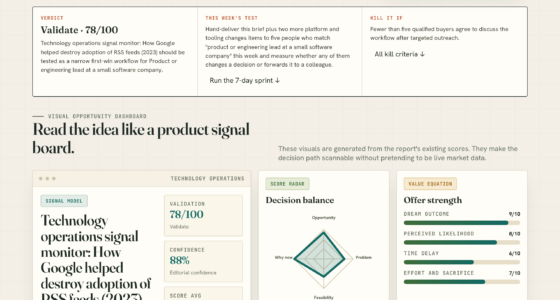

📊 Full opportunity report: A Skill Is A Folder, Not A Prompt: What Anthropic Learned Running Hundreds Of Them on ThorstenMeyerAI.com — validation score, market gap, and execution plan.
TL;DR
Anthropic has demonstrated that Skills are not just prompts but comprehensive folders containing instructions, scripts, and assets. This approach improves consistency, onboarding, and institutional knowledge sharing in AI deployment. The company ran hundreds of Skills internally to refine this methodology.
Anthropic has revealed that its approach to deploying AI agents involves packaging capabilities into Skills that are structured folders, not simple prompts. This shift aims to make AI-driven processes more consistent, maintainable, and scalable across organizations, marking a significant departure from traditional prompt engineering.
According to a detailed write-up from an Anthropic Claude Code engineer, Skills are defined as folders containing instructions, reference documents, scripts, templates, data, and configuration settings. These folders can be discovered and executed by AI agents, enabling a more durable and reusable form of organizational knowledge. This approach moves away from viewing prompts as static text snippets, instead framing Skills as comprehensive containers that encapsulate how a task is performed, including tribal knowledge and guardrails.
Anthropic’s internal experience shows that organizing Skills into nine categories—such as library references, data analysis, process automation, and verification—helps identify gaps in organizational capabilities. The most valuable Skills, according to Anthropic, are those that verify work, as they directly improve output quality. The company emphasizes that building Skills is an investment, with teams dedicating engineer-weeks to develop high-quality, reusable Skills that improve over time.
Technical insights highlight that effective Skills should focus on non-obvious, specific knowledge rather than restating basic facts. The descriptions of Skills act as trigger definitions for the agent, ensuring they activate under correct conditions. Bundling real code and helper functions within Skills further enhances their utility, making them powerful assets for organizational AI deployment.
A Skill is a folder, not a prompt
Anthropic published what it learned running hundreds of Skills across its own engineering org. Read as a business memo, the point is bigger than a coding trick: this is how ad-hoc prompting becomes durable institutional capability — the SOPs your agents actually follow, versioned and shared.
„A Skill is just a clever markdown prompt you save in a file.“
A folder the agent can discover, read & run — instructions, scripts, references, templates, config & on-demand hooks.
The knowledge of how your organization actually operates can be captured, versioned, shared & executed — and the thing capturing it is a humble folder with a script and a gotchas list inside. For the builder, that’s context engineering with real tools attached. For whoever owns the budget, it’s the difference between AI that starts from zero every morning and an asset that compounds. Caveats: best practices are still evolving, checked-in Skills cost context, and curation beats accumulation. Start with one Skill, one gotcha, and the category that catches your mistakes.
Implications for AI Deployment and Organizational Knowledge
This development signifies a shift toward more structured, reliable, and scalable AI integration within organizations. By treating Skills as reusable folders, companies can ensure consistent output, streamline onboarding, and preserve institutional knowledge. This approach reduces reliance on ad-hoc prompting and creates a foundation for more robust AI operations, potentially transforming how organizations leverage AI for complex workflows and operational procedures.
As an affiliate, we earn on qualifying purchases.
From Prompt Engineering to Asset-Based AI Strategies
Traditional AI deployment has relied heavily on prompt engineering—crafting specific prompts for each task. Anthropic’s internal experiments suggest that this method is inefficient and fragile, often requiring repeated manual adjustments. The concept of Skills as folders originated from the need to codify tribal knowledge, guardrails, and procedures into reusable units. This approach aligns with broader trends in AI engineering, emphasizing maintainability, versioning, and institutional memory. Anthropic’s focus on verification Skills underscores the importance of quality control in AI outputs, especially as organizations scale their AI use.
„A Skill is a folder — one that can contain instructions, reference documents, runnable scripts, templates, data, configuration, and even hooks that fire only while the Skill is active.“
— Anthropic engineer
As an affiliate, we earn on qualifying purchases.
What Aspects of Skills Deployment Are Still Unclear
It is not yet clear how widely adopted this Skills framework will become outside Anthropic or how it will integrate with existing enterprise systems. The scalability and maintenance of large Skills libraries remain to be tested in diverse organizational contexts. Additionally, the precise methods for versioning, updating, and governing Skills across teams are still being developed and standardized.As an affiliate, we earn on qualifying purchases.
Next Steps in Skills Development and Adoption
Organizations interested in this approach should begin cataloging their internal procedures into Skills folders, focusing on high-value categories like verification and automation. Further research and development are expected to refine best practices for Skills management, including version control, testing, and sharing across teams. Anthropic and other AI developers may release tools to facilitate this process, aiming to embed Skills more deeply into enterprise AI workflows. Monitoring how these practices scale and impact operational efficiency will be key in the coming months.
As an affiliate, we earn on qualifying purchases.
Key Questions
How do Skills differ from traditional prompts?
Skills are structured folders containing instructions, scripts, and assets, not just text prompts. They enable reusable, maintainable, and scalable organizational procedures for AI agents.
Why is organizing Skills into categories important?
Categorizing Skills helps identify gaps, prioritize development, and optimize workflows. It ensures that critical functions like verification and automation are well-supported.
Can Skills improve AI output consistency?
Yes, Skills encapsulate best practices and guardrails, leading to more consistent and reliable AI-generated results across different teams and tasks.
What are the main technical challenges in implementing Skills?
Designing effective descriptions that trigger the right Skills, managing version control, and integrating code assets are key technical hurdles that need careful management.
Will this approach be adopted by other companies?
While Anthropic’s internal success is promising, broader adoption depends on how well the framework scales and integrates with existing enterprise systems. Industry interest is growing, but widespread implementation remains to be seen.
Source: ThorstenMeyerAI.com