
📊 Full opportunity report: Estate Planning Workflows Begin With A Trust Tracker on IdeaNavigator AI — validation score, market gap, and execution plan.
TL;DR
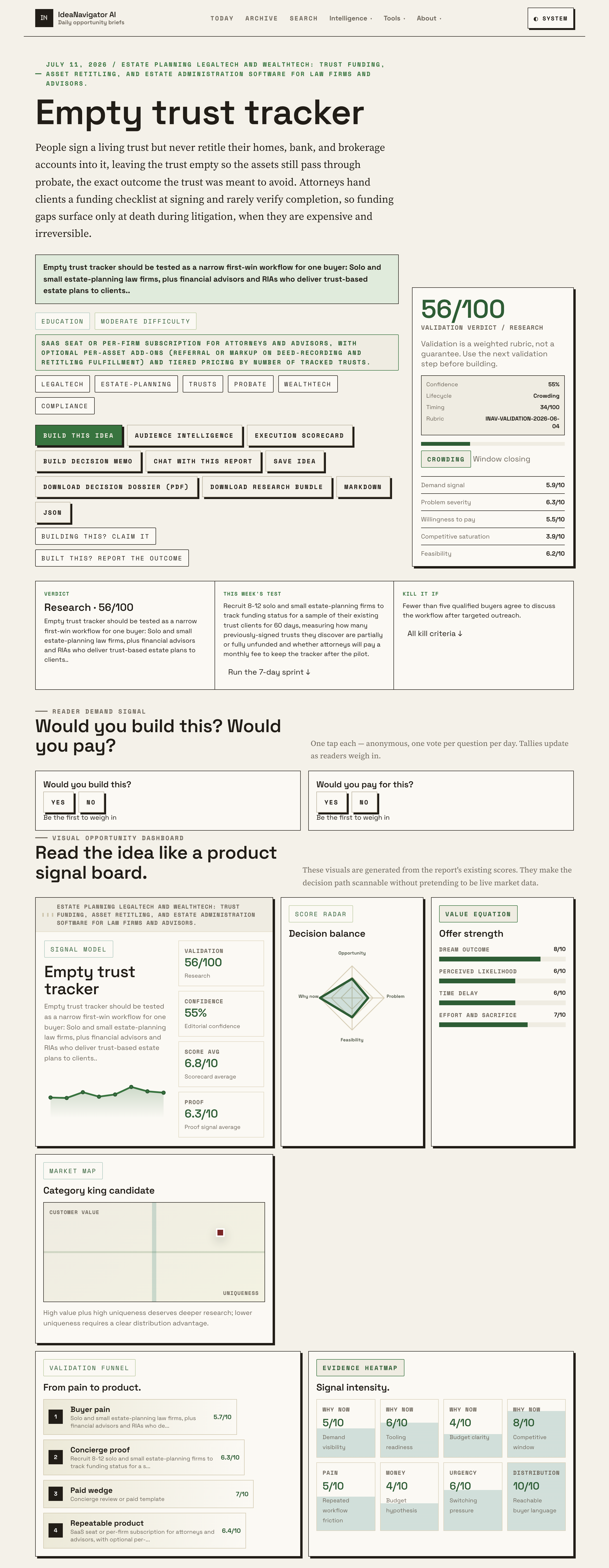
A proposed trust funding tracker would let small estate-planning firms and financial advisors monitor whether clients move assets into living trusts after signing. The concept is at the validation stage; no product launch, pilot results or customer commitments are reported.
IdeaNavigator AI has proposed a trust funding tracker for solo and small estate-planning firms, financial advisors and registered investment advisers, aimed at showing whether clients move assets into a living trust after signing. The concept addresses a gap between preparing trust documents and retitling property, a step that may determine whether assets are handled through the trust or remain subject to probate.
According to the IdeaNavigator AI proposal, the tool would let a firm create a funding checklist for each trust, covering real estate, bank and brokerage accounts, retirement assets, business interests and beneficiary designations. Each item could be marked pending, in progress or confirmed funded. Clients could attach documentation, such as a recorded deed or a statement showing a retitled account, and receive automated reminders.
The proposal says a firm dashboard would summarize its portfolio of trusts by percentage funded, allowing attorneys or advisors to identify plans with unresolved items. It suggests subscriptions priced by firm or seat, potentially tiered by the number of trusts tracked. Optional revenue could come from per-asset services, referrals or markups for deed recording and retitling. These are suggested business models, not reported prices or established revenue.
To test the idea, the proposal recommends recruiting 8 to 12 small firms to monitor a sample of existing client trusts for 60 days. The test would measure how many are found to be partly or fully unfunded and whether participating attorneys would pay a monthly fee to continue using the tracker. The proposal identifies no recruited firms, pilot outcomes or paying customers.
The Gap After Trust Signing
A signed trust document does not, by itself, establish that a client’s property has been transferred into the trust. If a home or financial account remains titled in the client’s name, that asset may not pass through the trust as intended. The IdeaNavigator AI proposal focuses on making this follow-through visible while the client can still act, instead of relying on a checklist handed over at signing and discovering gaps later.
For small firms and advisors, a shared status record could make it easier to follow up across multiple assets and clients. The proposal says per-deed funding services priced from $250 have created a paid market for related work, but it provides no provider, location, date range or supporting evidence of demand for a tracking subscription. Whether firms will pay for software, and whether clients will regularly supply proof, remain questions for a pilot.
Why Funding Follows Document Drafting
The idea sits within estate-planning legal technology and wealth management services. Document-drafting products can prepare estate-planning paperwork, while trust funding involves separate steps with banks, brokerages, county recording offices and other institutions. The IdeaNavigator AI proposal characterizes this process as manual and fragmented and argues that existing drafting software does not track whether each transfer has been completed.
The proposal also cites an estimate that about 11% of Americans hold a trust, alongside a claim that adoption and digital tools are increasing in 2026. It provides no underlying survey, measurement method or comparison period, so the figure and trend cannot be independently assessed from the information available here. The proposal further says advisors and RIAs are seeking to include funded estate plans in client offerings, but does not identify specific firms or programs.
Demand and Pilot Results Pending
The IdeaNavigator AI proposal presents the tracker as an opportunity to test, not as a launched product. It is unclear whether any firms have agreed to participate, how a firm would verify that an asset is legally and operationally funded, or what evidence would be sufficient for each asset type. A client-uploaded document could help record progress, but the proposal does not describe a review process or integrations with financial institutions and recording offices.
No findings are reported showing how often signed trusts remain unfunded, whether reminders increase completion, or how much time the tracker would save. The trust ownership estimate and per-deed price cited in the proposal lack supporting detail. Until a pilot reports its methods and results, the size of the problem and willingness to pay remain unconfirmed.
A 60-Day Firm Pilot
The next step proposed by IdeaNavigator AI is a 60-day pilot with 8 to 12 solo and small firms. Participants would enter a sample of existing trusts, record asset-level statuses and assess how many plans have outstanding funding steps. The test would also ask whether firms would retain the product for a monthly fee after the trial.
The proposal announces no start date or participants. Any assessment of the concept will depend on whether firms can verify funding consistently, clients respond to follow-ups and pilot users see enough value to pay. It does not specify a launch timetable or say that development has begun.
Source: IdeaNavigator AI
Key Questions
What would the trust tracker do?
It would let firms list assets tied to each living trust, track whether each funding step is pending, underway or confirmed, and store supporting documents and reminders.
Who is the proposed product for?
The proposal targets solo and small estate-planning law firms, financial advisors and registered investment advisers that provide trust-based estate plans.
Has the tracker launched?
No launch is reported. The proposal recommends a 60-day pilot, but provides no participant list, start date or results.
What would the pilot measure?
It would assess how many previously signed trusts are partly or fully unfunded and whether participating attorneys would pay a monthly fee to keep using the tracker.
Source: IdeaNavigator AI