
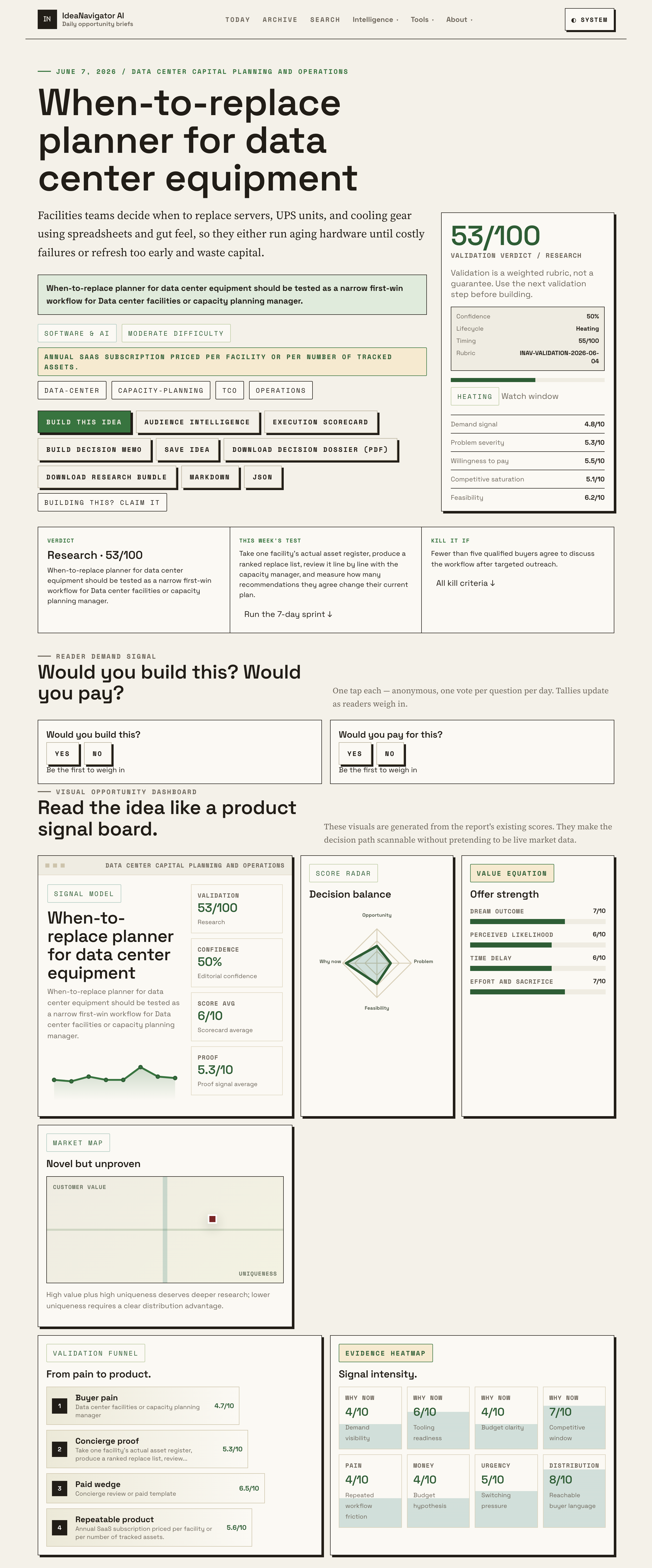
📊 Full opportunity report: How Capacity Planning Guides Data Center Hardware Replacement on IdeaNavigator AI — validation score, market gap, and execution plan.
TL;DR
A new capacity planning tool is being tested to assist data center managers in determining optimal hardware replacement timing. This approach aims to replace guesswork with data-driven decisions, potentially saving costs and improving efficiency.
A new capacity planning tool for data center hardware replacement is being tested, aiming to replace manual, intuition-based decisions with data-driven recommendations. Developed for facilities and capacity planning managers, this tool analyzes asset data to suggest optimal times for replacing servers, UPS units, and cooling systems. The development comes amid rising energy costs and increasing hardware efficiency, making replacement decisions more economically critical.
The tool, developed by IdeaNavigator AI, ingests an asset list including age, power consumption, and maintenance costs for each piece of equipment. It then ranks assets based on a score that considers rising energy costs and potential failure risks against the benefits of hardware efficiency improvements. The goal is to provide a clear, actionable replacement schedule rather than relying on spreadsheets or gut feel.
Validation involves applying the tool to an actual facility’s asset register, generating a ranked list of equipment for replacement, and then reviewing these recommendations with the facility’s capacity manager. The measure of success is the degree of agreement between the tool’s suggestions and the manager’s current plans, indicating its practical utility.
This approach aims to address a longstanding challenge in data center operations: balancing the costs of premature replacement against the risks and expenses of aging hardware failure. The tool’s focus on economic factors like energy costs and failure risks reflects current industry pressures to optimize capital expenditures and operational efficiency.
How Data-Driven Replacement Decisions Impact Data Center Operations
This new capacity planning approach could significantly improve how data centers manage hardware refresh cycles. By providing objective, data-backed recommendations, it may reduce unnecessary capital expenditure and prevent costly failures caused by aging equipment. As energy costs continue to climb and hardware becomes more efficient, such tools could become essential for optimizing operational costs and extending equipment lifespan, ultimately affecting the broader industry’s efficiency standards.
data center server replacement hardware
As an affiliate, we earn on qualifying purchases.
As an affiliate, we earn on qualifying purchases.
Rising Costs and Efficiency Push for Better Hardware Planning
Traditionally, data center facilities teams have relied on spreadsheets and experience to decide when to replace equipment. This often leads to either premature upgrades, which waste capital, or delayed replacements, risking failures and downtime. As energy costs increase and hardware efficiency improves, the economic calculus for replacement has become more complex. Industry observers note that decision-making is increasingly driven by data and analytics rather than intuition.
Recent developments in asset management and predictive analytics have laid the groundwork for tools that can automate and improve these decisions. The concept of a ‚when-to-replace‘ planner has been discussed in industry circles, but practical testing and validation are only now beginning to emerge, as seen in the current pilot efforts by IdeaNavigator AI.
„This tool could transform how data centers approach hardware replacement, making decisions more precise and cost-effective.“
— an anonymous researcher
As an affiliate, we earn on qualifying purchases.
Uncertainties About Adoption and Effectiveness
It is not yet clear how widely this tool will be adopted across the industry or how accurately it will predict optimal replacement times in diverse operational contexts. The validation process is still ongoing, and results from initial testing are not publicly available. Additionally, the effectiveness of the tool in different types of data centers and hardware configurations remains to be seen.
As an affiliate, we earn on qualifying purchases.
Next Steps in Validating and Scaling the Replacement Planner
The immediate next step is to complete the current validation phase, where the tool’s recommendations are compared with existing replacement plans. If results prove favorable, the developers plan to refine the algorithm and expand testing to additional facilities. Commercial deployment could follow, with subscription-based models offering tailored solutions for different data center sizes and needs. Industry observers will be watching for early adopters and case studies demonstrating tangible cost savings and operational improvements.
data center capacity planning tools
As an affiliate, we earn on qualifying purchases.
As an affiliate, we earn on qualifying purchases.
Key Questions
How does the capacity planning tool determine when to replace hardware?
The tool analyzes asset data such as age, power consumption, and maintenance costs, then scores each asset based on rising energy costs and failure risks versus the benefits of hardware efficiency, providing a ranked list of replacement recommendations.
Will this tool eliminate the need for manual decision-making?
It aims to supplement existing decision processes by providing data-driven insights, but human oversight and judgment will still be important, especially for context-specific considerations.
What types of hardware can this tool help manage?
The initial focus is on servers, uninterruptible power supplies (UPS), and cooling equipment, which are critical components in data center infrastructure.
When will the tool be commercially available?
The current testing phase is ongoing, with broader commercial deployment expected if validation results are positive. Specific timelines have not yet been announced.
What are the main benefits of using this capacity planning approach?
Potential benefits include reduced capital expenditure, minimized risk of hardware failure, and improved energy efficiency, leading to lower operational costs.
Source: IdeaNavigator AI